
AnalogWeb: Reimagining Engineering Labs through Web-Based Simulation
13767_A Web-Based Educational Interface for an Analog Communication Course Based on MATLAB Builder NE With WebFigures.
The paper presents AnalogWeb, a web-based educational interface for simulating analog modulation techniques in communication engineering. Built using MATLAB Builder NE with WebFigures and ASP.NET, it provides an interactive, no-install solution for distance learning that achieved a 20% increase in student pass rates at Sakarya University.
TL;DR
Hardware laboratories are the backbone of engineering education but are notoriously expensive and space-consuming. This paper introduces AnalogWeb, a sophisticated web interface that allows students to simulate complex analog modulation (AM, FM, PM) using only a browser. By integrating MATLAB’s processing power into a .NET web environment, the authors created a tool that boosted student pass rates by 20%.
The "Hardware Gap" in Engineering Education
Engineering students often struggle with the leap from theoretical formulas on a blackboard to the behavior of real signals on an oscilloscope. While physical lab sets are the gold standard, they cost between 5,000 per unit. For a class of 20, equipping a lab becomes a massive financial burden.
The authors argue that Computer-Assisted Learning (CAL) shouldn't just be a static substitute; it needs to be accessible, interactive, and mathematically accurate to be effective.
Methodology: The Engine Under the Hood
The core innovation of AnalogWeb is its architecture, which bridges the gap between high-level mathematical modeling and scalable web distribution.
1. The Architecture
The system utilizes MATLAB Builder NE and the MATLAB Compiler Runtime (MCR). This allows the server to execute complex MATLAB algorithms—such as Hilbert transforms for SSB modulation—without the end-user needing to install any software. The results are rendered via WebFigures, which provides high-fidelity, interactive 3D plots directly in ASP.NET.
2. Solving the Discrete-Time Problem
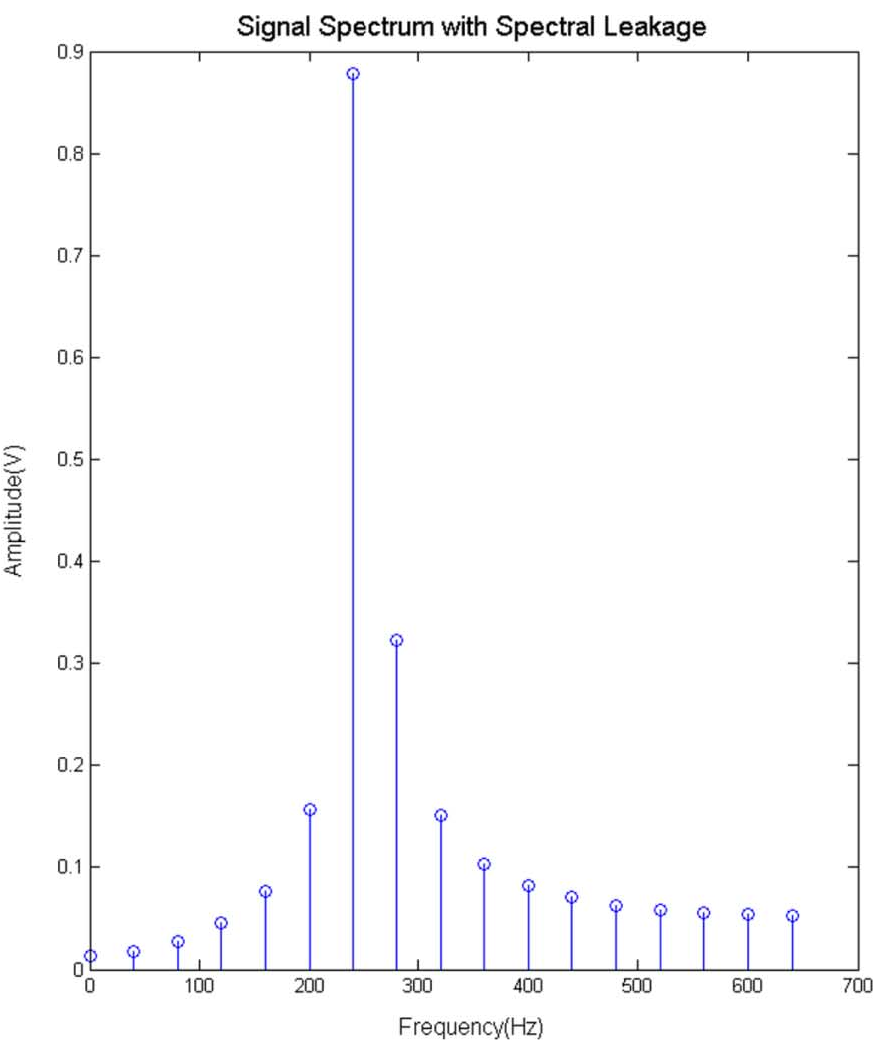
Since analog signals are continuous and computers are discrete, "spectral leakage" is a common Pitfall in simulations. If the sampling frequency () and the number of samples () aren't perfectly synchronized with the signal phase, the resulting Fast Fourier Transform (FFT) displays artifacts that confuse students.
AnalogWeb implements an automatic frequency resolution selector:
- It analyzes the maximum frequency component ().
- It selects a resolution () ranging from 0.01 Hz to 100 Hz.
- It ensures that the FFT output matches the theoretical continuous-time Fourier Transform (FT) as closely as possible.
Experimental Validation
The system was tested at Sakarya University with 60 senior students. The interface allows users to manipulate message signals (sine, square, or even uploaded audio files) and carrier signals to observe real-time modulation effects.
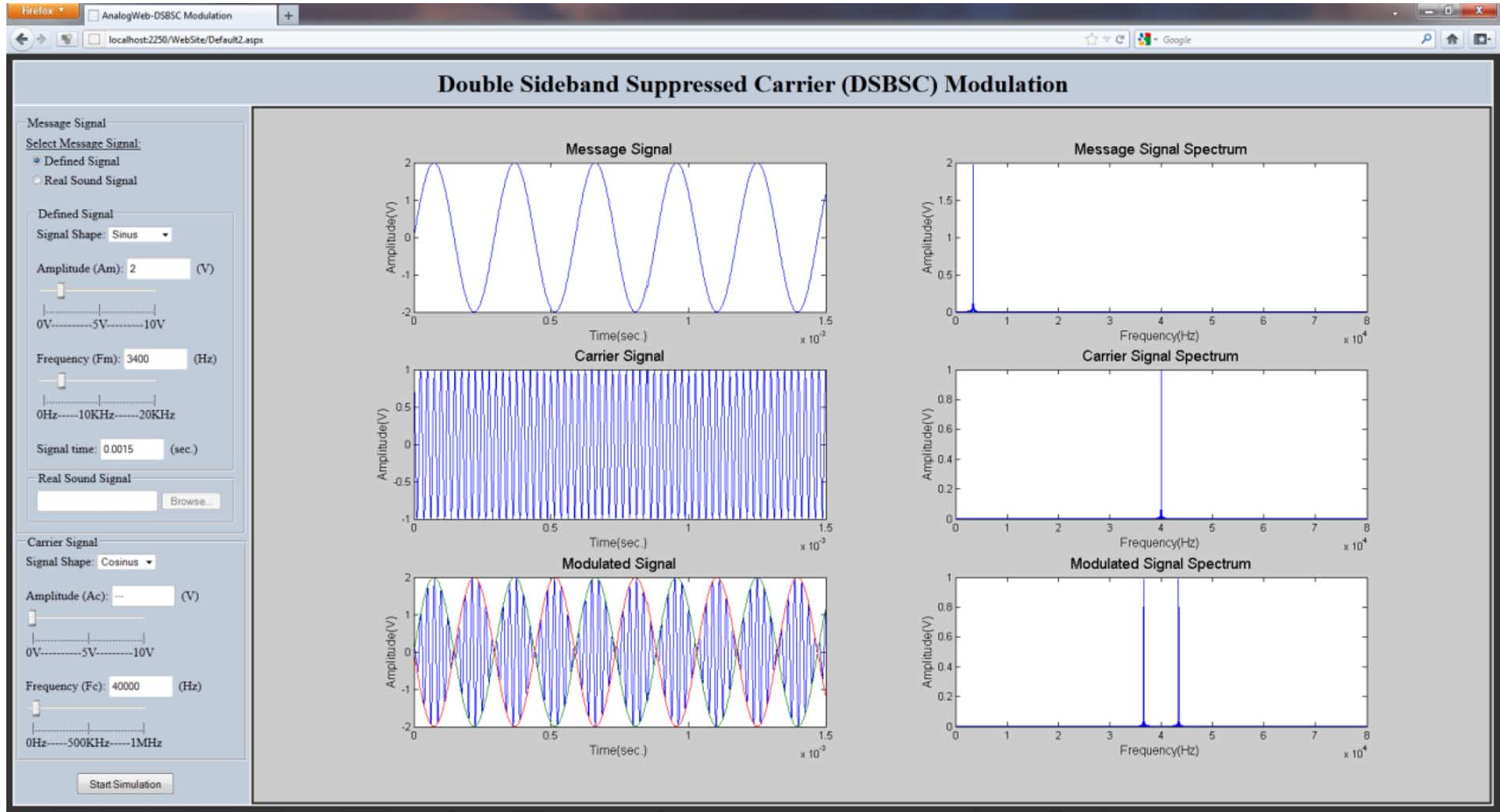
The results were striking:
- Student Performance: Pass rates in the analog communication lab exam rose from 45% to 65%.
- User Experience: 85% of students found it easier to understand modulation via the tool than via traditional lectures.
- Latency: The only significant critique was a response time of ~30 seconds due to client-server communication overhead.
Critical Insight & Conclusion
AnalogWeb proves that the value of CAL isn't just in the "cool factor" of a web app, but in its ability to provide mathematical rigor that mirrors physical instruments. By automating the complexities of sampling theory and FFT synchronization, the tool allows students to focus on the physics of communication rather than the math of the simulation.
While the 30-second latency is a bottleneck for 2026 standards, the methodology of using a centralized calculation engine (MATLAB) to drive lightweight clients remains a foundational principle for modern virtual engineering laboratories.