
The Climate Change Collaboratory: Engineering Collective Intelligence for Environmental Action
Building a Web-Based Knowledge Repository on Climate Change to Support Environmental Communities
The paper introduces the "Climate Change Collaboratory," a web-based knowledge repository designed to bridge the gap between climate science and policy-making. It integrates automated text mining, sentiment analysis, and the "Media Watch on Climate Change" platform to synthesize cross-stakeholder discourse into a unified knowledge base.
TL;DR
The Climate Change Collaboratory is an ambitious technological framework designed to unify the disjointed voices of scientists, policymakers, and the public. By employing automated text mining, sentiment analysis, and gamification, it builds a shared knowledge repository (ontology) from vast streams of web data to move beyond "awareness" toward measurable behavioral change.
Contextual Positioning
Within the landscape of environmental Informatics, this work functions as a SOTA integration platform. It doesn't just store data; it attempts to solve the "Science-Policy Gap" by creating a focal point for stakeholder discourse, making it a critical bridge between raw climate data and sociopolitical decision-making.
The "Action Gap": Why Knowledge Isn't Enough
The authors identify a critical paradox: while scientific consensus on anthropogenic climate change is absolute, global emissions continue to rise. Two primary inhibitors exist:
- Micro-level Disconnect: Individuals perceive climate change as a "distant" threat.
- Meso/Macro-level Misalignment: Stakeholders (NGOs vs. Corporations) operate in silos with conflicting agendas.
To solve this, the authors argue that we need more than data—we need Shared Meaning.
Methodology: Building the Knowledge Engine
The core of the Collaboratory is its ability to transform Unstructured Data into Structured Insight.
1. Media Watch on Climate Change
The platform serves as a high-frequency sensor, gathering documents from news media, blogs, and international partners. It doesn't just read; it interprets via:
- Automated Text Mining: Identifying topics gaining traction.
- Sentiment Analysis: Measuring the "emotional temperature" of the media toward specific climate topics.
2. Semi-Automated Ontology Learning
Standard ontology building is notoriously expensive and slow. The Collaboratory bypasses this bottleneck by:
- Social Sourcing: Pulling data from "Folksonomies" (social tags) and bookmarking services.
- Machine Learning: Using spreading activation and Hearst patterns to detect relationships between terms without human intervention.
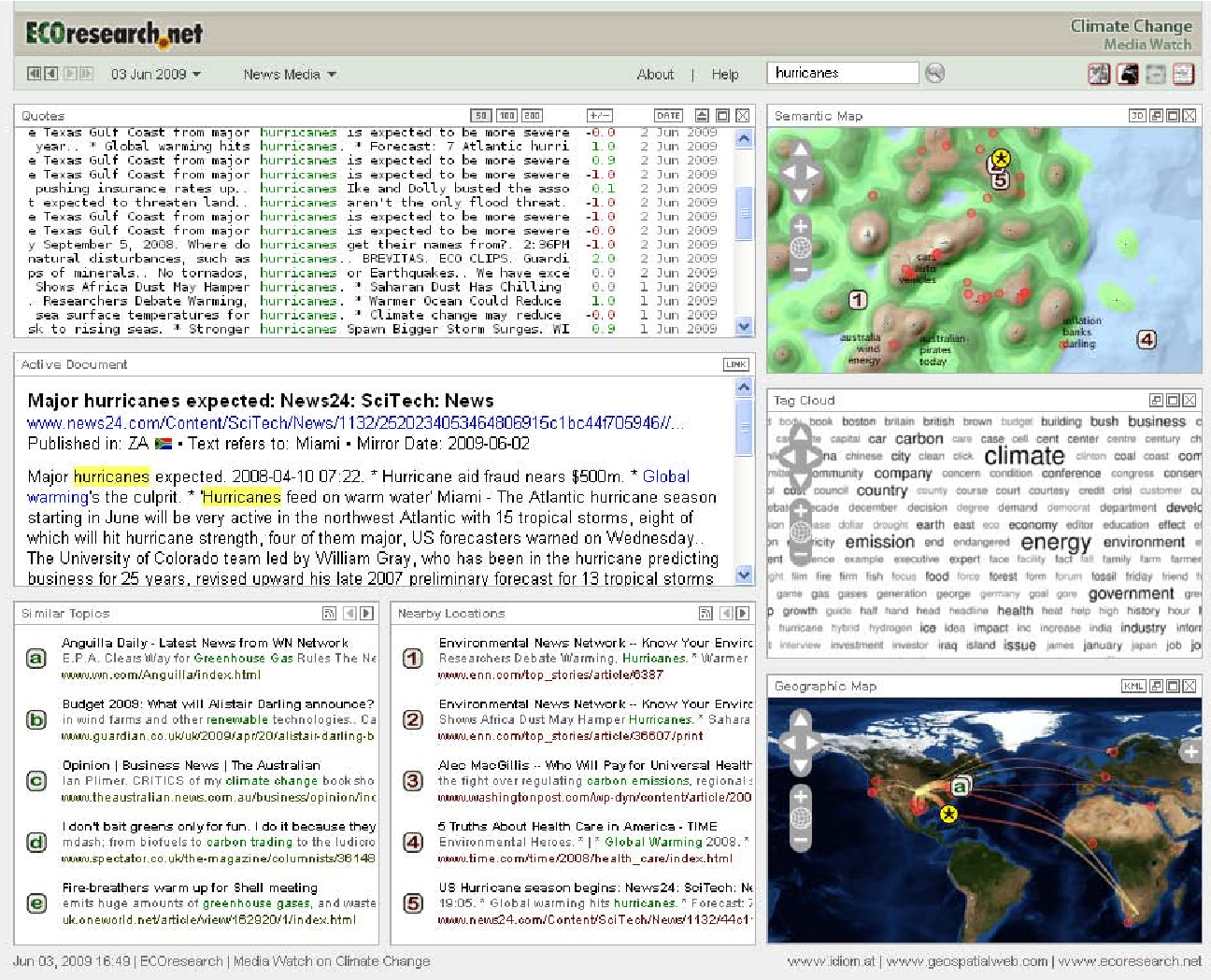 Figure 1: The Media Watch on Climate Change interface, showing geospatial distribution and topic hotspots.
Games with a Purpose (GWAP)
Perhaps the most innovative aspect is the use of gamification. Instead of traditional surveys, the project uses games to capture indicators of environmental attitudes. This "Human-in-the-loop" approach allows the system to:
- Validate automated ontology suggestions.
- Capture intercultural data on climate perception with minimal "cognitive load" for the user.
- Leverage massive existing user bases like the 250,000+ members of WWF's social applications.
Experimental Insights & Results
By integrating structured sources like GEMET (General Multilingual Environmental Thesaurus) with unstructured social data, the platform achieves:
- Scale: Handling tens of thousands of resources tagged with "climate change."
- Diversity: Breaking the bottleneck of "expert-only" knowledge by allowing the wider community to solve "tiny problems" of classification.
- Speed: Real-time identification of topics emerging in the global discourse, allowing policymakers to react to shifts in public opinion.
Critical Analysis & Future Outlook
Strengths
The Collaboratory's strength lies in its holistic view. It treats climate change not just as a physics problem, but as a communication problem. Its use of collective intelligence to lower the cost of knowledge representation is a significant technical contribution.
Limitations
A key challenge remains the "Echo Chamber" effect. If the sourced data comes primarily from environmental NGOs, the resulting ontology might lack the nuance of corporate or economic constraints, potentially alienating the very stakeholders it seeks to bridge.
Conclusion
The Climate Change Collaboratory represents a shift from "Passive Repositories" to "Active Discourse Platforms." By turning the web into a giant laboratory for social meaning, it provides a blueprint for how AI and social networking can be harnessed for global sustainability.
Takeaway: Future environmental impact won't come from more reports, but from the standardization of terminology and alignment of agendas fueled by automated knowledge engineering.