
DIONE: Bridging the Gap Between Symbolic Machine Learning and Plant Ecology
Web-based tools for data analysis and quality assurance on a life-history trait database of plants of Northwest Europe
The paper introduces DIONE, a web-based data mining tool integrated with the LEDA Traitbase, designed to analyze life-history traits of Northwest European flora. It combines an automated peer-review workflow for high-quality data ingestion with symbolic machine learning algorithms (like decision trees and clustering) to uncover ecological insights.
TL;DR
This paper presents DIONE, a specialized web-based data mining environment built atop the LEDA Traitbase. By solving the twin problems of data quality (via a structured peer-review workflow) and tool accessibility (via an intuitive J2EE-based mining interface), researchers can now use decision trees and clustering to predict plant rarity and analyze life-history strategies across 2,000 species of Northwest European flora.
The "Data Quality" Bottleneck in Ecology
In the field of ecology, the transition from "data collection" to "knowledge discovery" is often hindered by the sheer heterogeneity of data sources. The LEDA project involves scattered measurements, literature reviews, and new observations.
The authors argue that typical data mining fails if "garbage in" is permitted. Therefore, they treat Quality Assurance (QA) not as a post-processing step, but as a core architectural component of the database system itself.
Methodology: The Two Pillars of LEDA-DIONE
1. The Quality Guard: Software-Aided Reviewing
To ensure high-quality data ingestion, the system implements a "Reviewing Guidance System." Unlike simple upload forms, LEDA uses a collaborative workflow:
- Individual Queues: Submissions are assigned to specific expert reviewers to foster accountability.
- Self-Balancing Scheduling: The system monitors queue lengths and uses timeouts to reassign "stalled" sub-batches, ensuring that the human bottleneck doesn't stop the pipeline.
2. The Analytical Engine: DIONE Data Miner
DIONE provides a web-based UI for complex algorithms (J4.8, K-Means, Association Rules) without requiring the user to write code or manage local installations.
 Figure 1: The integration of the Reviewing Tool and Data Miner within the LEDA Traitbase infrastructure.
Ecological Insights: What the Machines Found
The paper validates DIONE through several high-impact case studies:
- Predicting Rarity: By applying the J4.8 decision tree algorithm, researchers identified that rare species in the Netherlands exhibit specific combinations of low seed production and limited clonal growth. This "trait combination" approach provides more actionable conservation data than traditional single-variable statistics.
- Seed Bank Longevity: The tool confirmed the ecological "common sense" that smaller seeds persist longer in soil, but it also flagged exceptions—large fruits containing many tiny seeds—proving that data mining is excellent for refining ecological theories.
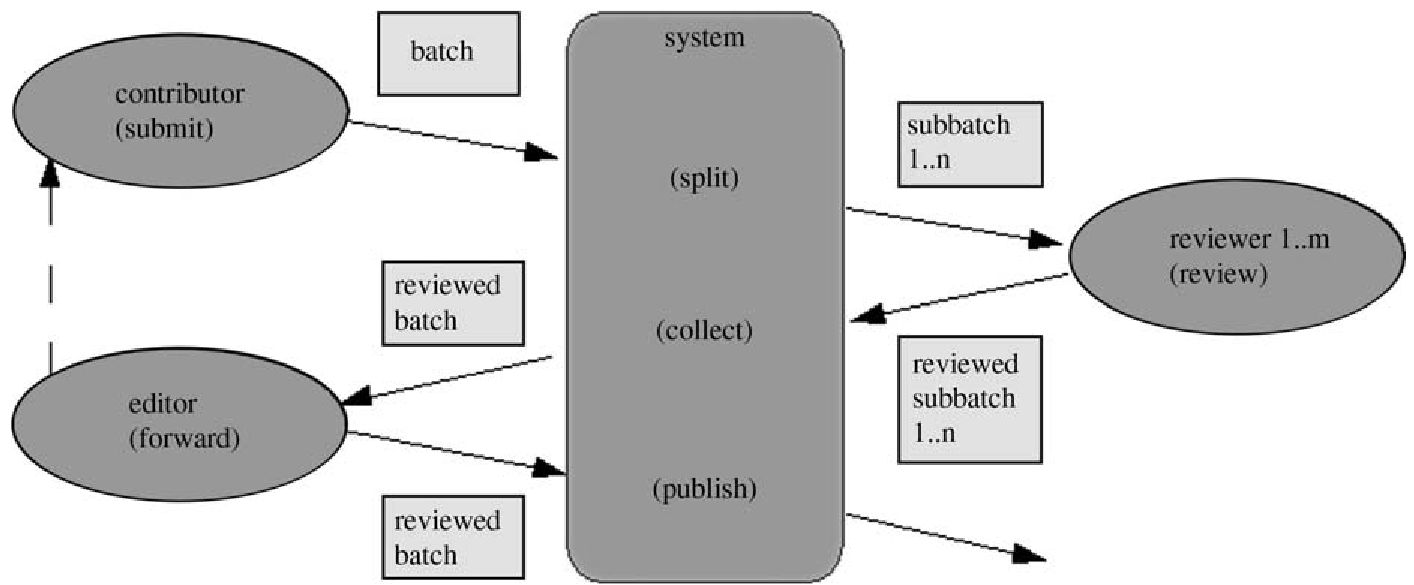 Figure 2: The Logic of the Reviewing Process, from Contributor to Editor.
Deep Insight & Conclusion
The true value of DIONE lies not in the novelty of its algorithms—which are well-established (WEKA/Xelopes)—but in its Domain-Specific Integration. By wrapping complex Symbolic AI in a workflow that respects the "peer-review" culture of biology, the authors successfully lowered the barrier to entry for machine learning in environmental science.
Takeaway for the Future: As we move toward 2026 and beyond, the "LEDA model" suggests that the future of AI in science isn't just about bigger models, but about trustworthy data pipelines that empower domain experts to interpret the "Why" behind the "What."
Limitations
- The system still relies heavily on human experts for the initial review.
- The 2006-era architecture (Tomcat/Oracle 9i) would today require migration to cloud-native/NoSQL structures to handle global-scale trait data.