
Unified Directory Service: Bridging the Gap Between People and Sensors in u-Cities
Web-Based Unified-Directory Service for Social Networking Services and Ubiquitous Sensor Network Services
The paper proposes a Web-Based Unified-Directory Service designed to integrate Social Networking Services (SNS) and Ubiquitous Sensor Network (USN) services. It introduces a mobile-centric interface using multi-lingual single-character domain names as indexing keys to access metadata for both human-centric and sensor-centric networks.
TL;DR
As we move toward "Ubiquitous Cities" (u-Cities), the line between human social networks and sensor networks (USN) is blurring. This paper introduces a Web-Based Unified-Directory Service that treats both individual people and sensor nodes as addressable entities. By utilizing a "HandBoard" text-based interface and multi-lingual single-character domain names, it solves the problem of high interaction latency and resource consumption on mobile devices.
The Problem: The Complexity of the Ubiquitous Interface
In the modern information society, the volume of data from social circles and sensor grids is exploding. The author identifies two primary pain points:
- Interaction Inefficiency: Typing long URLs or navigating complex portals on mobile devices is cumbersome.
- Architectural Fragmentation: Social networks and sensor networks are treated as silos, even though they share similar "node-based" structural characteristics.
The motivation is simple: if we can find an analogy between human interaction and sensor data reporting, we can use a unified directory to manage both, reducing administrative overhead and increasing usability.
Methodology: The "HandBoard" and Single-Character Indexing
The core of the methodology lies in the realization that the first letter of a person’s name or a sensor node's name can serve as a powerful indexing key.
1. Unified Architecture
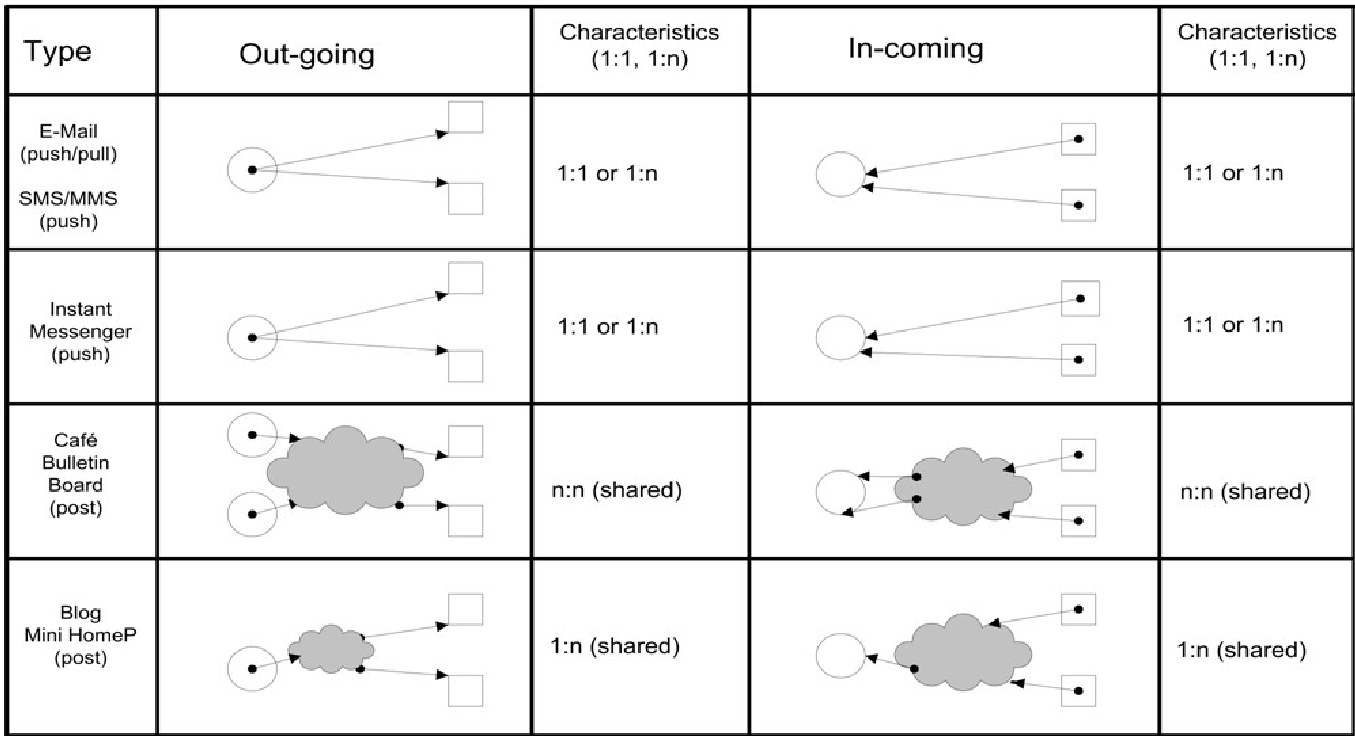
The system utilizes a single web-based server for metadata management. This "HandBoard" service acts as a common posting area for both human social updates and sensed environmental data.
2. Mobile User Interface (UI)
To improve the "Ubiquity Metric" (U) and "Interaction Time" (D), the author proposes using single-character multilingual domain names. Instead of typing www.sensor-network-service.com/node-123, a user can access information via a simplified index, drastically reducing the "keypad-press number."
3. Real-Time Estimation
For the sensor networking aspect, the paper introduces a mathematical approach to handle data quality. To identify statistical outliers in real-time without overwhelming the CPU, it uses:
- EWMA (Exponentially Weighted Moving Average) for mean values.
- MAD (Mean Absolute Deviation) to reduce computational complexity compared to standard variance calculations.
Experiments & Results
The author implemented a prototype for a lecture group (~120 students) and an alumni association (~60 members). They also simulated sensor networks with 70 to 160 nodes (similar to the number of sensors in a modern automobile).
Resource Utilization Comparison
The paper highlights a critical shift from multimedia-based "Pulling" (like standard blogs or mini-homepages) to text-based "HandBoard" services.
| Metric | Multimedia Blocks/UCC | HandBoard (Proposed) |
|---|---|---|
| Bandwidth Consumption | High | Low (Efficient) |
| Disk Space | Rapidly Expanding | Minimal/Text-only |
| Interaction Speed | Slow (Loading time) | Fast (Instant) |

The findings suggest that the frequency of pulling metadata () must be at least twice the update frequency () to maintain QoS, providing a practical guideline for network managers.
Critical Insight & Conclusion
The real value of this work is the Social-Sensor Analogy. By treating a sensor node as a "participant" in a social network that "posts" updates to a directory, the author simplifies the middleware required for the Internet of Things (IoT).
Limitations: While text-based interaction is efficient, the modern web is increasingly visual. Future work would need to balance the low-latency benefits of "HandBoard" with the growing demand for rich sensor visualization (e.g., real-time heatmaps).
Future Outlook: As we build "u-Cities," unified directories will become the phonebooks of the future—not just for people, but for every smart light, air quality sensor, and autonomous vehicle in the urban landscape.