
Trust Over Delight: The Hierarchy of Web Design in High-Risk Cultures
Web Design Attributes in Building User Trust, Satisfaction, and Loyalty for a High Uncertainty Avoidance Culture
This study investigates how web design attributes (typography, color, content, interactivity, and navigation) influence user trust, satisfaction, and loyalty within high Uncertainty Avoidance (UA) cultures. Using Pakistan as a case study and a PLS-SEM approach (n=558), it demonstrates that while satisfaction is driven by aesthetics and interactivity, trust is the primary driver of loyalty in risk-averse environments.
TL;DR
In e-commerce, a "pretty" website isn't enough to win over risk-averse customers. This research proves that in high Uncertainty Avoidance (UA) cultures like Pakistan, Trust is a more powerful driver of Loyalty than Satisfaction. While typography and color enhance the user experience, functional "safety nets" like guided navigation and high-quality content are what actually build the trust necessary for long-term retention.
Background: The Psychology of Avoidance
In the world of UX, we often treat "Users" as a monolith. However, Hofstede’s cultural dimensions suggest otherwise. People in high Uncertainty Avoidance (UA) cultures—such as Pakistan (UA index of 70)—are fundamentally less tolerant of ambiguity and perceived risk. For these users, an e-commerce transaction isn't just a convenience; it's a potential threat.
The authors of this study sought to understand which specific design levers can lower this psychological barrier and move a user from "visitor" to "loyal customer."
Methodology: Mapping Design to Emotion
The research team built a bespoke travel booking prototype, rigorously testing five design dimensions:
- Typography: Spacing, readability, and font style.
- Color: Emotional appeal and functional signaling.
- Content Quality: Depth and accuracy of information.
- Interactivity: Personalization and system responsiveness.
- Navigation: The "road map" and reversibility of actions.
Using PLS-SEM (Partial Least Squares Structural Equation Modeling) on a sample of 558 participants, they quantified how these design inputs translate into the mental states of Trust and Satisfaction, and finally, into Loyalty.
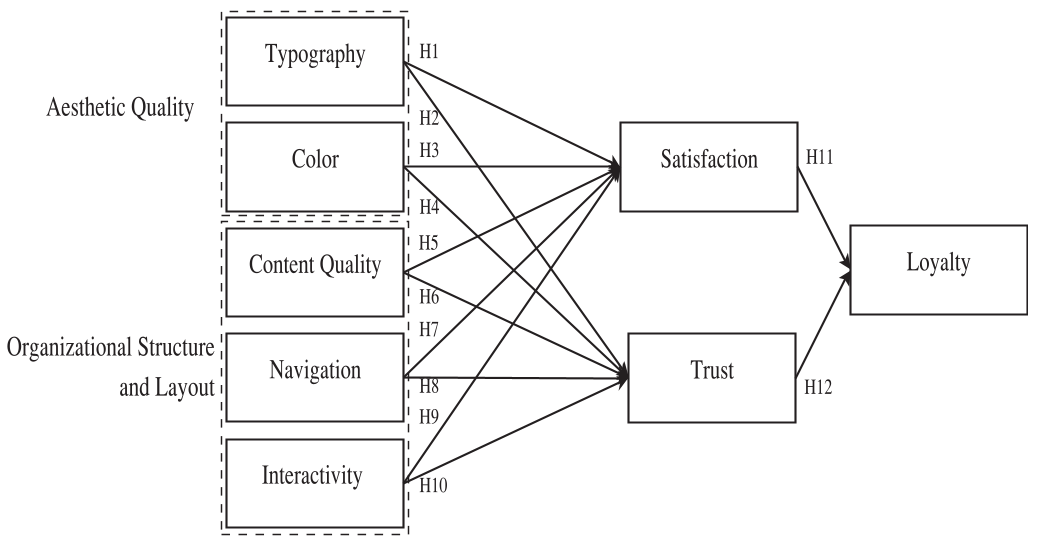 Figure 1: The hypothesized structural model linking design attributes to loyalty.
Key Insights: Why "How it Works" Beats "How it Looks"
1. The Typography Discovery
Typography is the "unsung hero" of this study. While often ignored in e-commerce papers, it showed a significant positive influence on satisfaction. Proper line spacing (1.08 to 1.5) and readable sans-serif fonts reduce cognitive friction, making the user feel more comfortable—yet, uniquely, its impact on trust was lower than its impact on satisfaction.
2. Functional Trust-Builders
The study found that Content Quality (β = 0.304) and Navigation (β = 0.185) have the strongest paths to Trust. In a high-UA culture, users look for "Proof of Life" and "Escape Hatches":
- Content: Detailed info reduces the "unknown."
- Navigation: Obvious buttons and the ability to reverse actions (reversibility) provide a sense of control that mitigates the fear of making a mistake.
3. The Loyalty Equation
The most striking result is the comparison of path coefficients to Loyalty.
- Trust → Loyalty: 0.424
- Satisfaction → Loyalty: 0.393
In low-trust cultures, a user can be satisfied with a beautiful interface but still refuse to return if they don't feel the platform is credible. Trust is the "bridge" that satisfaction alone cannot build.
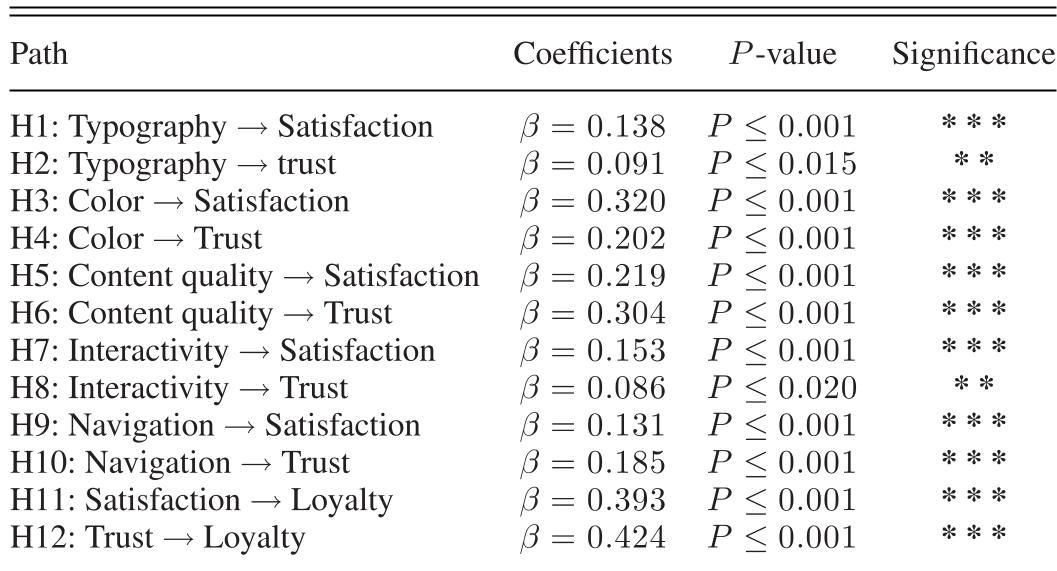 Table VII: Significant path coefficients showing the weight of each attribute.
Deep Insight: The Senior Tech Editor's Perspective
This paper fundamentally challenges the "Aesthetic-Usability Effect"—the idea that users perceive more attractive designs as more usable. In high-UA cultures, this effect is filtered through a Trust-Lens. An attractive site (Typography/Color) makes a user happy, but a logically structured site (Navigation/Content) makes them feel safe.
For global product managers, the takeaway is clear: Localization is not just translation; it is an adjustment of the Trust-to-Satisfaction ratio.
Conclusion & Future Outlook
The study concludes that for risk-averse populations, designers should prioritize "Guided Navigation" and "Information Transparency" over pure aesthetic experimentation.
Limitations: The study used a student sample and a prototype without real financial transactions. Future research should investigate if these correlations hold when "real money" is on the line, potentially magnifying the Trust-Loyalty link even further.
Final Thought: If you are designing for markets in South Asia or the Middle East, shift your focus from delight to assurance.