
Does Web Design Truly Drive Our Emotions? A Reality Check on Affective HCI
Does the Web Design Disconnect the Emotional Connection?
This study investigates the correlation between user emotions and web design usability by employing the FaceReader facial expression recognition tool and expert heuristics. Despite the shift toward emotional HCI, the researchers found that web design quality (usability) does not significantly correlate with the user's expressed emotions.
TL;DR
In the burgeoning field of "Affective Computing," we often assume that sleek, usable web design makes us happy, while clunky interfaces make us angry. This paper, "Does the Web Design Disconnect the Emotional Connection?", puts this assumption to the test. Using the FaceReader tool for automated emotion detection, the researchers found a surprising "disconnect": expert usability scores and user emotions show no significant correlation. Instead, the real driver of digital frustration appears to be the user's own prior experience.
Background: The Third Wave of HCI
Human-Computer Interaction (HCI) has transitioned through three stages:
- First Wave: Focus on the individual and human factors (man-machine).
- Second Wave: Focus on groups, communication, and work environments.
- Third Wave: The current era, where computers are integrated into everyday life, focusing on culture, experience, and emotion.
Despite this shift, the authors noticed a gap: we talk about "emotional design," but do we actually see it on the users' faces?
The "Disconnect" Hypothesis: Problem & Motivation
The researchers set out to challenge the intuitive belief that "good design = happy user." They hypothesized that other factors—specifically user background and application content—might outweigh the objective quality of the web design. If a user is highly skilled, does a bad layout bother them more, or less? If the content is "scary" or "funny," does that override the frustration of a broken navigation menu?
Methodology: Science Behind the Smile
To measure this, the study utilized two distinct tools:
- The FaceReader: An automated tool that differentiates six basic emotions (Happy, Angry, Sad, Surprised, Scared, Disgusted) with 89% accuracy based on Ekman's theory.
- Expert Heuristics: A 5-point checklist evaluating structure, navigation, text, layout, and media to generate a "Usability Score."
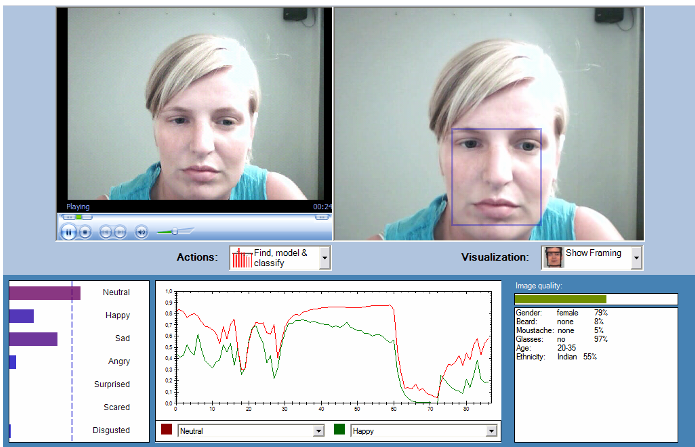 Figure 1: The FaceReader interface used to track facial muscle movements and map them to emotional states.
The test involved 12 participants across three categories of web apps:
- Information (e.g., News sites, Route planners)
- Communication (e.g., IM clients with "scary" or "funny" video links)
- Recreation (e.g., Quizzes and online games)
Challenging the Status Quo: Results
The study's findings were counter-intuitive and essentially debunked the "Usability creates Emotion" myth:
1. The Usability Gap
There was no general correlation between the expert-rated usability of a site and the emotions recorded on users' faces. A site could be a navigational nightmare, but the user's face remained neutral or didn't reflect the specific expert-identified flaws.
2. The Experience Factor
The researchers found that computer and Internet experience was a much stronger predictor of emotion. Specifically, experienced users were angrier when dealing with low-usability sites.
- Insight: Experts likely have a lower tolerance for "bad design" because they know how it should work, whereas novices may blame themselves rather than the interface.
3. Content vs. Emotion
Surprisingly, even manipulating content (e.g., sending a scary video vs. a funny one) did not result in significant differences in average facial expressions during the tasks.
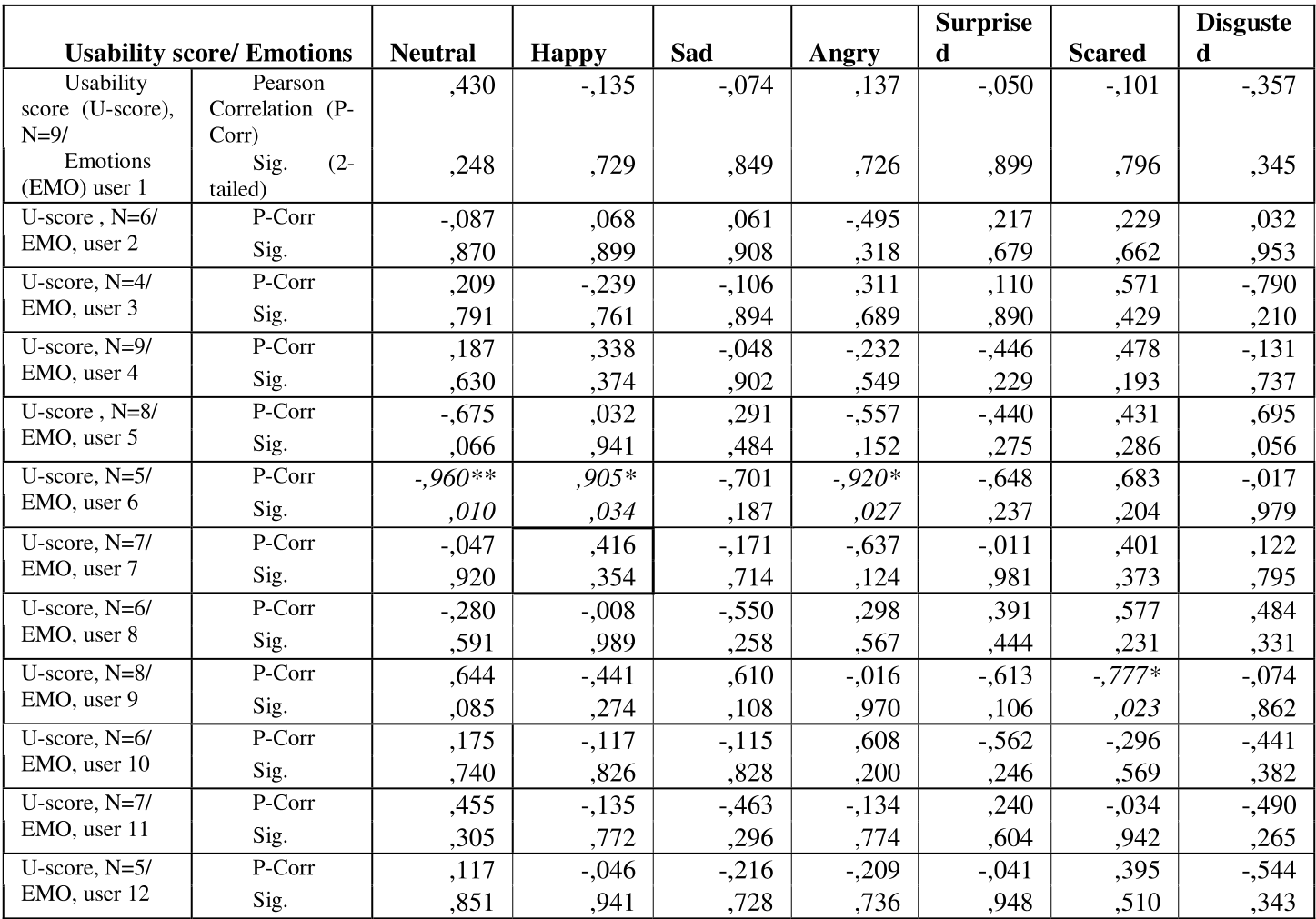 Table 1: Statistical breakdown showing the lack of significant correlation (Sig. values > 0.05) between Usability Scores and various emotions across most test users.
Critical Analysis & Conclusion
Takeaway
The core contribution of this paper is the realization that web design quality is not the primary driver of physiological emotional response. Emotions in HCI are a complex interplay of internal user traits (like experience levels) rather than a direct reaction to "pretty" or "functional" pixels.
Limitations
- Sample Size: With only 12 participants, the statistical power is limited, which the authors acknowledge.
- Laboratory Effect: Expressing emotions in a "living room" lab setting with a one-way mirror may lead to "social masking," where users suppress natural reactions.
Future Outlook
This work prompts a rethink for UX designers: simply improving usability might reduce friction, but it doesn't automatically "delight" the user. To truly influence emotion, we must look deeper into the individual psychological profile of the user and their expectations based on their digital literacy. The "emotional connection" in web design may be more of a cognitive appraisal than a raw facial reaction.