
Web Mining: Cracking the Cold-Start Problem in Online Bookstore Marketing
Applications of Web Mining for Marketing of Online Bookstores
This study proposes a Web Content Mining framework to identify potential customers for online bookstores without relying on internal transaction records or demographic data. By leveraging search engine results, the authors employ Association Analysis and Hierarchical Cluster Analysis (HCA) to segment scholars and their IT expertise into targeted marketing communities.
TL;DR
How do you recommend the right book to someone who has never visited your website? This paper introduces a framework that uses Web Content Mining to bypass the need for private transaction records. By analyzing search engine hit counts between scholars and technical keywords (Association & Cluster Analysis), the researchers achieved a statistically significant boost in recommendation accuracy for "cold" potential customers.
Context: Beyond the "One-to-All" Spam
In the late 2000s, online bookstores faced a dilemma: they could market to current users using data mining, but reaching new customers usually meant "spray and pray" email blasts. This paper addresses the "cold-start" marketing problem. It positions itself as a bridge between high-privacy constraints and the need for personalized "one-to-one" marketing by treating the entire World Wide Web as a proxy for a customer database.
The "Physical Intuition" of Web Co-occurrence
The core insight is simple yet profound: If a scholar’s name frequently appears on the same web pages as a specific technology (e.g., "Fuzzy Logic"), they belong to that "Community of Practice."
The Methodology Pipeline
- Data Collection: 200 scholars and 200 IT keywords are paired.
- Web Search: Using search engines to find how many pages mention both (Scholar + Expertise ).
- The Normalization Formula: To avoid bias from famous names or generic terms, the authors used a specific index:
- Binarization: Turning these scores into 1s and 0s based on a threshold to create a "Transaction Matrix."
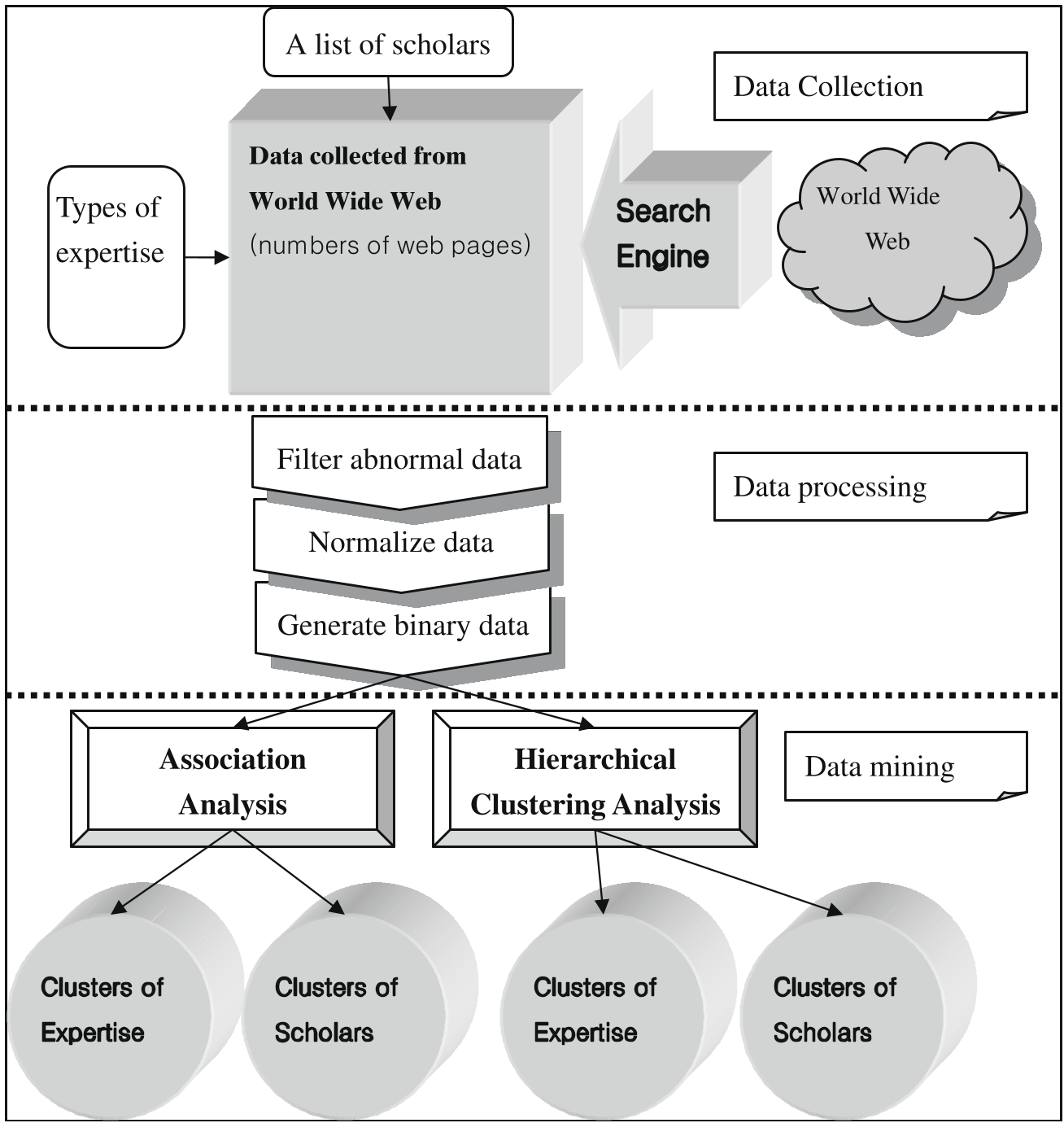
Association Analysis vs. Hierarchical Clustering
The paper compares two major unsupervised learning techniques:
- Association Analysis (C1 & C2): Great for visualizing relationships (Map-based). It identifies "rules" (e.g., if you know Neural Networks, you likely know Genetic Algorithms). However, it often ignores "isolated" items that don't meet the support threshold.
- Hierarchical Cluster Analysis (C3 & C4): Using Ward's Method, HCA forces every scholar into a dendrogram (tree). This proved superior for marketing because it ensures no potential customer is left behind in the segmentation process.
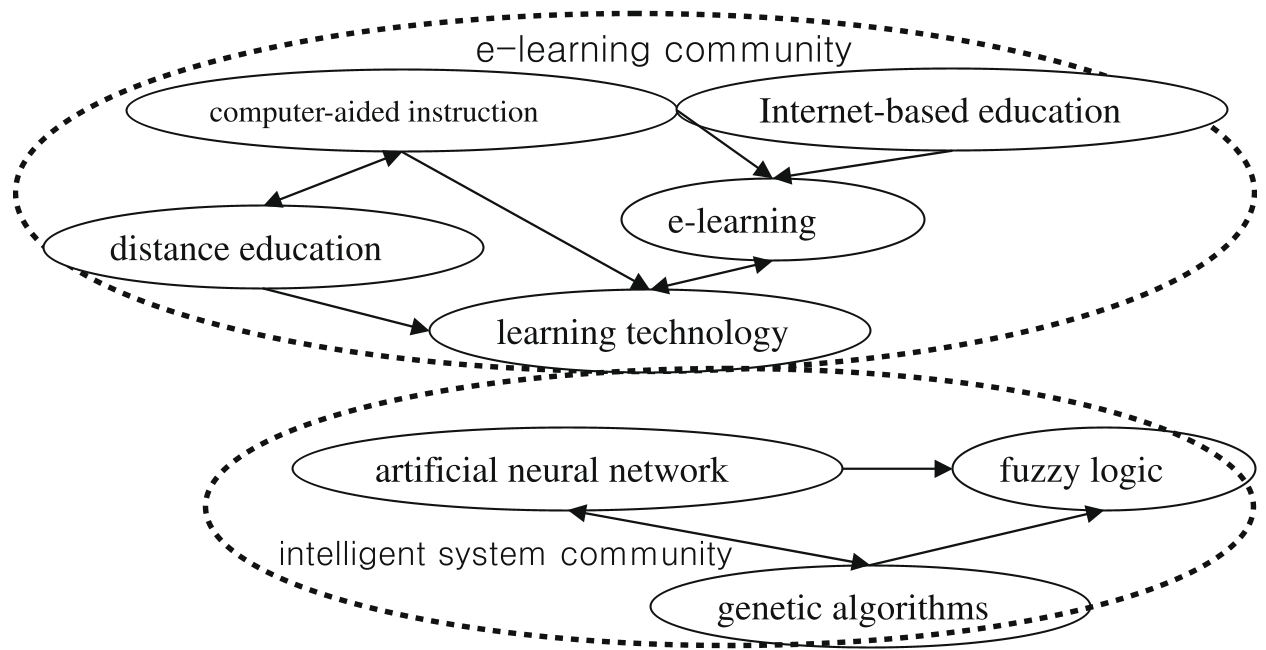 Figure: The association map revealing distinct "Communities of Practice" like Intelligent Systems and E-learning.
Experimental Results: Does It Actually Work?
To validate, the authors sent "blindly" generated booklists to the scholars based on their web-mined clusters.
- Hit Rate: 38.1% of scholars correctly identified the booklist specifically designed for them out of 5 random choices.
- Significance: Using a Binomial Distribution, the probability of this occurring by chance was , well below the standard academic threshold.

Critical Insight: The "Digital Shadow"
This work was a precursor to modern "Lookalike Modeling" used by platforms like Meta and Google today. The key takeaway is that Content is Proxy for Intent. Even in 2009, the authors realized that a person's public professional identity is an incredibly accurate predictor of their consumption needs.
Limitations & Future Directions
- Data Noise: The researchers had to manually filter "famous name" bias (e.g., a scholar shared a name with a celebrity).
- Static Nature: Search engine hit counts are a "snapshot." Modern versions would likely use Real-time Stream Mining or Social Media Graph Analysis.
Conclusion: By moving data mining from the internal database to the external web, marketers can transition from being "spammers" to "solution providers" for experts in niche fields.