
Beyond Clicks: Decoding Web Personalization through Artificial Psychology
Web Personalization Based on Artificial Psychology
The paper introduces a novel Web Personalization architecture that integrates Artificial Psychology (AP) with traditional Web mining. By utilizing cognitive expansion and K-means clustering on psychological profiles, the system automates the creation of personalized content and user interfaces (UI).
TL;DR
Most web personalization today is reactive—it looks at what you clicked and shows you more of the same. This paper argues that this approach is shallow and computationally wasteful. Instead, the authors propose a framework that uses Artificial Psychology (AP) to model a user’s internal cognitive state. By transforming subjective feelings (like "romantic" or "elegant") into a mathematical reactor matrix, the system can predict user preferences for both content and UI aesthetics (like color schemes) with much higher precision.
The "Intuition" Gap in Web Mining
Current State-of-the-Art (SOTA) in the early-to-mid 2000s relied heavily on Web Usage Mining. While effective for finding patterns, it suffers from two major flaws:
- Resource Exhaustion: Analyzing every single clickstream takes massive memory and time.
- Lack of Subjectivity: Algorithms treat "keywords" as cold data points, ignoring the "why" behind the search.
The authors argue that personalization should not just be about "identifiable information" but about Cognitive Knowledge—understanding the human expectation and social context of a query.
Methodology: The Cognitive Expander
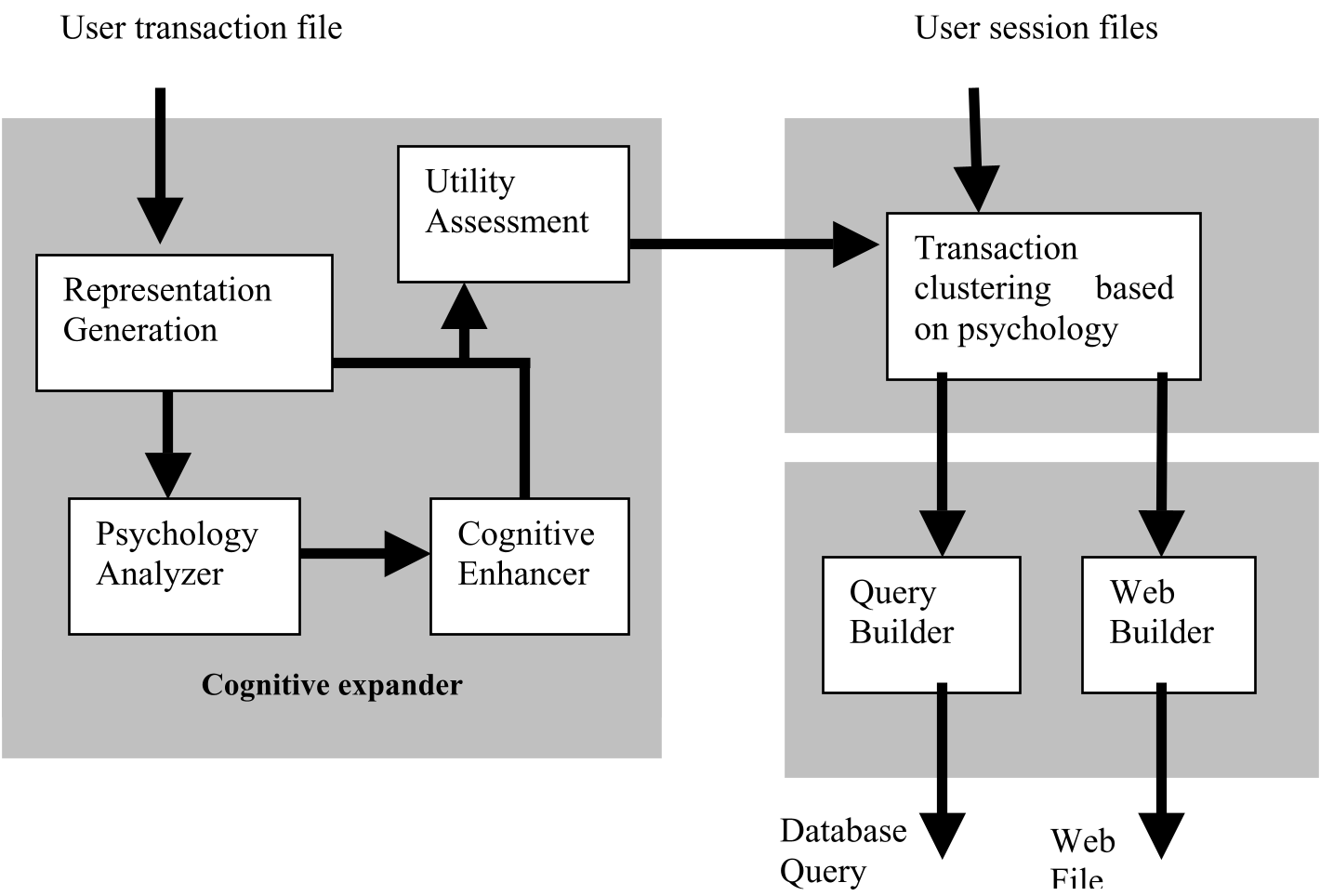
The heart of the paper lies in the Cognitive Expander, a module that bridges the gap between human psychology and data mining.
1. The Psychology Analyzer
The system collects "adjective pairs" (e.g., Lovely vs. Bothersome, Expensive vs. Cheap). Through Factor Analysis, it reduces these into representative pairs. These are then converted into a numeric evaluation value.
2. Mathematics of Emotion: Quantification Theory I
The paper uses a reactor matrix to map physical attributes (like RGB color values) to user feelings.
The core calculation follows the formula: Where:
- : The reactor matrix (physical features of the web object).
- : The relationship coefficient derived from previous user evaluations.
- : The predicted psychological satisfaction/utility.
Experiments: Color and Commodity
The authors tested this by mapping 5 samples against attributes like Red, Green, Blue, Lightness, and Warmth. By using a questionnaire to get the initial "average" feeling of a user, the system could then predict how that user would feel about a new "Case" based solely on its color properties.
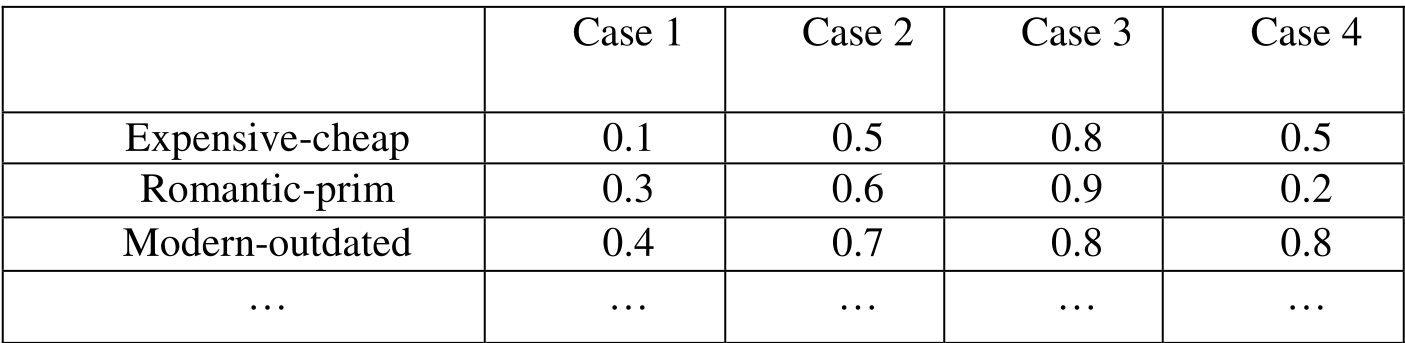
This is then fed into a multivariate K-means algorithm. Unlike standard K-means which clusters by URL frequency, this version clusters by Psychological Support, making the resulting user profiles much more meaningful for "Display Strategies" (UI personalization).
Critical Insight & Conclusion
The true value of this work is its role as a precursor to Affective Computing. It suggests that a user's interface should "self-evolve." If the Psychology Analyzer determines a user is in a "minimalist" mood or has a "utilitarian" personality, the web composition (color, complexity, query depth) should shift dynamically.
Limitations
- Manual Input: The requirement for users to fill out questionnaires to initialize the "Psychology File" is a hurdle in real-world UX.
- Scale: While the K-means approach is more refined, the initial reactor matrix calculation requires significant ground-truth data to be accurate.
Future Outlook
As we move into an era of Generative AI, the concepts in this paper—mapping latent emotional adjectives to concrete generation parameters—are more relevant than ever. Modern implementations would likely replace the manual reactor matrix with Latent Vector Embeddings, but the core goal remains: making the web feel "human" by understanding the user's psyche.