
WebAGENT: Bridging the Semantic Gap in Web Prefetching with HMM and Ontology
An Approach to Web Prefetching Agent Based on Web Ontology with Hidden Markov Model
This paper presents WebAGENT, a semantic-driven web prefetching agent that combines Web Ontology with Hidden Markov Models (HMM). By mapping user access paths to HMM states and latent information concepts to observation symbols, it achieves a high hit ratio by predicting user intent rather than just link patterns.
TL;DR
WebAGENT is a novel prefetching system that treats the web as a semantic landscape. By combining Web Ontology (site structure) with Hidden Markov Models (HMM), it predicts not just the next URL, but the next Information Concept the user is pursuing. This semantic-first approach yields a prefetching hit ratio of nearly 60%, significantly outperforming non-predictive caching.
Background: The Latency Problem
As web services scale, bandwidth limitations remain a bottleneck for user experience. Standard caching is passive—it stores what you already saw. Prefetching is active—it fetches what you will see. However, most prefetching algorithms are "blind" to the content; they look at transition probabilities (A usually follows B) without understanding why.
The Core Insight: Intent-Based Browsing
The author, Xin Jin, proposes two fundamental observations:
- Hyperlinks are Conceptual: Authors use links to organize information logically.
- Anchor Text is Key: A user clicks a link based on the anchor text, which generalizes the content of the target page.
By extracting these "Information Requirement Concepts," the WebAGENT creates an HMM where the intent is the bridge between the current page and the next likely request.
Methodology: HMM Wrapped in Ontology
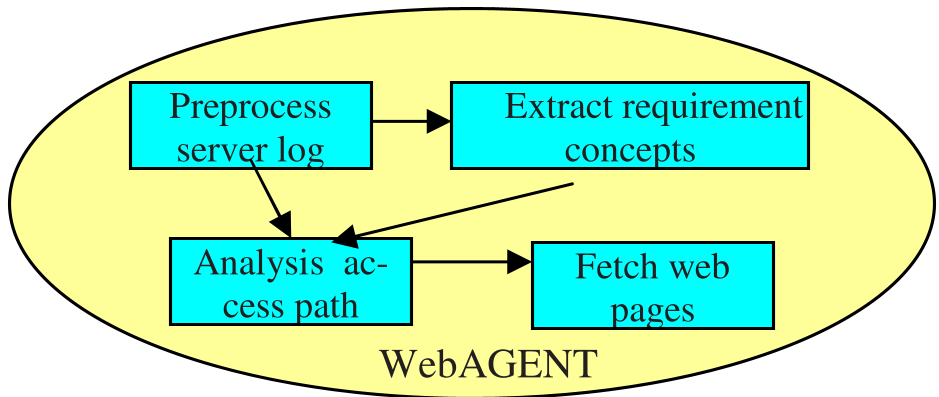
The system architecture follows a four-phase workflow: Preprocessing, Concept Extraction, Path Analysis, and Prefetching.
1. Modeling the HMM
In this HMM configuration ():
- States (): The sequence of web pages () in the user's access path.
- Observation Symbols (): Semantic concepts () extracted from the
HyperDoc(a collection of all anchor texts on the current page). - Navigation Capacity: A specialized weight formula () that measures a page's ability to lead a user to a specific concept based on historical session data.
2. Semantic Score Calculation
The agent doesn't just rank URLs; it ranks concepts. It calculates the probability of a concept sequence using the normalized navigation capacities across the access path. The top (usually 7) concepts are used to score and prefetch the candidate pages.
Experimental Evidence
The system was tested using 4 months of server logs from the Central University of Finance & Economics.
Performance Highlights:
- Optimal Path Length: Accuracy peaks when the access path is roughly 7 steps long (58.6% hit ratio). Beyond this, "interest drift" or noise begins to degrade performance.
- Threshold Efficiency: Increasing the prefetch threshold (the number of pages loaded in advance) improves the Session Hit Ratio, though the rate of return diminishes after 4 pages.


Critical Analysis & Future Outlook
Why it works: By mapping pages to concepts, the model handles the "sparsity problem" of web logs. Two different pages with the same anchor text (e.g., "Download PDF") are treated conceptually similarly, even if their URLs differ.
Limitations:
- Cold Start: The system relies on existing logs to calculate transition probabilities and weights.
- Computational Overhead: Real-time HMM probability calculations for every user path could be taxing for massive, high-concurrency portals.
Conclusion: WebAGENT proves that "browsing is a search for meaning." By injecting Ontology into the HMM framework, we move away from simple link-prediction toward a more human-aligned semantic prediction model, paving the way for smarter, faster web infrastructures.