
Building an Efficient "Knowledge Bridge": The Power of Fragmented Background Knowledge in Ontology Matching
Web Semantics: Science, Services and Agents on the World Wide Web
The paper introduces a novel framework for Background Knowledge (BK)-based ontology matching that dynamically builds a customized, reduced-size resource instead of using complete external ontologies. By combining concept selection with automated path-driven derivation across multiple intermediate ontologies, the approach achieves state-of-the-art results on OAEI Anatomy and LargeBio datasets.
TL;DR
Ontology matching is the "Rosetta Stone" of data integration. This paper presents a breakthrough approach that doesn't just use external ontologies as dictionaries, but builds a dynamic, high-speed bridge using only the relevant fragments of those ontologies. By focusing on a "Built BK" (Background Knowledge) resource, the authors slashed computation time by up to 60% while outperforming global state-of-the-art systems on complex biomedical benchmarks.
Background: The Semantic Gap
Most ontology matchers look at two things: Lexical similarity (do the names look the same?) and Structural similarity (is the hierarchy the same?). But in domains like medicine, where "Hers Disease" might be identified across different systems by completely different technical codes or labels, direct matching hits a wall.
The community uses Background Knowledge (BK) to fill this gap. However, traditional BK usage is a "double-edged sword." Using massive ontologies like MeSH or SNOMED-CT in their entirety is slow and introduces "false positives"—mappings that look correct but are semantically incorrect.
The Core Innovation: "Just Enough" Knowledge
The researchers identified a critical flaw in prior work: we don't need the whole dictionary to translate one sentence.
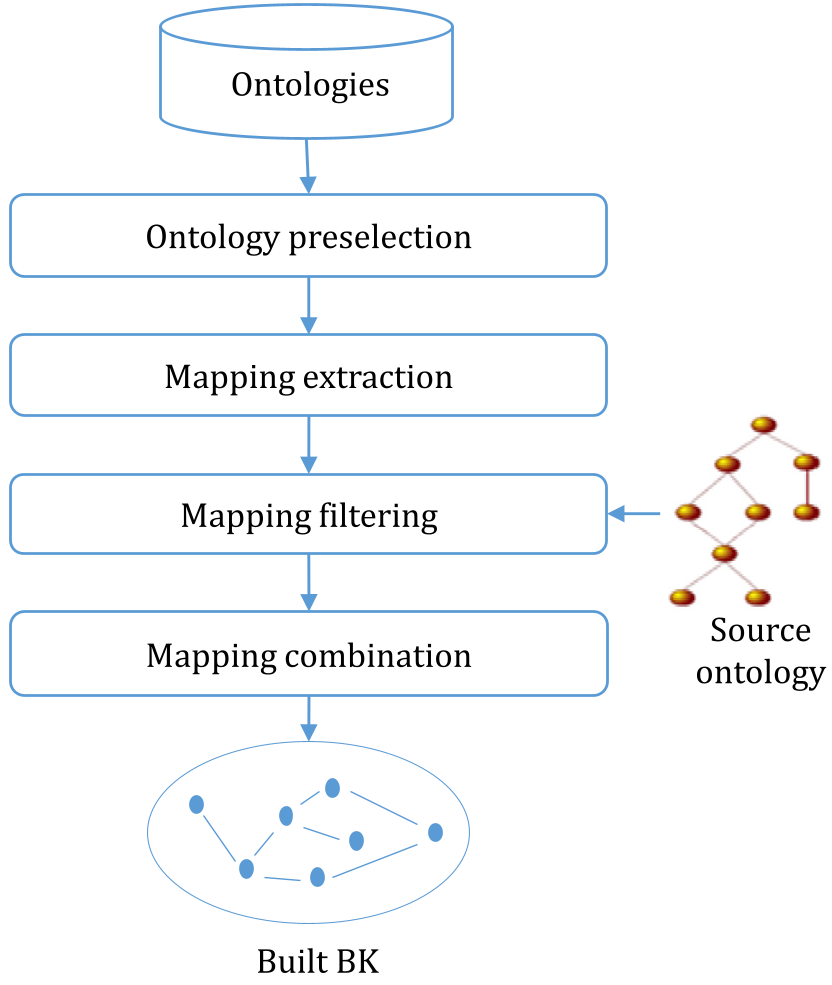
1. The Dynamic "Built BK"
Instead of loading entire ontologies, the system:
- Pre-aligns external ontologies to each other.
- Filters only the concepts that actually touch the "Source" ontology.
- Combines these fragments into a single, light-weight graph.
This results in a resource that is 90% smaller than the original ontologies but contains 100% of the useful information.
2. Path-Driven Derivation
Traditional systems usually look for a single "mediator" (A -> BK -> B). This paper allows for long-distance relationships (A -> BK1 -> BK2 -> B). By extracting paths through multiple BK resources, they found up to 7% more correct mappings that other systems missed.
Separating Signal from Noise: Machine Learning
If you generate thousands of potential "paths" between concepts, how do you know which ones are real? The authors turned mapping selection into a classification problem.
They used RandomForest with 27 features, including:
- Path Length: Shorter paths are usually more reliable.
- Composition Scores: Mathematical aggregations of similarity along a path.
- Manual Alignment Evidence: Does this path rely on human-verified cross-references (like OBO x-refs)?
Experimental Results: Leaner and Meaner
In the OAEI (Ontology Alignment Evaluation Initiative) tracks, the results were definitive:
- Efficiency: Matching a target ontology against the "Built BK" is significantly faster than matching against the original 18+ biomedical ontologies.
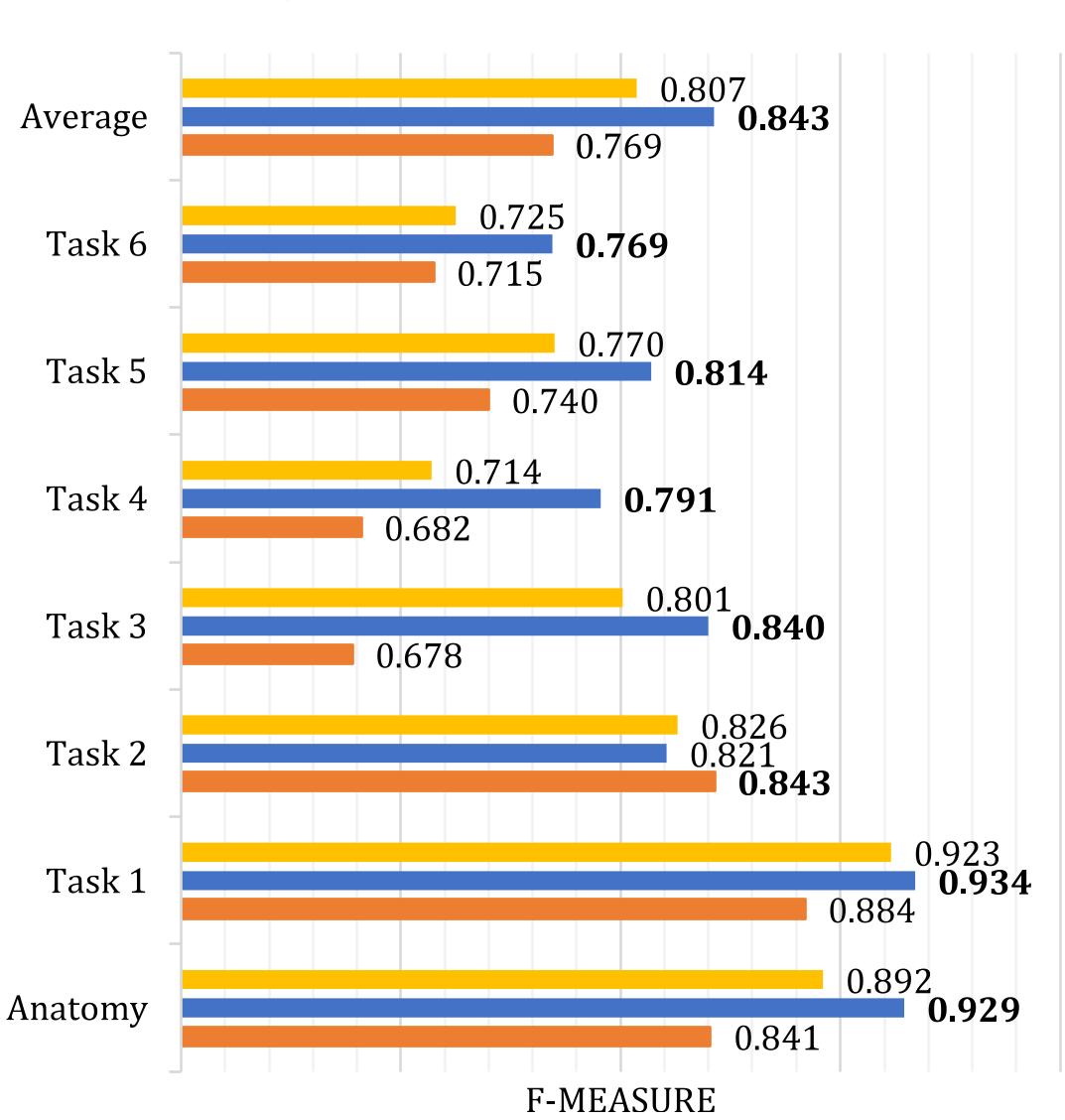
- Effectiveness: On the LargeBio track, the system outperformed LogMapBio in almost every task.
Critical Insight: Why This Matters
The most profound takeaway from this work is the shift from ontology selection to concept selection. In the era of "Big Data," the bottleneck is no longer having enough information—it's filtering out the noise. This paper proves that localized, context-specific Background Knowledge is the key to building scalable, heterogeneous data integration systems.
Future Directions
While highly effective in biomedicine, the system currently focuses on equivalence mappings. Extending this to "is-a" (subsumption) or "part-of" relationships by preserving more of the BK's internal hierarchy during the filtering phase is the next logical frontier.
Conclusion
By treating Background Knowledge as a graph of fragments rather than a collection of monoliths, Annane et al. have provided a blueprint for the next generation of efficient semantic matchers.