
DMOP: Cracking the "Black Box" of Data Mining via Semantic Meta-Mining
Web Semantics: Science, Services and Agents on the World Wide Web
The Data Mining OPtimization Ontology (DMOP) is a comprehensive OWL 2 DL framework designed to automate algorithm and model selection through "semantic meta-mining." It achieves SOTA decision support by conceptualizing the internal mechanisms of data mining algorithms, workflows, and performance metrics, moving beyond previous "black-box" approaches.
TL;DR
The Data Mining OPtimization Ontology (DMOP) is a robust technical framework that replaces the traditional "blackbox" view of machine learning algorithms with a "glass-box" semantic model. By codifying the internal strategies of algorithms (e.g., cost functions, optimization policies), it enables Semantic Meta-Mining—a process where AI agents can autonomously design and rank optimal data mining workflows, improving predictive accuracy while reducing the need for human trial-and-error.
Problem & Motivation: The "Black-Box" Limitation
In traditional Meta-Learning (learning to learn), algorithms are often treated as atomic units. We observe that "Algorithm A" works well on "Dataset B," but we rarely quantify why in a machine-readable format. Existing standards like CRISP-DM provide high-level guidelines but lack the granular technical detail required for automation.
The authors argue that without understanding the internal "DNA" of an algorithm—its mathematical assumptions and optimization strategies—we cannot truly optimize the Data Mining (DM) process. DMOP was built to fill this gap, providing the "missing knowledge" that links data characteristics to algorithm internals.
Methodology: The Glass-Box Architecture
DMOP is built using OWL 2 DL and is aligned with the DOLCE foundational ontology. This alignment is critical because it provides a rigorous philosophical and logical basis for describing qualities, regions, and measurements.
1. Unified Conceptual Framework
The ontology is structured into three distinct layers:
- Top Layer: Formal conceptual framework (e.g., algorithm classes).
- Middle Layer: Accepted DM knowledge (e.g., specific implementations like C4.5).
- Bottom Layer: Application-specific data (e.g., actual experiment results and workflows).
2. Solving Meta-Modeling with Punning
A major technical hurdle was relating specific instances (like the C4.5 algorithm) to input/output classes. Standard OWL does not allow classes to be property values. The authors utilized OWL 2 Punning, allowing an entity to be treated as both a Class (for logical inheritance) and an Individual (for meta-data assertions).
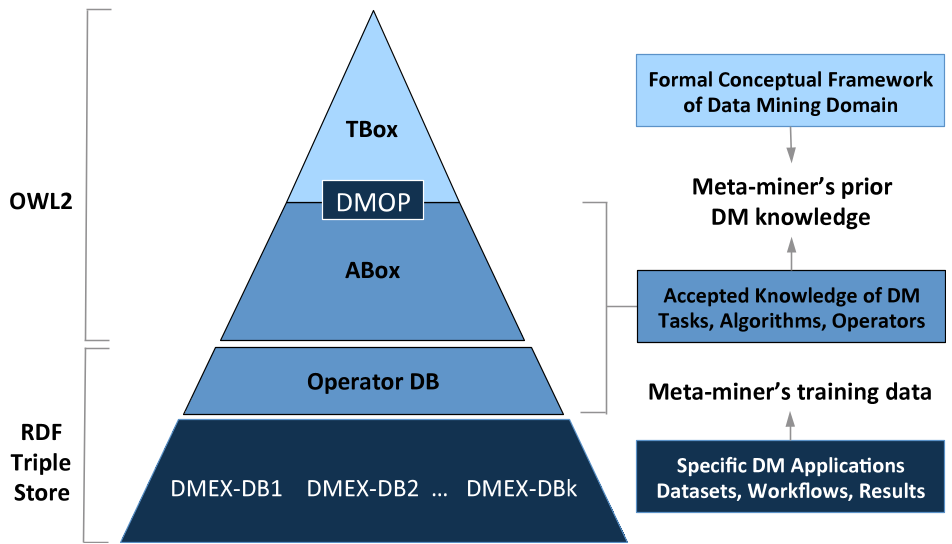 Figure 1: The DMOP architecture, bridging formal theory with application-specific experiment databases.
Experiments & Results: The Power of Meta-Mining
DMOP was evaluated using the e-LICO Intelligent Discovery Assistant (IDA), which suggests optimal workflows to users within the RapidMiner environment.
- Performance Prediction: When tested on high-dimensional microarray data (where variables vastly outnumber instances), systems using DMOP's internal features outperformed those using only data-centric meta-learning. The error rate dropped from a 45.38% baseline to 38.24%.
- Workflow Integration: The DMOP-based IDA was deployed as a plugin for RapidMiner, garnering over 10,000 downloads, proving the practical utility of semantic modeling in real-world data science tasks.
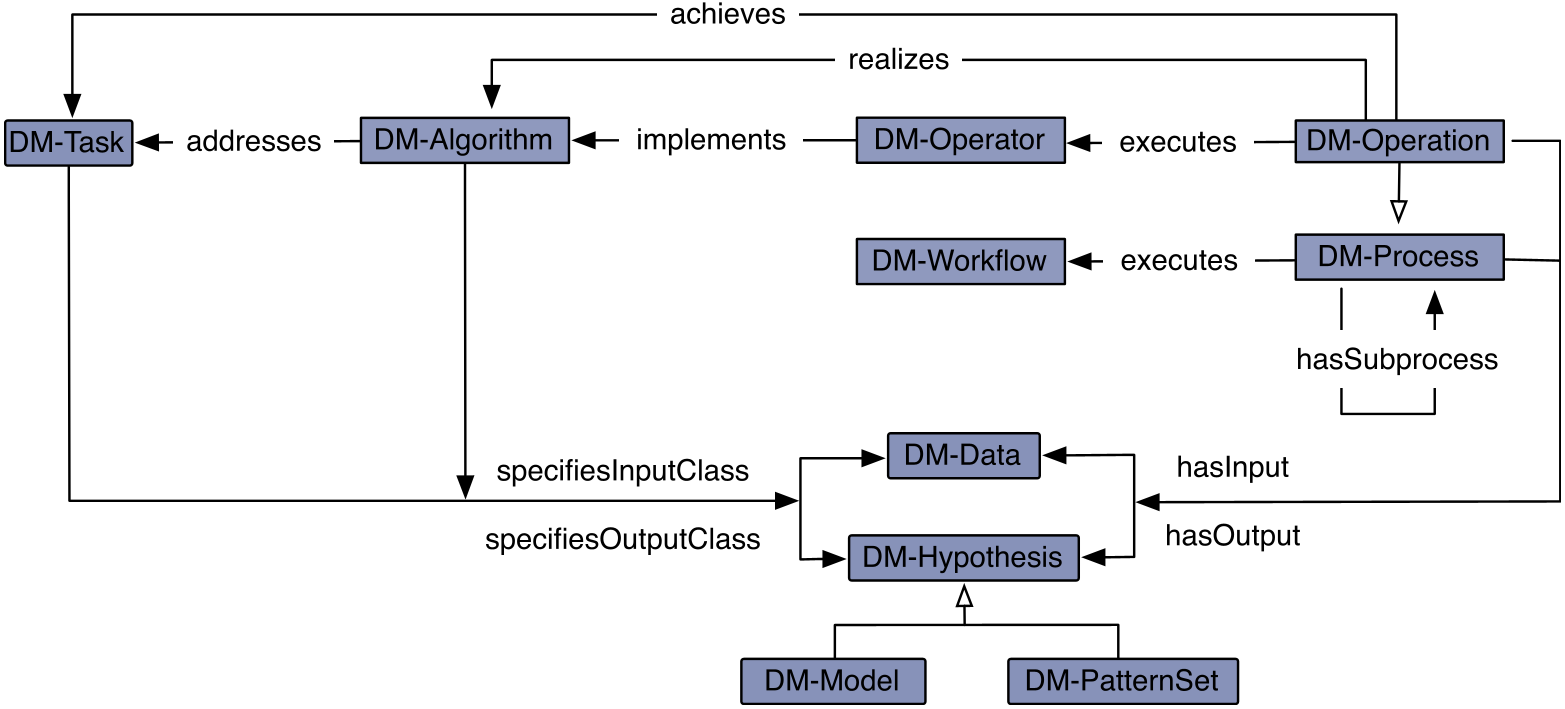 Figure 2: The core conceptual schema of DMOP, linking Tasks, Algorithms, and Hypotheses.
Critical Analysis & Conclusion
The Takeaway: DMOP represents a shift from "brute-force" machine learning to "informed" automated discovery. By structuring the domain's deep expertise into a formal ontology, the authors have created a "long-term memory" for DM systems.
Limitations:
- Complexity: The ontology is highly axiomatized (SROIQ(D) expressivity), which can lead to slow reasoning times (10-20 minutes in some versions).
- Maintenance: As new algorithms (like deep learning transformers) emerge, the ontology requires manual updates to maintain its "glass-box" transparency.
Future Outlook: DMOP paves the way for "Self-Driving Data Science." As AI systems become more autonomous, frameworks that allow them to reason about their own tools—rather than just processing data—will be indispensable.