
WSQSPSNM: Synchronizing Web Queries Across Professional Hierarchies
Web Service Query Selection for a Professional Social Network Members
The paper proposes WSQSPSNM, a Web Service Query Selection framework designed for professional social networks. It dynamically generates and adapts web queries for different group members based on their hierarchical levels, professional roles, and characteristic features when any single actor initiates a query.
TL;DR
Information needs in a professional setting are rarely uniform. A Professor and an Undergraduate student might both be interested in "Monsoon rainfall," but their technical requirements differ significantly. This paper introduces the Web Service Query Selection for a Professional Social Network Members (WSQSPSNM), a framework that identifies an actor's "Level" and "Relations" to automatically generate and distribute relevant sub-queries to all members of a professional group.
Problem & Motivation: The Context Gap in Search
In most professional social networks, information sharing is either manual or lacks technical granularity. Current systems treat "actors" as flat nodes. The authors argue that a true professional network must understand:
- Hierarchical Relations: The vertical flow of expertise (e.g., Senior Scientist to Junior Researcher).
- Equivalence Relations: Information sharing between peers at the same technical level.
- Activity Context: How current tasks (research, teaching, administration) shift query relevance.
Without these factors, web service selection remains program-centric rather than actor-centric, leading to "information noise" for low-level actors or "information gaps" for high-level experts.
Methodology: The Calculus of Professional Relations
The core innovation lies in how the system calculates the weight of an actor and their subsequent query relevance.
1. Weight Allocation
The system maps actors to a set of features including Education, Occupation, and Role. For instance, a PhD carries more weight (23) in an academic setting than a BS (15). Using these weights, the system establishes whether two actors are peers (Equivalence) or in a mentor-mentee dynamic (Hierarchical).
2. Hierarchical Architecture
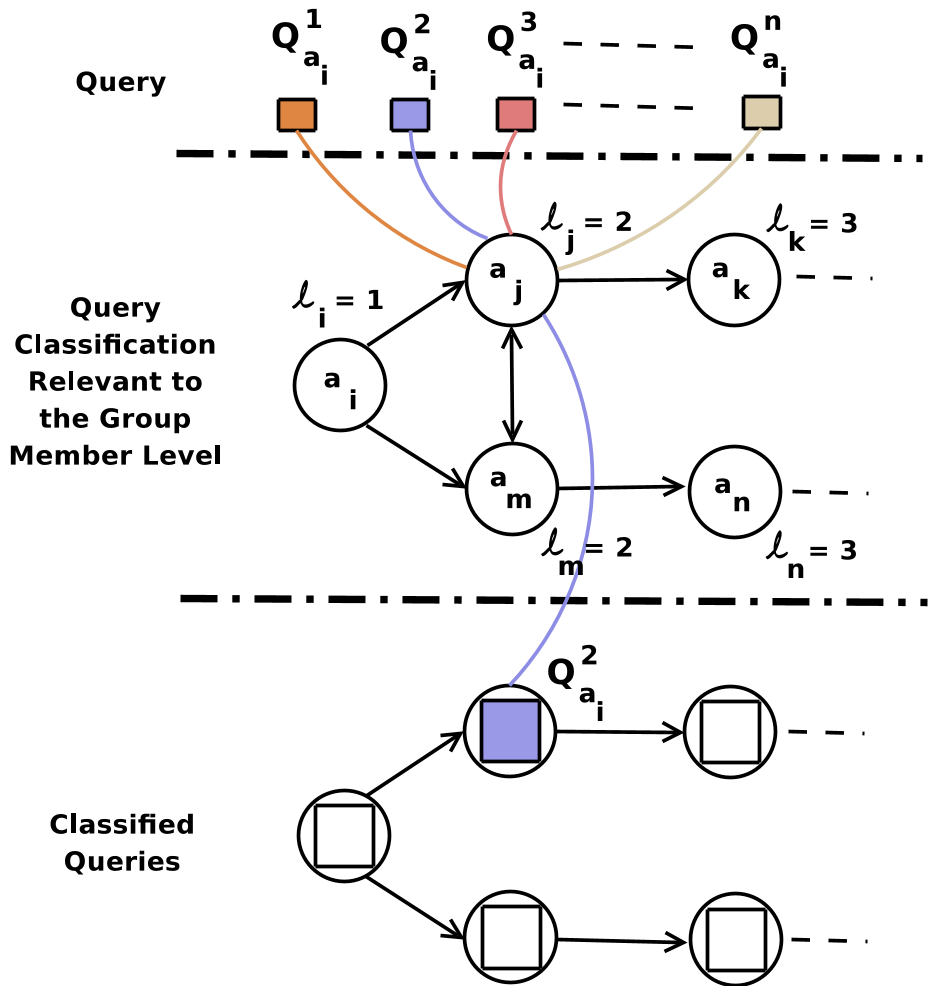
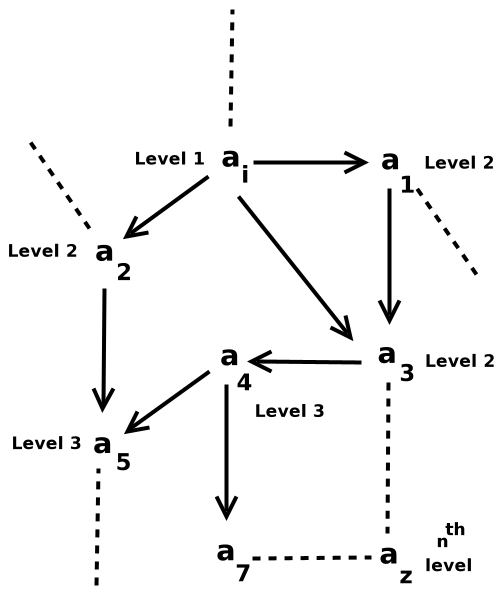
The methodology organizes the network into levels. Level 1 (the query initiator) triggers a ripple effect.
3. Query Decomposition
When a "Principal Scientist" queries "Monsoon rainfall is predicted as shortfall," the system uses a mathematical ratio: This formula ensures that while the Scientist gets detailed data, an Undergraduate group member automatically receives a broader sub-query like "Monsoon season" to match their educational level.
Experiments: Performance in the Academic Social Network (ASN)
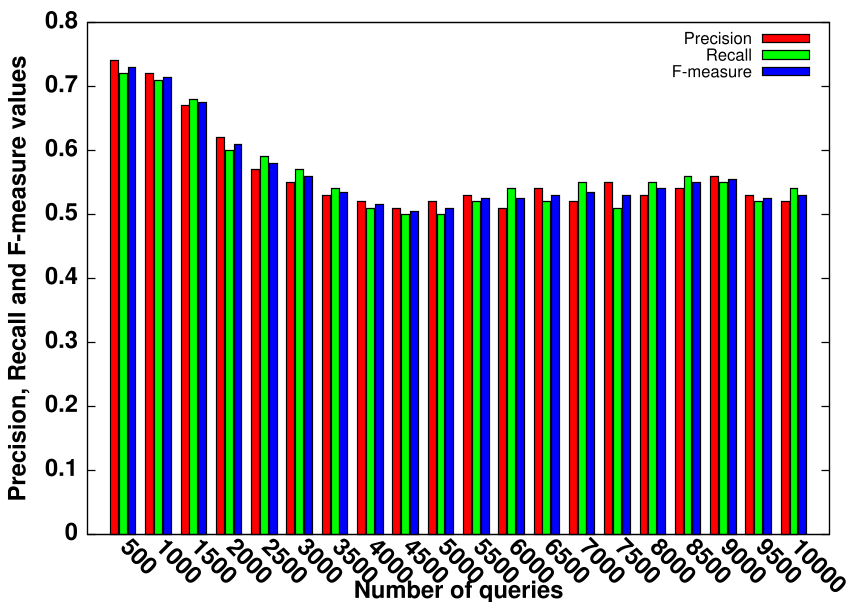
The system was tested on a simulated 100-actor ASN. The researchers used metrics common in Information Retrieval: Precision, Recall, and F-measure.
- Stability: The Precision and Recall values (around 0.6-0.8) remained fairly stable even as the query volume increased, suggesting the model is robust under load.
- Temporal Scaling: A critical finding was the "tipping point" at 20 actors. Below this, relationship establishment is nearly instantaneous. Beyond this, the time grows exponentially, suggesting that for massive networks, further optimization or "clustering" of actors might be necessary.
Critical Insight & Conclusion
The WSQSPSNM framework moves away from the "one-size-fits-all" search paradigm. Its strength lies in its Intelligent Sub-query Generation—the ability to pivot information based on who is receiving it.
Limitations: The current model relies heavily on predefined weights for characteristic features (like fixed numbers for degrees). In a real-world dynamic network, these weights might need to be learned via Machine Learning rather than assigned manually. Furthermore, the exponential growth in processing time for groups over 20 members suggests that the system in its current form is best suited for "Professional Teams" or "Lab Groups" rather than entire global social platforms.
Takeaway: This work represents an early but vital step in blending social structure with automated web services, ensuring the right information reaches the right level of professional expertise automatically.