
Chinese CSOs in the Web 2.0 Era: Empowerment, Inequality, and the Digital Divide
The use of Web2.0 style technologies among Chinese civil society organizations q
This study presents the first quantitative analysis of Web 2.0 technology adoption among over 500 Chinese Civil Society Organizations (CSOs) using a nationwide survey. It reveals that technologies like Instant Messaging (IM) and video sharing have achieved high penetration (over 70%), signaling a widespread shift toward social media-based communication in the sector.
Executive Summary
In the landscape of Chinese civil society, technology is not just a tool but a lifeline. This paper, "The use of Web 2.0 style technologies among Chinese civil society organizations," provides a landmark quantitative assessment of how grassroots organizations transitioned from the "read-only" Web 1.0 to the "participatory" Web 2.0. By surveying over 500 organizations, the research uncovers a counter-intuitive reality: money doesn't always buy digital innovation, and geography remains a stubborn barrier to communication equality.
The "Read/Write" Motivation: Why Web 2.0 Matters
Chinese CSOs traditionally struggle with two "bottlenecks": Lack of legal status (registration difficulties) and Lack of funding.
The author argues that Web 2.0—defined by its low technical barriers and "Web-as-free-platform" nature—offers a strategic fix. Unlike traditional websites that require expensive webmasters and servers, a Blog or an IM group allows a resource-poor grassroots organization to become its own media outlet. This shift from consumption to production ("Produsage") allows CSOs to bypass traditional gatekeepers and reach the public directly.
The Adoption Landscape: IM is King
The study highlights that Chinese CSOs are not just passive observers of technology. By 2009, adoption rates for several technologies were surprisingly high:
- Instant Messaging (IM): 84.1% (Reflecting the cultural dominance of platforms like QQ/MSN)
- Video/Image Sharing: 70.3%
- Forums/BBS: 56.0%
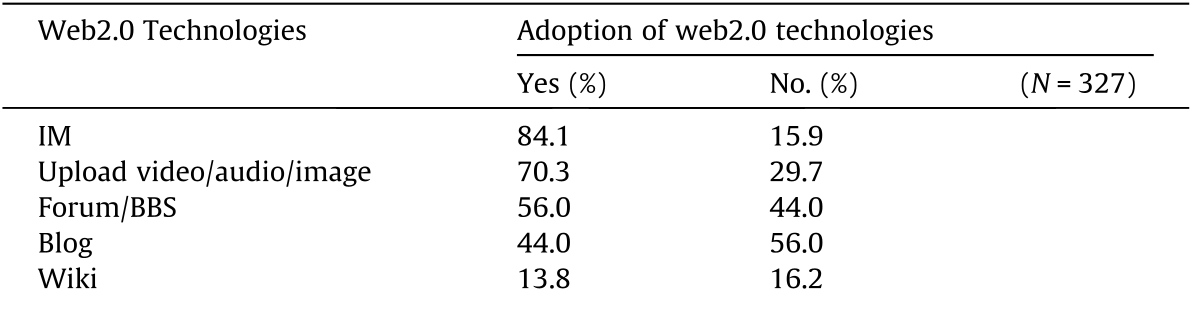
The high rate of IM use suggests a unique "Chinese pattern" of digital activism, where real-time, private, and semi-private circles are more critical than public Wikis (which had the lowest adoption at 13.8%).
The Paradox of Financial Resources
One of the most striking findings is the rejection of the hypothesis that "more money equals more technology."
- The Medium-Income Lead: CSOs with medium financial support (10k - 100k Yuan) showed the highest likelihood of using Blogs and uploading video content.
- The Elitist Lag: High-income organizations were actually less likely to use Blogs than their medium-income counterparts.
Why? The author posits that wealthy CSOs often have the budget for traditional Web 1.0 sites and mainstream media PR. They lack the motivation to pivot to "scrappy" Web 2.0 tools. Conversely, grassroots CSOs use these free tools out of necessity.

Regional Inequality: The Great Firewall Within
While financial resources show a complex relationship with tech, geography is clear-cut. There is a persistent "Digital Divide" between Eastern, Central, and Western China.
- Eastern CSOs: Leaders in Blogs and Forums (52.2%).
- Central CSOs: Surprisingly dominant in Video/Audio sharing (88.4%).
- Western CSOs: Consistently left behind, reporting the lowest usage across nearly all categories.

The author attributes this to a "Triple Threat": lack of motivation, poor hardware infrastructure in remote areas, and a scarcity of human talent (new media literacy) in the West.
Critical Insight: The "Crisis of the Bigs"
The paper concludes with a prophetic warning. While small CSOs thrive on Web 2.0 to build awareness, large, established CSOs (like the Red Cross Society) often fail to master these tools. This leads to a disconnect: when public scandals break out on social media, these large organizations lack the "digital muscle memory" to respond effectively, leading to devastating blows to their institutional credibility.
Conclusion & Future Outlook
This research fundamentally shifts our understanding of the digital divide in China. It suggests that:
- Motivation > Money: Small CSOs are more innovative because they have to be.
- Infrastructure Still Matters: You cannot have a "Writeable Web" if the Western provinces are still struggling with basic access.
- IM as a Mobilizer: The high IM adoption paved the way for the "WeChat era" of the 2010s, which would eventually redefine Chinese civil society.
For future researchers, the question is no longer "are they online?" but "how are they using these interactive platforms to survive in an increasingly complex regulatory environment?"