
Beyond DOM Trees: Bridging the Semantic Gap in Multilingual Webpage Segmentation
Webpage Segmentation Using Ontology and Word Matching
The paper introduces a novel multilingual webpage segmentation approach leveraging the WordNet ontology and the Jiang and Conrath word matching algorithm. By moving beyond traditional DOM-tree or visual-cue methods, the tool achieves superior accuracy in identifying informative segments across diverse languages.
TL;DR
Webpage segmentation is evolving from "looking at the code" to "understanding the meaning." This paper proposes a multilingual segmentation tool that uses the WordNet ontology and SOM clustering to identify informative segments based on semantic similarity. By focusing on how humans perceive information rather than just how HTML tags are nested, the researchers achieved a massive jump in precision, reaching 95.15%.
Background Positioning
In the landscape of web mining, segmentation is the task of separating the "wheat" (main content) from the "chaff" (ads, navigation, footers). While classic methods like VIPS (Vision-based Page Segmentation) or DOM-tree weighting have long dominated, they struggle with the ambiguity of modern web design. This work positions itself as a semantic-first solution, specifically targeting the limitations of monolingual (English-only) research.
The Problem: The "Semantic Gap" and Linguistic Barriers
The authors identify two critical flaws in current SOTA methods:
- The Semantic Gap: Machines see
<div>tags and pixel dimensions; humans see "Articles about Golden Retrievers." Current tools fail to translate machine-understandable structures into human-understandable context. - Monolingual Bias: Most existing ontological tools are "stuck" in English, making them ineffective for the global web.
Methodology: Semantic Matching via WordNet
The proposed solution utilizes a multi-step pipeline that prioritizes the meaning of the words within the nodes.
1. Constructing the Domain Ontology
The system parses the webpage into a DOM tree but then goes deeper. It tokenizes text nodes and performs a similarity check using the Jiang and Conrath algorithm. If word pairs or "bags of words" hit a 70% similarity threshold, they are linked.
2. Cluster Groups & Iterative Segmentation
The tool identifies potential segments by checking the density of similar keywords. To refine this, it employs Self-Organizing Maps (SOM).
- Logic: SOM allows for multi-objective clustering. For example, segments about "Cats" and "Dogs" can be grouped because they share high-level ontological parents (Mammal, Animal), whereas "Cats" and "Houses" are separated.
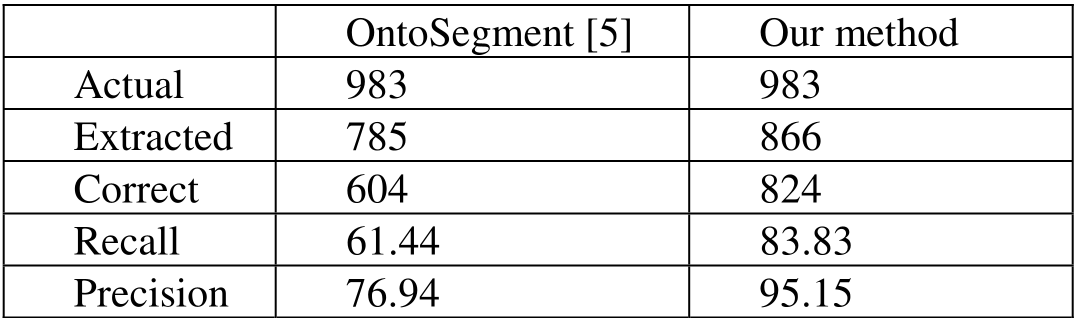 Figure 1: Comparison of the proposed method against OntoSegment [5].
Experimental Results
The researchers tested their approach on 200 pages from deep web repositories. The results were stark:
- Recall: Jumped from 61.44% to 83.83%.
- Precision: Jumped from 76.94% to 95.15%.
The key to this success was the system's ability to ignore visual boundaries and instead focus on contextual information surrounding images. If the text surrounding an image is semantically related to the image's meta-data, the segment is classified as informative.
Deep Insight & Conclusion
This paper proves that ontologies are a powerful antidote to HTML ambiguity. By leveraging multilingual WordNet, the researchers solved a major pain point in web mining: the ability to process the 20% of the web that isn't written in English without losing semantic accuracy.
Limitations & Future Outlook
While the method is highly accurate, the paper notes that WordNet's multilingual implementation requires specific mapping for different syntaxes (e.g., Chinese vs. English). Future research might look into LLM-based embeddings to replace manual WordNet similarity checks, potentially automating the mapping process even further while maintaining the semantic-first philosophy established here.
Takeaway
For developers in web scraping and data mining, the message is clear: Context is King. Moving from tag-based extraction to semantic-based clustering is the most viable path to high-precision data harvesting in a multilingual world.