
Beyond the "Like": Deciphering Relationship Strength in WeChat's Private Ecosystem
Relationship strength estimation based on Wechat Friends Circle
This paper introduces a general framework for estimating relationship strength specifically tailored for WeChat Friends Circle (Moments). By integrating user profile similarity, WeChat Subscription interests, and interaction frequency, the researchers achieved significantly higher accuracy in tie-strength calculation compared to existing models.
TL;DR
WeChat is a unique "black box" for social scientists. Unlike Twitter or Facebook, you can't see the whole world—only your mutual friends. This paper presents a novel framework to calculate how close two users actually are by analyzing their profile overlaps, their shared WeChat Subscription interests, and the frequency of their "Likes" and "Comments" within specific topical circles.
The "Mutual Friend" Problem
The fundamental challenge in WeChat's Friends Circle (Moments) is its privacy model. In a standard social graph, we can see the global degree of connectivity. In WeChat, the visibility of an interaction is contingent upon being a mutual friend. This "uniqueness" renders traditional global graph algorithms nearly useless.
The authors argue that a single strength score isn't enough. Relationships are contextual—you might have a "strong tie" with someone in the context of "Food" (sharing restaurant reviews) but a "weak tie" in "Work."
Methodology: A Three-Tiered Approach
The proposed framework operates through a pipeline designed to handle sparsity and privacy:
1. Relationship Circle Division
Using a Traversal Method, the algorithm starts with a target user and clusters friends into circles. If Friends A and B both interact with Target User T and also with each other, they form a cohesive "Relationship Circle."
2. Semantic Activity Mapping
Instead of treating all interactions as equal, the model assigns each circle to an Activity Area. By extracting keywords and using semantic distance (based on WordNet/Ontology), circles are categorized into topics like Medical, Education, Travel, or Shopping.
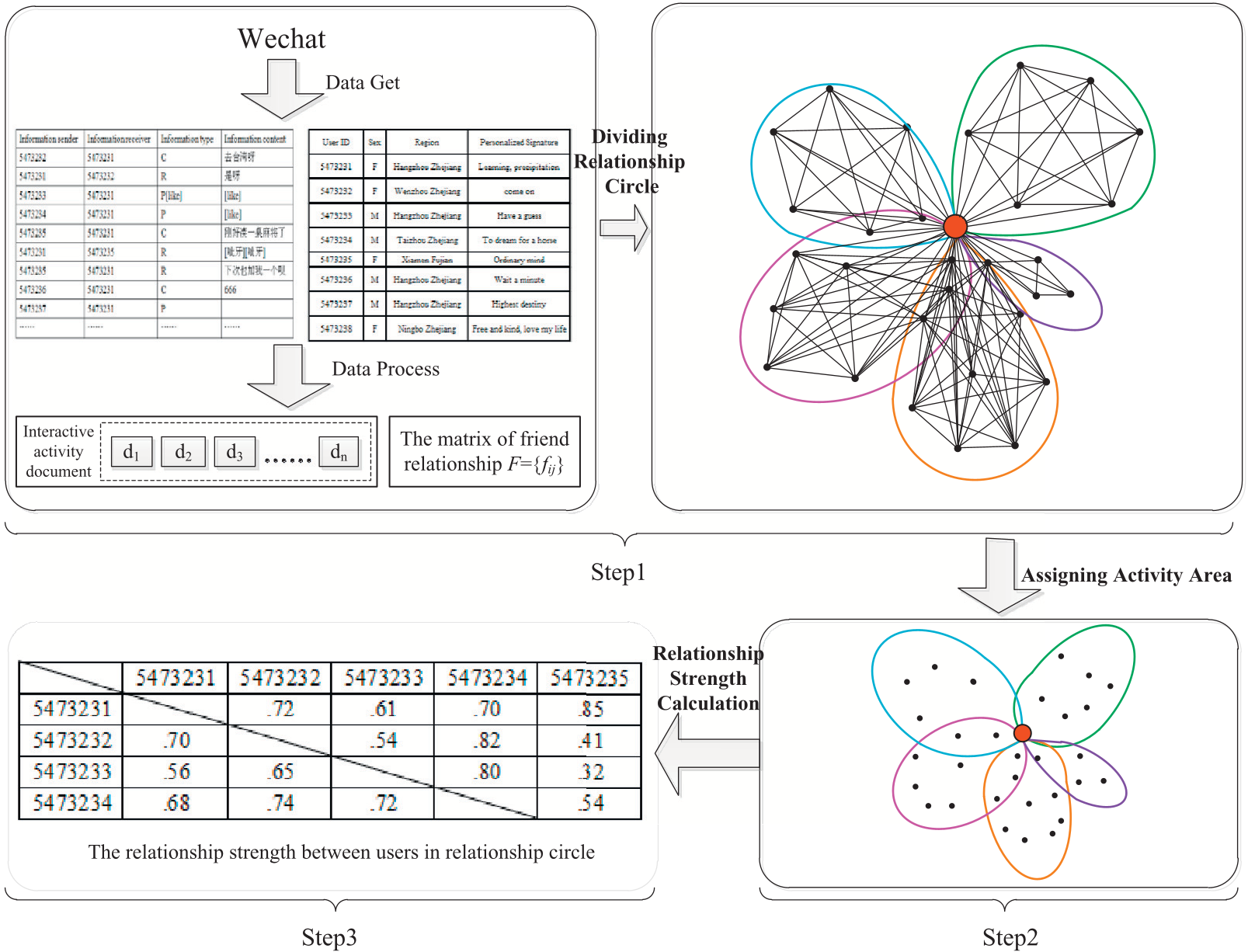
3. The Weighted Strength Formula
The core innovation lies in the fusion of three distinct data vectors:
- Profile Information (PI): Categorical similarity (Gender, Region).
- WeChat Subscriptions: A proxy for latent interests. If two users follow the same niche "public accounts," their tie is naturally stronger.
- Interaction Frequency (IF): The raw count of Likes, Comments, and Collections.
The final Relationship Strength () is calculated as:
Experimental Results: Precision and Recall
The researchers manually labeled 1,237 relationships to create a ground-truth dataset. When compared against WSNG (Weighted Social Network Graphs) and LVM (Latent Variable Models), the proposed framework showed a massive leap in performance.
| Method | Precision | Recall |
|---|---|---|
| WSNG | 0.446 | 0.305 |
| LVM | 0.452 | 0.350 |
| Our Method | 0.679 | 0.531 |
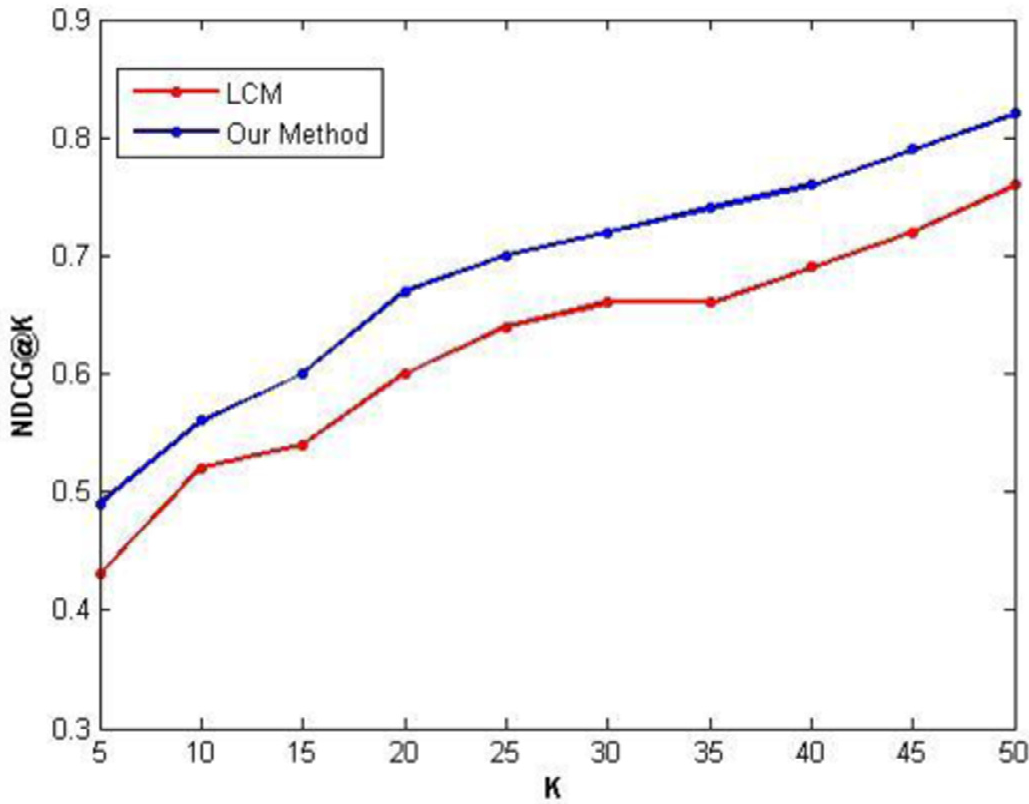
As shown in the comparison graph below, the proposed method consistently provides higher Disconnected Cumulative Gain (nDCG) across various friend ranks, proving that the ranking of "strongest friends" is much closer to human intuition.
Critical Insight: Why Subscriptions Matter
The most profound takeaway is the role of WeChat Subscriptions. In an era where "active interaction" (commenting) is rare, "passive interest" (following the same accounts) is a powerful, low-noise signal for relationship strength. By using squared Euclidean distance to measure the gap between users' subscription lists, the model captures a form of Homophily that surface-level interactions miss.
Summary & Future Outlook
This work provides a robust blueprint for calculating relationship strength in high-privacy environments. While effective, the model's reliance on manual weight setting () via the Analytic Hierarchy Process (AHP) could be a limitation. Future iterations could leverage Deep Learning to automatically learn these weights from longitudinal data.
For developers and marketers, this study opens doors for Precision Marketing—identifying the "influencers" in a user's specific activity circle rather than just counting their total number of friends.