
The "Always-On" Challenge: How WeChat’s Traffic Profile Strains Mobile Networks
WeChat traffic profile and impact on mobile networks
This paper presents a comprehensive empirical study of WeChat's traffic profiles and their impact on 3G mobile networks. Using a specialized experimental testbed, researchers from Ericsson analyze core services like instant messaging and VoIP, revealing how application-layer behaviors trigger excessive Radio Resource Control (RRC) signaling.
TL;DR
This research by Ericsson provides a deep dive into the traffic signatures of WeChat—a powerhouse social app with over 600 million users at the time of study. By analyzing text, voice, and live chat services, the authors expose a critical reality: the app’s background "heartbeats" and small-packet bursts create a massive signaling burden on 3G networks, particularly on Android devices, compared to the more optimized notification handling on iOS.
Context: The Signaling Storm
In the era of 3G and early 4G, mobile operators faced a new enemy: the "Chatty" application. Unlike a browser that loads a page and goes silent, social apps maintain persistent connections to ensure instant message delivery. This paper investigates the disconnect between high-level user activity and the underlying Radio Resource Control (RRC) state machine, which governs how a phone talks to the base station.
Methodology: Under the Microscope
To bridge the gap between application behavior and network signaling, the researchers built a dedicated lab environment. They monitored two specific points:
- The Mu Interface: Capturing high-priority signaling between the Radio Network Controller (RNC) and the phone.
- The Gi/Mi Interface: Monitoring the actual user data packets.
By comparing an Android (Galaxy S2) and an iOS (iPhone 4S) device running WeChat 4.5.0, they could isolate how Operating System (OS) implementation affects network health.
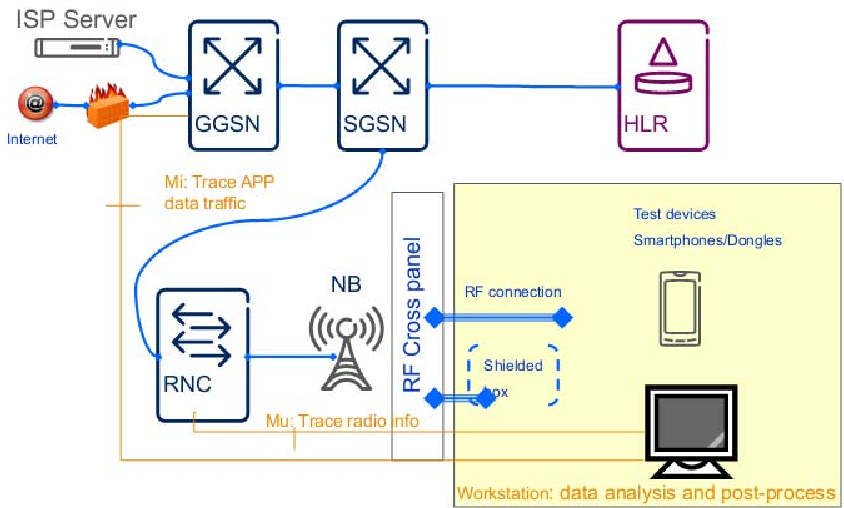 Fig 1: The experimental setup used to correlate application packets with RRC signaling.
Key Insights: Android vs. iOS
The study reveals a stark contrast in "Idle" behavior:
- Foreground Persistence: In the foreground, both devices send periodic "keep-alive" messages. However, Android pings every 180s, while iOS pings every 270s.
- The Background Gap: When moved to the background, the iPhone stops sending independent heartbeats by leveraging the Apple Notification Service (APNs). The Android device continues its 180s ping cycle, staying in a high-power RRC state longer and generating constant signaling traffic.
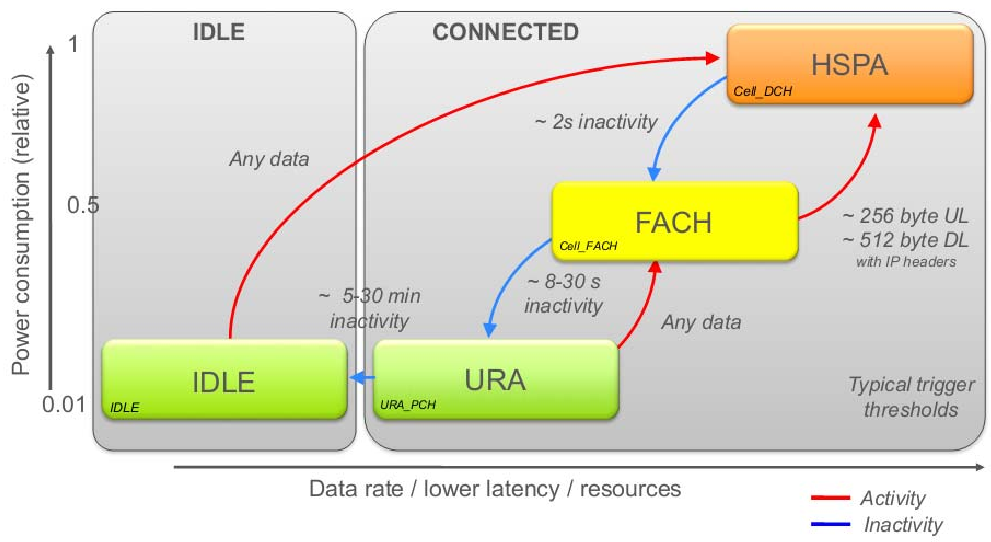 Fig 2: The complex UMTS RRC state machine. Each jump from IDLE to HSPA requires ~30 signaling messages.
The Efficiency Paradox of Small Packets
The research highlights three problematic service profiles:
1. The High Cost of "Hello"
For small text messages, the overhead is staggering. Sending a single character requires approximately 10-12 IP packets. The study found that the average packet size remains between 300-400 bytes regardless of message length, meaning larger messages are actually more "efficient" from a network perspective.
2. Group Chat "Chatter"
In a 5-person group voice chat, the network experiences constant UL/DL bursts. For Android, every burst triggers a transition between HSPA and IDLE, the most signaling-heavy transition possible. 80% of these packets are "small packets" (<300 bytes), which provide poor transmission efficiency against the control channel overhead.
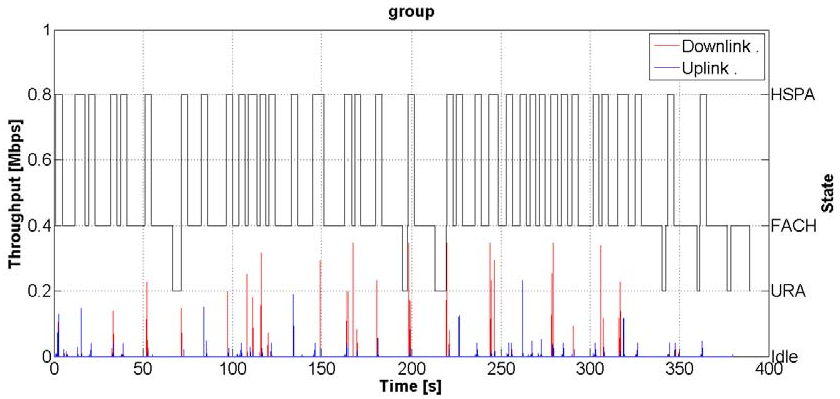 Fig 3: Analysis of text message size vs. traffic volume and packet count.
3. Live Chat (VoIP) Dynamics
Unlike traditional VoIP (like Skype) which maintains a constant flow, WeChat's half-duplex "Live Chat" is intermittent. This causes frequent RRC state switching during a single session, further taxing the network's processing resources.
Critical Analysis & Future Outlook
The authors conclude that solving the "WeChat problem" requires a multi-pronged approach:
- Application Layer: Developers should adopt lightweight protocols (like MQTT or CoAP) to reduce packet counts for simple messages.
- OS Layer: Unified notification services (like APNs) are essential to prevent every app from running its own background timer.
- Network Layer: Operators must tune Inactivity Timers—the time the network waits before moving a user to a lower power state—to balance battery life vs. signaling load.
While this study focuses on 3G (UMTS), the fundamental tension between "Instant Experience" and "Network Signaling" remains a cornerstone of 5G optimization today. As we move toward 6G, the lessons learned from the "Chatty" apps of the 2010s will continue to inform how we manage massive machine-type communications and the Internet of Things.