
Experts vs. The Crowd: Improving Stock Market Prediction via Verified Financial Authority
Do Weibo Platform Experts Perform Better at Predicting Stock Market?
This paper introduces a sentiment-based stock market prediction framework that differentiates between "Authorized Financial Advisors" (AFA) and "Unauthorized Financial Advisors" (UFA) on the Weibo platform. By combining BERT for sentiment classification and LSTM for time-series forecasting, the study achieves a peak prediction accuracy of 87.0% for the Hang Seng Index.
TL;DR
Not all tweets (or Weibo posts) are created equal. This research demonstrates that by filtering social media sentiment through the lens of professional certification, we can boost stock market prediction accuracy to 87%. Using a combination of BERT and LSTM, the study proves that authorized financial experts provide a signal that is nearly 40% more precise than the general public.
The "Noise" Problem in Sentiment Analysis
The "wisdom of the crowd" is a common trope in social media analytics. However, in the high-stakes world of the stock market, the "crowd" is often driven by panic, hype, and a lack of fundamental understanding. Previous SOTA models like SVM or word2vec-based LSTMs have tried to predict market moves by aggregating sentiment from everyone, yet they often hit a "glass ceiling" of accuracy (~50-67%) because the expert signal is drowned out by retail noise.
Methodology: The BERT-LSTM Hybrid
The researchers utilized the Weibo platform—China's equivalent to X (Twitter)—because of its robust professional verification system. They categorized users into Authorized Financial Advisors (AFA) and Unauthorized Financial Advisors (UFA) based on their certification status.
The technical pipeline involves two sophisticated stages:
- Sentiment Extraction (BERT): A pre-trained Chinese BERT model was fine-tuned on 10,000 labeled Weibo comments to classify posts as positive (anticipating a rise) or negative (anticipating a fall).
- Time-Series Forecasting (LSTM): Since social sentiment usually precedes market moves, the authors calculated a Pearson’s correlation to find the optimal "Time Window" (T). They discovered that the sentiment signal has the strongest impact approximately 12 days before the price change.
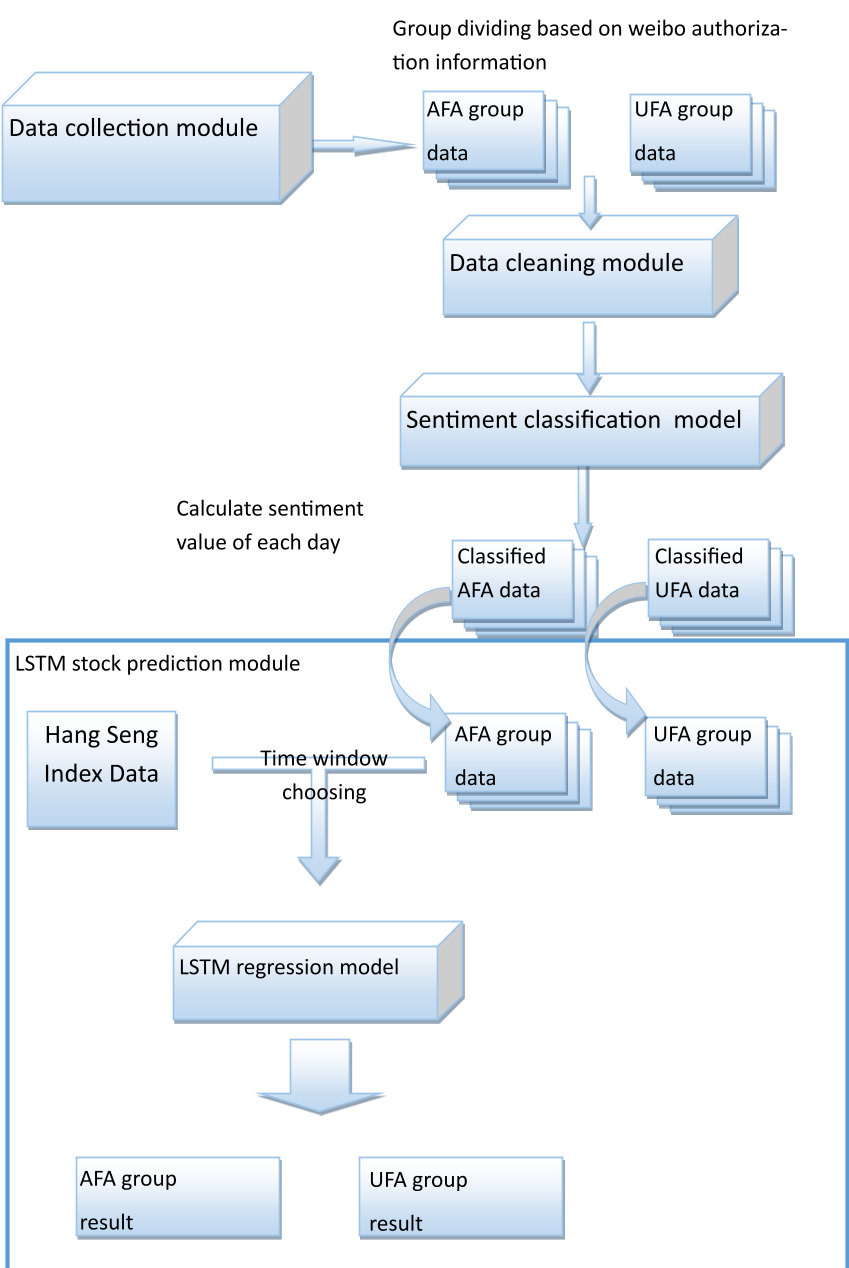 Figure 1: The system architecture showing the flow from data collection to LSTM-based price prediction.
Key Findings: The Power of Authority
The results were striking. While the general public (UFA) had some correlation with market trends, the professionals (AFA) were far more reliable indicators.
- Precision Advantage: The AFA group achieved a precision of 90.15%, compared to just 64.64% for the UFA group.
- Trend Prediction: The AFA group showed a peak accuracy of 87% when predicting the Hang Seng Index, surpassing previous models using SVM or kNN by a wide margin (often over 20% improvement).
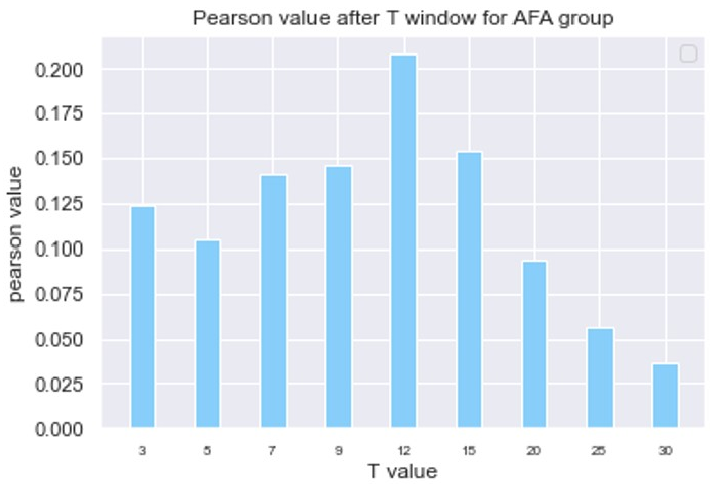 Figure 2: Analysis of the 12-day time lag (T) showing higher correlation peaks for the AFA group.
Critical Insight: Why Does This Work?
The study highlights two major takeaways for the AI and Finance community:
- Expert Signal Quality: Professional advisors likely base their posts on fundamental analysis and policy shifts rather than emotional reactions. This results in a cleaner "lead indicator" for AI models.
- Self-Fulfilling Prophecies: The authors admit a fascinating possibility—because these advisors are "authenticated," their large follower bases might actually move the market in the direction they predict, creating a feedback loop that the LSTM successfully captures.
Strategic Conclusion
For developers building financial LLMs or trading bots, the message is clear: Weight your data sources. A single post from a certified advisor may be worth more than a thousand posts from unverified accounts. Future iterations of this work could refine this further by distinguishing between government-level experts and individual private professionals.
Academic Comparison
| Approach | Data Source | Accuracy |
|---|---|---|
| kNN (1888) | Hang Seng | 53% |
| SVM (2016) | 67% | |
| Word2Vec+LSTM (2019) | Shanghai Comp | 66% |
| This Work (BERT+LSTM AFA) | Weibo (Verified) | 87% |
Disclaimer: This blog post summarizes academic research and does not constitute financial advice.