
Weighted Feature Fusion: Elevating Emotion Recognition in Variable-Length Speech
Weighted Feature Fusion Based Emotional Recognition for Variable-length Speech using DNN
The paper proposes a Speech Emotion Recognition (SER) model for variable-length speech using a CNN-BLSTM architecture. It introduces a novel weighted feature fusion mechanism that combines CNN-extracted spectral features with hand-crafted Chroma features, achieving state-of-the-art results on the IEMOCAP dataset.
TL;DR
Recognizing emotions in speech is notoriously difficult because human utterances vary in length and emotional cues are often subtle. This paper introduces a CNN-BLSTM framework that solves this by fusing spectrogram-based deep features with Chroma features (musical/pitch representations) using a novel learnable weighting mechanism. The result? A massive 10.43% boost in accuracy on the IEMOCAP benchmark compared to previous state-of-the-art methods.
The Problem and Motivation: Why fixed-length models fail
Traditional Speech Emotion Recognition (SER) systems often cut speech into fixed-length segments. This is a "one-size-fits-all" approach that kills the natural context of a sentence. Furthermore, modern deep learning research has moved toward using raw spectrograms via CNNs, often discarding classic "hand-crafted" features.
The authors observed a critical gap: Chroma features, which map energy into 12 musical scales, are highly correlated with human pitch and emotion (e.g., "excitement" shows distinct patterns in specific frequency levels). By ignoring these, models lose vital "pitch evolution" data. The challenge is: how do we combine these different feature types effectively when their importance varies?
Methodology: The Power of Weighted Fusion
The proposed architecture consists of two main pillars:
- Feature Extraction: A dual-layer CNN extracts spatial features from the log power spectrum, while Chroma features are extracted and normalized to represent pitch distribution.
- Temporal Modeling: A 2-layer Bidirectional LSTM (BLSTM) is used instead of a standard GRU. Because BLSTM processes data in both forward and backward directions, it captures context from the "future" and "past" of an utterance, which is crucial for variable-length speech.
The Core Innovation: Learnable Weights
Instead of simply concatenating features (), the authors introduce weight coefficients and : These coefficients are not fixed; the network learns them during backpropagation. This allows the model to decide, based on the data, how much it should trust the deep CNN features versus the hand-crafted Chroma features.
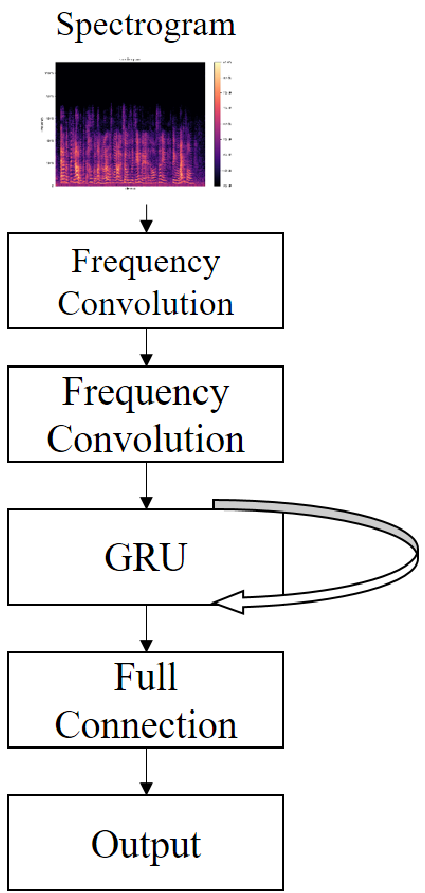 Fig 1. The CNN-BLSTM structure showing the integration of different feature streams.
Experiments & Results: Crushing the Baseline
The model was tested on the IEMOCAP dataset, the gold standard for SER.
Performance Jump
Compared to the CNN-GRU baseline, the results were definitive:
- Weighted Accuracy (WA): Increased from 68.72% to 79.15%.
- Unweighted Accuracy (UA): Increased from 67.04% to 70.92%.
Ablation Study: Model Depth Matters
The study proved that both the fusion and the architecture depth were necessary. Adding a second BLSTM layer provided a better hidden representation of emotional information than single-layer models.
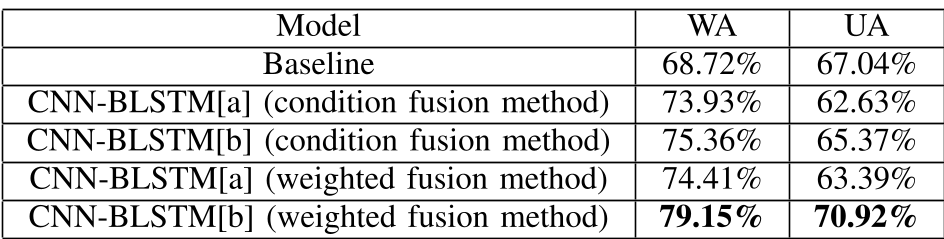 Table 1. Performance comparison between different fusion strategies and the baseline.
Critical Analysis & Conclusion
Takeaway
The synergy between deep learning (raw data processing) and domain expertise (Chroma features for pitch) is the secret sauce here. By allowing the network to weight these features, the researchers bypassed the "black box" limitation of using only spectrograms.
Limitations & Future Work
Despite the success, the "Happy" emotion remains difficult to classify, often being confused with "Neutral" or "Angry" due to high arousal. The authors suggest that future work could involve even deeper networks or specialized features specifically designed to distinguish high-arousal happy states from other emotions.
Conclusion
This work demonstrates that even in the age of "end-to-end" deep learning, intelligently re-introducing hand-crafted features through a learnable fusion layer can provide substantial performance gains in specialized fields like affective computing.