
From Tweets to Wellness: Jointly Modeling Heterogeneity and Temporality in Social Media
Wellness Representation of Users in Social Media: Towards Joint Modelling of Heterogeneity and Temporality
The paper introduces a novel representation learning framework for User Wellness from social media data. It proposes a Personalized Latent Space (PLS) model that factorizes longitudinal Patient Generated Wellness Data (PGWD) into shared and personalized latent components, achieving SOTA performance in attribute prediction and patient clustering.
TL;DR
Social media is a goldmine for Patient Generated Wellness Data (PGWD), but it's messy, sparse, and inherently longitudinal. This paper proposes a Personalized Latent Space (PLS) framework that treats user behavior not as a static vector, but as an evolving trajectory. By combining shared medical knowledge with personalized deviations and temporal smoothness, the authors achieve superior results in predicting diabetic health outcomes and user attributes.
Background: The Hidden Value of "Digital Exhaust"
Millions of users share their blood glucose levels, diet, and medication experiences on platforms like Twitter using hashtags like #bgnow. While valuable for personalized medicine, this data is a nightmare for traditional ML. It is longitudinal (requires repeated measures), incomplete (users don't post every day), and heterogeneous (a Type I diabetic lives differently than a Type II daily).
The Core Insight: Why Standard Embedding Fails
Traditional representation learning (like PCA or standard NMF) assumes data points are independent (i.i.d). In wellness, your state today is highly dependent on your state yesterday (Temporal Contingency). Furthermore, most models try to find one global "average" user, ignoring that individual variations in disease progression are the rule, not the exception (Heterogeneity).
Methodology: The PLS Framework
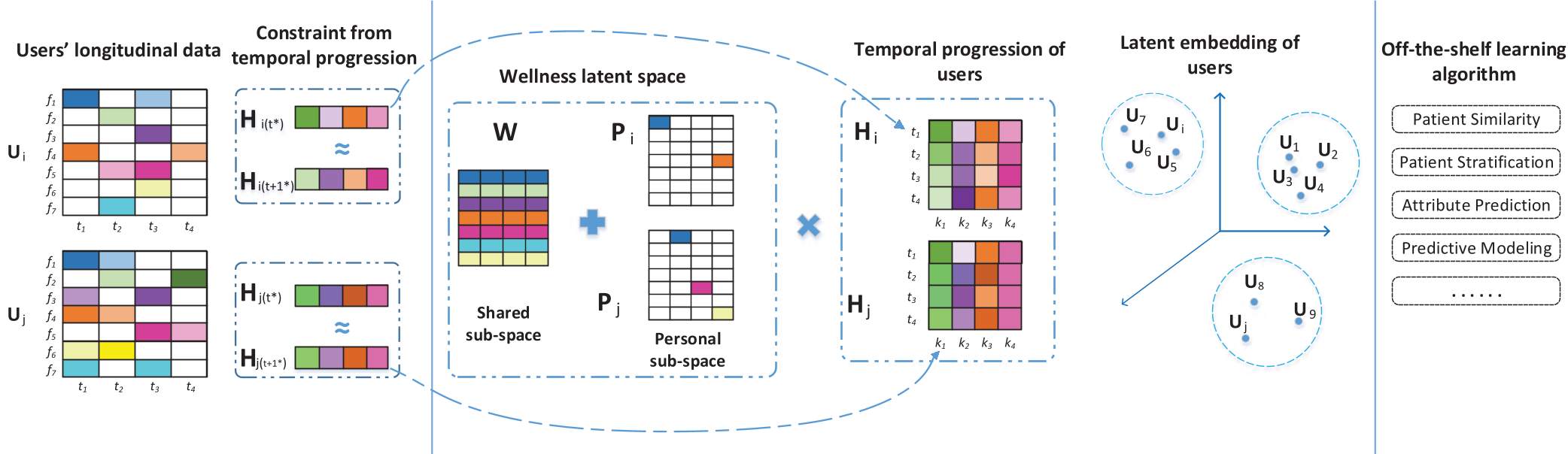
The authors solve this by factorizing the user's longitudinal data matrix into two specific components:
- The Wellness Latent Space (): A combination of a Shared Space () representing general medical concepts and a Personalized Space () capturing user-specific nuances.
- Temporal Progression (): A matrix representing how these latent concepts evolve over time for user .
Modeling Temporal Smoothness
To handle gaps in posting, the model introduces a Temporal Smoothness Indicator (). It penalizes sudden, unrealistic jumps in latent wellness states, effectively "imputing" missing data by assuming health trends change gradually.
Experiments and SOTA Comparison
The model was tested on two real-world datasets (Diabetes and BG datasets).
Key Findings:
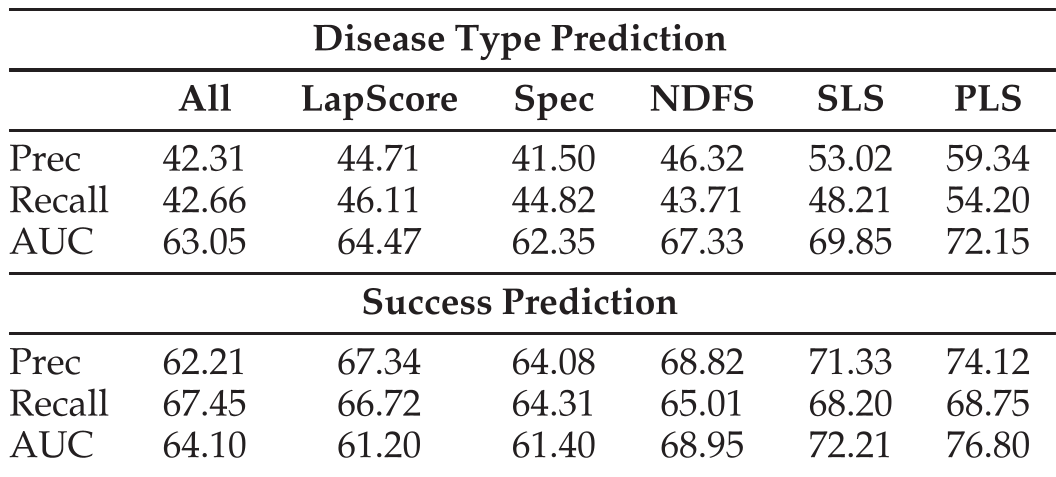
- Predictive Power: In predicting disease types (Type I vs Type II), the PLS model achieved a precision of 59.34%, significantly outperforming standard LapScore (44.71%) and NDFS (46.32%).
- The "Dirty Model" Advantage: By allowing personalized deviations (), the model captured specific medication signatures (e.g., Metformin for Type II) that a global model would have blurred.
- Success Prediction: The framework accurately predicted if a user would maintain healthy blood glucose levels with an AUC of 76.80%.
Critical Insight: Interpretability of Latent Dimensions
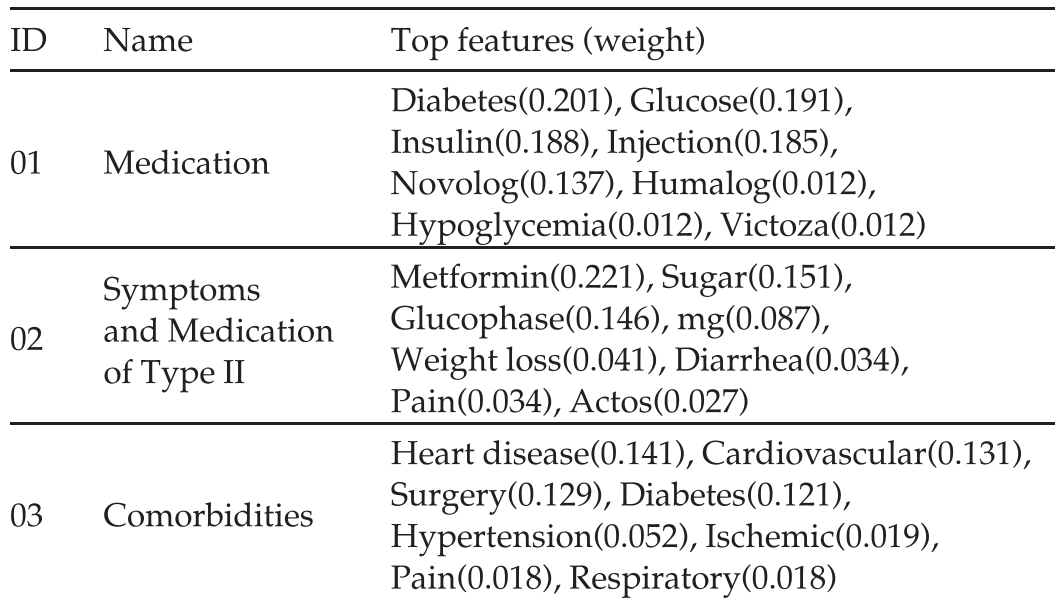
One of the strongest parts of this work is the interpretability of the learned dimensions. By mapping the latent weights back to original features, the authors identified clusters for "Medication," "Symptoms," and "Comorbidities." This allows the model to act as a "computational phenotype" generator, turning raw tweets into clinical insights.
Conclusion & Future Outlook
This paper proves that specialized architectures that respect the longitudinal nature of health are far superior to "black-box" vector embeddings. For future work, incorporating social network graphs (who follows whom) could further refine these embeddings by leveraging "community-based" wellness priors.
Takeaway for Practitioners: When dealing with patient data, don't just flatten time. Model the trajectory.