
What’s Happening and What Happened: A New Frontier in Social Search
What's Happening and What Happened: Searching the Social Web
The paper introduces a social-web search engine architecture that prioritizes "virality" over simple popularity to surface niche but high-quality content. By constructing diffusion trees from millions of tweets, the system identifies relevant links and provides a "wayback machine" feature to search historical social discourse.
TL;DR
Most search engines tell you what is "popular," but they rarely tell you why it matters or how it spread. This paper by Microsoft researchers introduces a search engine built atop the Twitter firehose that utilizes Structural Virality to surface high-quality content. By moving beyond raw click counts and focusing on how information moves from person to person, the system creates a searchable "Wayback Machine" for the social web that is surprisingly resilient to fake news.
The Problem: Popularity is a Poor Proxy for Value
In the rapid-fire ecosystem of social media, we face two main issues:
- The Popularity Trap: Trending algorithms prioritize "Broadcast" events—where a celebrity or news outlet tweets to millions. This ignores niche, high-quality stories that spread organically through communities.
- Ephemeral Memory: Once a topic stops trending, it effectively vanishes. We lack a robust way to search for what was "relevant" to the crowd on a specific day in the past.
The authors argue that the missing ingredient is the structure of the sharing, not just the volume.
Methodology: Mining Diffusion Trees
The core innovation lies in the transition from viewing a link as a "count" to viewing it as a Diffusion Tree.
1. Structural Virality vs. Broadcast
The researchers utilize the Weiner Index to quantify virality.
- Broadcast (Low Virality): One source → Many followers. The tree is shallow and wide.
- Viral (High Virality): User A → User B → User C. The tree is deep and branching.
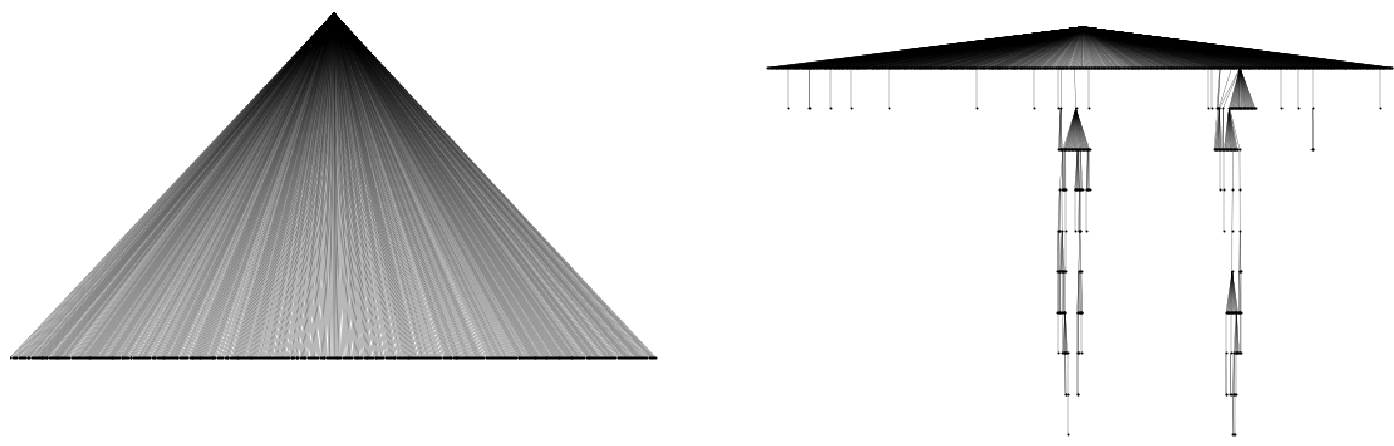 Figure: The tree on the left shows shallow broadcast diffusion; the tree on the right shows the multi-generational branching of true viral content.
2. The Trusted User Ring
To combat the noise and "Like Economy" manipulation, the system starts with a seed of Verified Users. It then expands this "Trust" to anyone who has had meaningful interactions with them, creating a multi-ringed safety net. Only links shared by at least one trusted user enter the pipeline, effectively filtering out most bot-driven spam.
Experimental Results: The Wayback Machine & Fake News
The researchers tested their "Wayback Machine" against the 2016 US Election timeline. By extracting top hashtags and links, the system achieved a 92-93% recall compared to manual Wikipedia timelines, capturing the "pulse" of the day with high precision.
The Fake News Filter (Accidental or Intentional?)
In a fascinating case study using BuzzFeed’s dataset of fake vs. real news, the researchers found that their Virality Filter (Step 3) was the most effective weapon against misinformation.
- Real news naturally creates deep, viral trees.
- Fake news often relies on sudden spikes or bot-amplified broadcasts, leading to low structural virality scores.
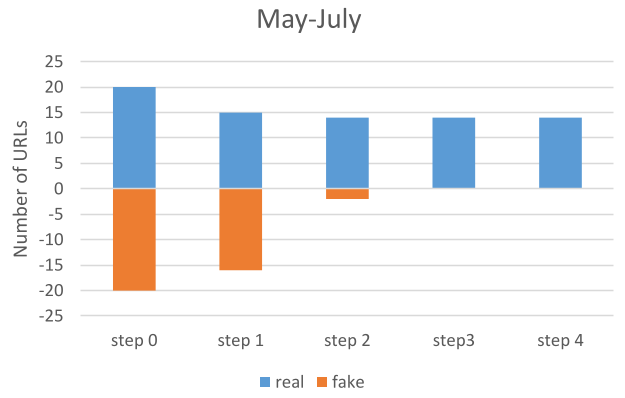 Figure: The chart shows how "Step 3" (Virality Computation) significantly prunes fake news links (orange) compared to real links (blue).
Critical Analysis & Takeaways
This work shifts the focus of social search from "What is the loudest?" to "What is the most contagious?".
Strengths:
- Scalability: The use of the SCOPE language and distributed clusters allowed them to process 227 million tweets down to the 1,000 most meaningful daily links.
- Insight: Demonstrating that structural virality is a natural filter for authenticity is a major contribution to the fight against misinformation.
Limitations:
- Latency: The current system is not strictly "real-time," as it waits for data to stabilize over a 24-hour window.
- Language: The scope was limited to English, which might behave differently in heterogeneous social clusters.
Closing Thought: As search moves toward AI-generated summaries, the source of truth becomes more critical. This paper provides a blueprint for an "Archive of Human Interest" that values the structure of human collaboration over the noise of the crowd.