
Digital Afterlife: Architecting an Integrated Framework for the Social Estate
What Happens to My Online Social Estate When I Am Gone? An Integrated Approach to Posthumous Online Data Management
The paper proposes an integrated framework for Posthumous Online Data Management, categorizing social media assets into four types (Donation, Legacy, Intellectual Property, and Destructible). It introduces a systematic approach for users to plan their digital afterlife, moving beyond simple account deletion or full ownership transfer.
TL;DR
As our lives become increasingly digitized, our "online social estate" grows in complexity. This paper argues that current OSN solutions (like Google’s Inactive Account Manager or Facebook’s Memorialization) are insufficient. The authors propose an integrated framework that uses data categorization and automated curation to manage post-mortem data according to the user's specific wishes, balancing privacy with the needs of the bereaved.
The Problem: The "Binary" Death of Digital Identities
In 2012 alone, Facebook hosted 20 million accounts belonging to deceased users. Yet, the industry standard for handling these accounts remains primitive. Current systems typically offer:
- Total Deletion: Erasing potentially valuable intellectual or sentimental history.
- Memorialization: Freezing an account, which often blocks heirs from accessing specific, desired assets (like photos) or forces them to see painful reminders.
The authors identify a fundamental flaw: Inheritance vs. Stewardship. Unlike physical property, digital data often represents an identity or a social interaction that shouldn't necessarily be "owned" by a survivor, but rather "stewarded."
Methodology: The Four Pillars of Digital Legacy
The core of the paper is a proposed framework that categorizes data into four distinct buckets, each requiring a different post-mortem lifecycle:
- Donation Data: Digital traces (e.g., shopping habits, health logs) donated to research or science.
- Legacy Data: Tangible digital assets (e.g., photo albums, e-books) intended for heirs (next-of-kin).
- Intellectual Property: Creative works (e.g., professional photography, code) where the user wants to maintain posthumous ownership via a "steward" who manages it under strict guidelines.
- Destructible Data: Highly private content (e.g., private messages, search history) that should be permanently deleted upon death.
The Proposed Architecture
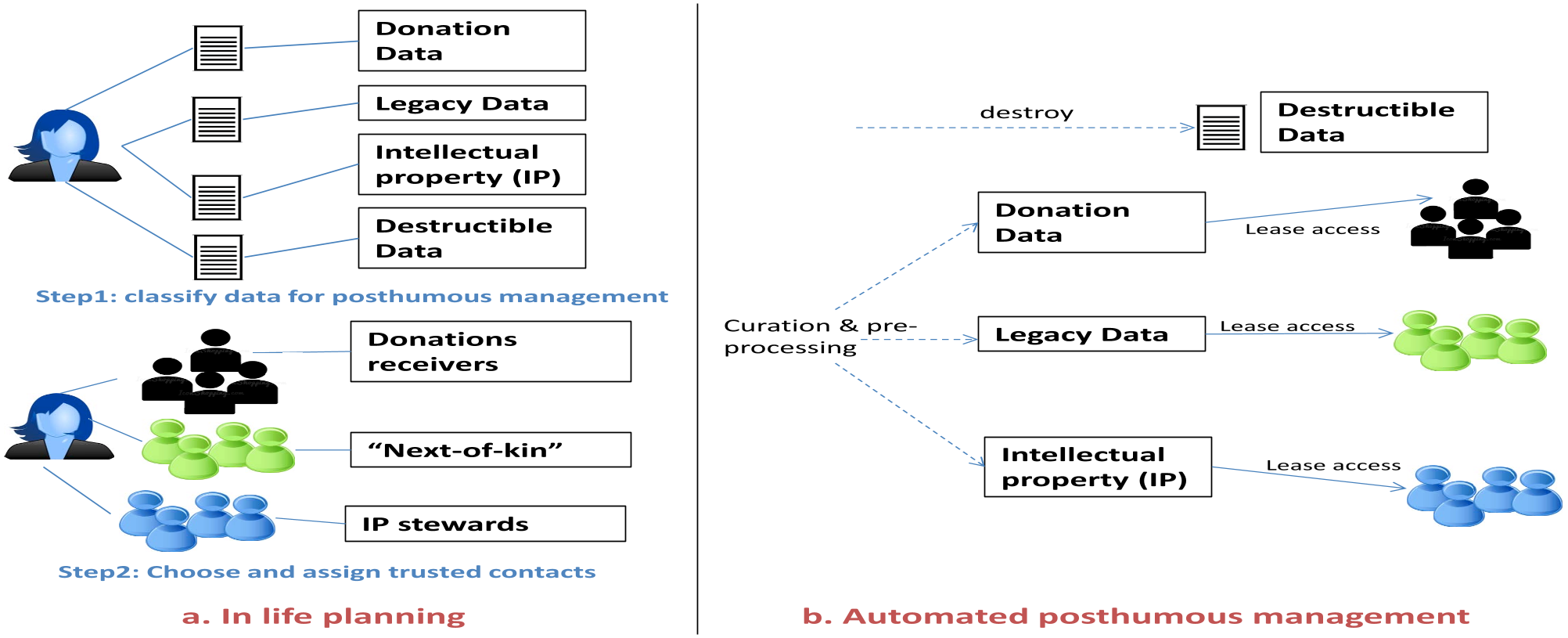 The framework spans two phases: Planning (while alive) and Execution (post-confirmation of death).
Challenges in Execution: How Does the System "Know"?
The paper delves into the high-stakes technical challenge of Timing and Confirmation. Relying solely on "Inactivity Periods" is risky—users might be hospitalized or temporarily offline.
The authors propose a Hybrid Approach:
- Behavioral Analysis: Using text mining to detect "grieving patterns" in how friends interact with the account.
- Automated Curation: Before leasing access to "Donation Data," the system must perform concealed curation—automatically anonymizing sensitive identifiers (names, locations) using NLP techniques like topic modeling (LDA).
Critical Insight: Stewardship over Ownership
The most profound contribution of this work is the shift toward Stewardship. In social data, "Inheritance" is often inappropriate because identities are non-transferable. A "Steward" acts as a mediator who respects the deceased's original social connections without occupying their identity. This recognizes that social interactions (like threads on a memorial wall) are living processes that continue after the individual is gone.
Conclusion & Future Outlook
While the paper focuses on centralized OSNs, it acknowledges the growing difficulty of managing posthumous data in decentralized (P2P) systems where no central authority exists to execute a "will."
Takeaways for Researchers:
- Inductive Bias for Deletion: Systems should be designed with "privacy by default" for post-mortem scenarios.
- Interoperability: There is a dire need for a universal protocol or standard that allows a user to set one "digital will" that propagates across all service providers (Facebook, Google, LinkedIn).
Ultimately, this work reminds us that as we build "Usable" and "Attractive" features for the living, the "Social Estate" of the deceased is a looming technical and ethical frontier that requires more than a simple "delete" button.