
AffectVec: Beyond Binary Sentiment — Inducing a Database for 239 Fine-Grained Emotions
What Sparks Joy: The AffectVec Emotion Database
This paper introduces AffectVec, a high-coverage emotion database providing graded intensity scores for over 76,000 English words across a fine-grained inventory of 239 emotion categories. By utilizing a sentiment-aware vector space modification technique, the authors induced interpretable affective vectors that significantly outperform existing lexicons like EmoLex and DepecheMood in both intrinsic human correlations and downstream text classification tasks.
TL;DR
Researchers from Rutgers University have developed AffectVec, a massive emotion database that provides graded intensity scores for over 239 distinct emotions across 76,000+ words. By modifying standard neural vector spaces to be "sentiment-aware," they created a tool that outperforms existing lexicons in describing the subtle emotional "sparks" inherent in human language.
Problem: The Limits of Binary Emotion
In the world of Affective Computing, we've long relied on simple models like Plutchik’s wheel (8 basic emotions) or Ekman’s 6 universal expressions. However, human language is far more nuanced. Existing lexicons like EmoLex often use binary tags—either a word is "joyful" or it isn't. This fails to capture that "elated" is more intense than "cheerful," or that "alertness" has a much weaker tie to "fear" than "terror" does.
Standard word embeddings (word2vec, GloVe) also struggle here. In a raw GloVe space, "sadness" and "happiness" are quite close because they share similar distributional contexts. Using raw cosine similarity to measure emotion would lead to the absurd conclusion that "sadness" is highly associated with "happiness."
Methodology: Engineering a Sentiment-Aware Space
The core innovation of this paper is a vector space modification technique. The authors argue that while distributional word vectors capture semantic relatedness, they don't inherently respect affective boundaries.
1. The Optimization Objective
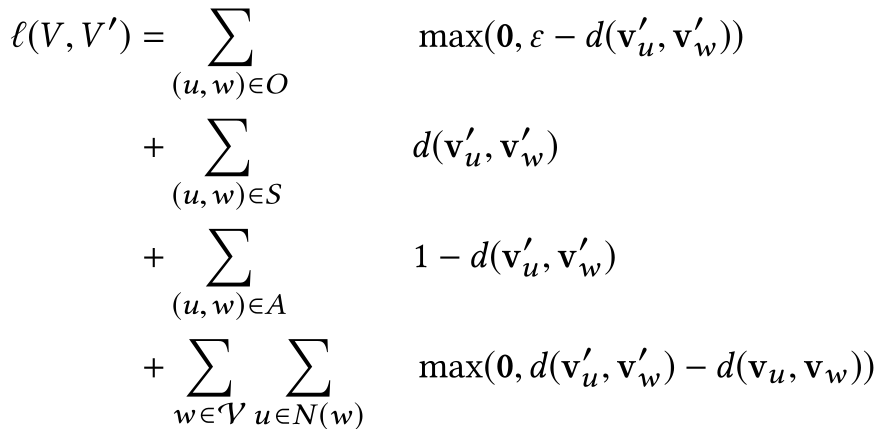
They introduce a loss function that applies "soft constraints" to the vector space:
- Polarity Separation: Words with opposite sentiment (e.g., "awesome" vs. "sadness") are pushed apart.
- Synonym/Antonym Alignment: Drawing from WordNet and PPDB, synonyms are pulled together while antonyms are pushed apart.
- Space Preservation: A regularization term ensures the new vectors don't drift too far from the original semantic relationships.
2. Creating Interpretable Vectors
Once the space is modified, an AffectVec for a word is generated by calculating the cosine similarity between that word and 239 specific "anchor" emotion words. This transforms a dense, opaque vector into one where each dimension has a clear meaning (e.g., the "Anger" dimension or the "Melancholy" dimension).
Experiments: Proving the "Spark"
Intrinsic Evaluation
The authors compared AffectVec against human-annotated ground truth (NRC Affect Intensity Lexicon). The results were striking: AffectVec achieved a 0.551 Pearson correlation, far surpassing traditional lexicons and even "counter-fitted" vectors.
| Method | Overall Correlation |
|---|---|
| EmoLex (Crowdsourced) | 0.066 |
| DepecheMood++ | 0.191 |
| AffectVec (Our Method) | 0.551 |
Downstream Impact
By concatenating AffectVec to standard embeddings in a CNN-LSTM architecture, the researchers saw a massive jump in text-level emotion intensity prediction. In some cases, the correlation with human judgment improved by over 20%.

Deep Insight: Why It Works
The success of AffectVec lies in its Inductive Bias. By explicitly forcing the vector space to respect valence (positive vs. negative sentiment), the model learns to disentangle "semantic relatedness" from "affective similarity." It recognizes that while "hot" and "cold" are related to temperature, they occupy opposite emotional poles in many contexts.
Conclusion & Future Outlook
AffectVec proves that "Big Data" co-occurrence patterns contain deep emotional signals—we just need the right mathematical lens to extract them. While the current model is limited to English and individual words, its success in unsupervised classification suggests it could be a powerful tool for analyzing social media trends or mental health indicators where labeled training data is scarce.
Takeaway: Future NLP models should move beyond sentiment polarity (Positive/Negative) toward these high-dimensional affective spaces to truly understand human intent.