
WhatsUpNow: Redefining Urban Social Apps with P2P Ambient Sensing
WhatsUpNow: urban social application with real-time peer-to-peer ambient and sensory data exchanges
The paper introduces WhatsUpNow, an urban social application designed for real-time sharing of ambient multimedia and sensory data in Peer-to-Peer (P2P) Mobile Ad Hoc Networks (MAHNE). It implements a decentralized architecture leveraging a novel replication-based caching strategy and intuitive one-handed visualization metaphors to provide "up-to-the-minute" venue information, significantly outperforming the COACS baseline in query latency.
TL;DR
WhatsUpNow is a pioneering urban social application that moves beyond static star ratings by allowing users to share real-time sensory data (noise, light, temperature) via a Peer-to-Peer (P2P) network. By introducing a replication-based caching strategy into Mobile Ad Hoc Networks (MAHNE), the system slashes query latency compared to previous SOTA methods like COACS, making "up-to-the-minute" urban exploration a reality.
Context: Beyond the Five-Star Scale
Why do we still rely on reviews from three months ago to decide where to go tonight? The authors argue that current social platforms are limited by static historical data. For a tech-savvy user, the "vibe" of a place—the crowd density, the music volume, or even the current temperature—is more valuable than a stale rating. However, capturing and distributing this "ambient data" in real-time without relying on a central server in a crowded urban environment presents a massive networking challenge.
The Problem: The Latency of Single-Copy Caching
In Mobile Ad Hoc Networks (MANETs), mobile devices act as both clients and routers. Previous strategies like COACS (Cooperative and Adaptive Caching System) established a framework for caching queries and data. However, COACS had a fatal flaw: it allowed only one copy of a data item in the network. If the node holding that data was 10 hops away, the user faced significant delays.
Methodology: Dynamic Replication and Peripheral Visualization
WhatsUpNow solves this through a three-pronged approach:
1. The Caching Strategy (The "How")
The researchers introduced a Service Manager (SM) node that calculates the optimal number of Query Directories (QD) based on network density. Crucially, they enabled multi-copy replication. If a node requests data and finds it several hops away, it doesn't just display it—it caches a new copy locally if it meets a "Threshold_RN" distance requirement. This effectively brings popular data closer to the users who need it.
2. Service Discovery
The architecture uses cluster heads as lookup directories, integrating Quality of Service (QoS) metrics to ensure a requesting node (RN) connects to the provider offering the best performance.
3. Ambient Visualization
To avoid cognitive overload, the GUI uses a "Glowing Clock" metaphor.
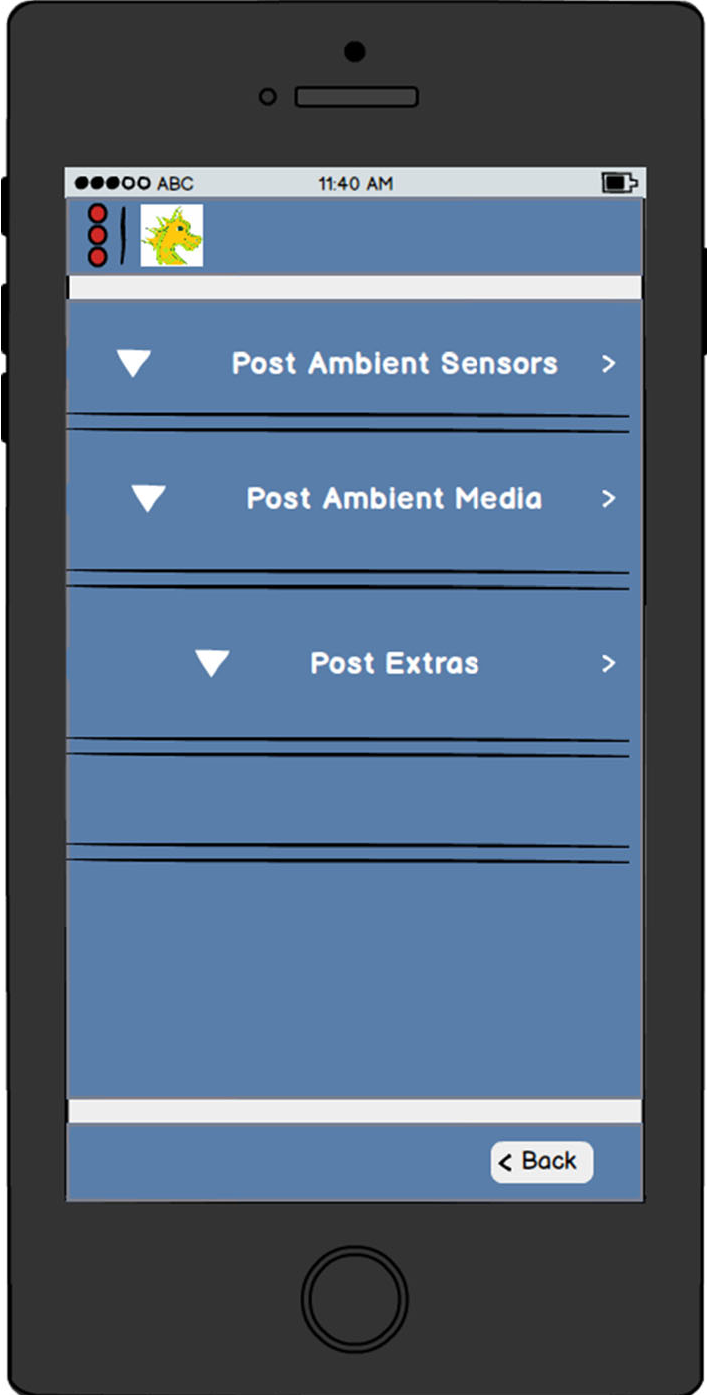 Figure: The Request View utilizing a clock metaphor with a glowing Red-Yellow-Green (RYG) band to represent sensory data intensity across time intervals.
Experimental Results
Using NS2 (Network Simulator 2), the authors compared WhatsUpNow against COACS and a "No Cache" baseline.
- Latency: The replication strategy significantly outperformed COACS in average query delay. As the cache size for QD nodes increased, the latency dropped further because more copies were available.
- Hit Ratio: While there is a slight trade-off in query replacement, the hit ratio reclaimed efficiency through a dual LFU (Least Frequently Used) and LRU (Least Recently Used) replacement policy.
- Bandwidth: By resolving requests at the nearest neighbor rather than traversing the entire directory list, bandwidth consumption per node was minimized.
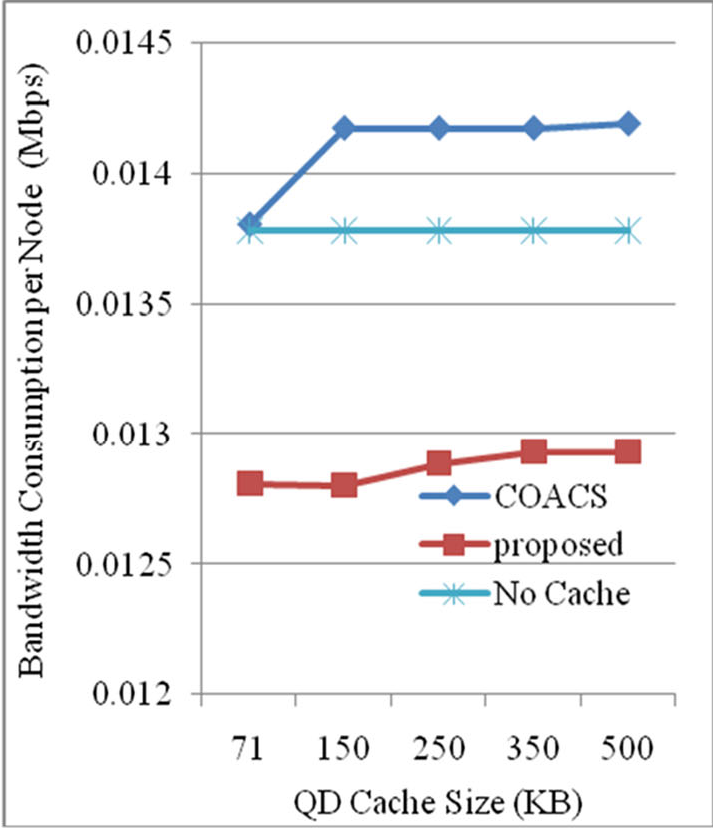 Figure: Impact of QD cache size on average query delay (left) and bandwidth consumption (right).
Critical Insight: The Value of "Ephemeral" Data
The brilliance of WhatsUpNow lies in its recognition that sensory data is temporally sensitive. Unlike a Wikipedia page, a noise-level reading from a bar is only useful for about 30 minutes. By optimizing the network for these short-time intervals and using a P2P structure, the authors bypass the bottleneck of centralized cloud uploads, providing a truly "tangible" social experience.
Conclusion & Future Work
WhatsUpNow demonstrates that high-performance P2P networking can enable entirely new categories of social interaction. While the current simulation assumes a Random Waypoint mobility model, future versions will likely explore more realistic urban movement patterns and integrate historical "Big Data" analytics for yearly urban trend reporting.
Takeaway: Real-time urban intelligence isn't just about faster internet; it's about smarter, localized data distribution.