
Wheeling Around WantEat: Turning Gastronomy into a Social Web of Things
Wheeling around with Wanteat: exploring mixed social networks in the gastronomy domain
WantEat is a pervasive computing framework and suite of applications designed to explore a "Social Web of Things" within the gastronomy domain. It utilizes a novel "Wheel" interaction model to connect users with smart objects (food products), producers, and territories, effectively transforming cultural heritage into an interactive social network.
TL;DR
WantEat is an innovative framework that treats food items (like cheese or wine) as "Smart Objects" within a mixed social network. By using a unique Wheel-based UI, it allows tourists and foodies to "talk" to products, discover their origins, and see how they relate to other people and recipes. Evaluated by over 600 users, it bridges the gap between the physical world of gastronomy and the digital Social Web.
Background Positioning
Published at IUI '12, this work is a seminal exploration of the Social Web of Things (SWoT). It moves beyond simple IoT (Internet of Things) connectivity to incorporate social dynamics, where objects have histories, reputations, and relationships. It sits at the intersection of Mobile HCI, Semantic Web, and Cultural Heritage.
Problem & Motivation: Why Should an Apple have a Social Life?
Most food apps are practical: "How many calories are in this?" or "What is the nearest restaurant?" The authors argue that this overlooks the cultural weight of food. In regions like Italy, a piece of Pecorino isn't just a product; it’s a node in a network of producers, historical territories, and pairing traditions.
The challenge was twofold:
- Infrastructure: Traditional IoT often requires RFID or QR codes, which many local artisans don't use.
- Interaction: Traditional list-based interfaces fail to represent the "web" of connections between a product and its surroundings.
Methodology: The "Wheel" Interaction Model
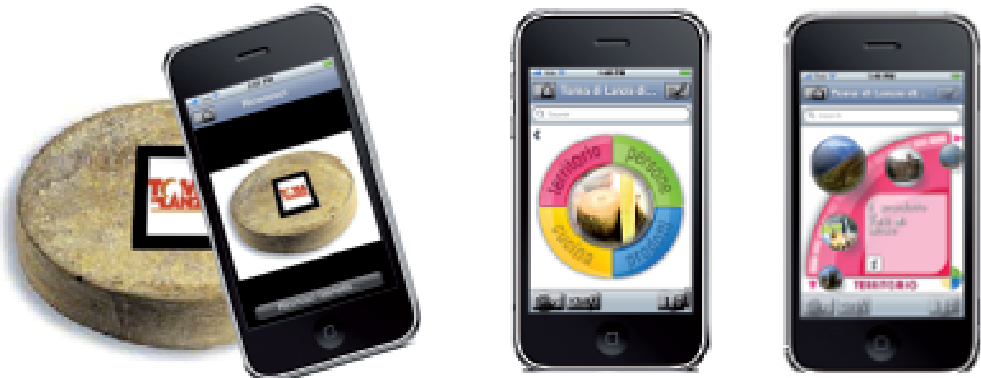
The core innovation is the Wheel Metaphor. Instead of navigating menus, the user interacts with a circular interface:
- The Hub: The central object (the "focus").
- The Spokes/Sectors: Regions representing categories like "Territory," "Products," or "People."
- The Rotation: Users rotate the wheel (like an old rotary phone) to browse related items and drag them to the center to change the focus.
The Backend: Agents and Ontologies
Behind the playful UI, WantEat uses a sophisticated multi-agent system:
- Ontology Manager: Maps the "DNA" of the food world (e.g., knowing that Salampatata is a pork-and-potato salami from a specific region).
- Social Network Manager: Tracks user actions (likes, comments, bookmarks) to create emergent relationships. If many users taste a specific cheese at a specific restaurant, the system "learns" a new link between them.
Experiments & Results: Real-World Testing
The researchers didn't just stay in the lab; they took WantEat to the world's largest food fairs.
Quantitative Success
At the Salone Internazionale del Gusto, they achieved stellar ratings from 684 users:
- Comprehensibility (3.46/4.0): Proving that the unconventional "Wheel" was actually intuitive.
- Pleasantness (3.43/4.0): Validating the "Playful Interaction" design goal.
Critical Analysis & Conclusion
Takeaway
WantEat successfully demonstrates that Graph-based navigation (the Wheel) is superior to Hierarchical navigation (Lists) for exploring interconnected domains like cultural heritage. It shifts the focus from "searching for data" to "exploring relationships."
Limitations
Given its 2012 context, the system relied on basic image recognition of labels. Today, we would expect more robust computer vision. Additionally, the "No Infrastructuring" claim is slightly limited by the reliance on product labels being pre-registered in the "Backshop" application.
Future Outlook
The concept of a "Social Web of Things" is more relevant than ever with the rise of Digital Twins. Future iterations could leverage LLMs to let these "Smart Objects" literally speak to users, providing a more natural language-driven exploration of the gastronomy web.
References
- Biamino, G. et al. (2011). "The Wheel": An innovative visual model...
- Console, L. et al. (2011). Toward a Social Web of Intelligent Things.