
When in Doubt Ask the Crowd: Scaling Intelligence via Human-in-the-Loop Active Learning
When in Doubt Ask the Crowd: Employing Crowdsourcing for Active Learning
The paper introduces a hybrid framework that integrates Active Learning (AL) with Crowdsourcing to solve the entity deduplication task in digital libraries. By utilizing a "wisdom of the crowd" approach through Amazon Mechanical Turk, the system iteratively trains automatic classifiers (Naive Bayes, SVM, Decision Tree) and a custom "Duplicates Scorer" to achieve high accuracy while minimizing manual labeling costs.
TL;DR
This work addresses the high cost of data labeling by merging Active Learning (AL) with Crowdsourcing. By systematically selecting the most "useful" publication pairs for workers on Amazon Mechanical Turk to label, the researchers built an automated deduplication system that learns "on the fly," achieving expert-level accuracy with significantly lower resource expenditure.
Background: The Deduplication Dilemma
In digital libraries like DBLP or CiteSeer, the same publication often appears with slightly different metadata—titles with typos, abbreviated author names, or missing journals. Computers struggle with these nuances, while experts are too expensive to hire for millions of records. The authors' insight: Why not treat the "crowd" as a noisy but affordable teacher for the machine?
Methodology: The Active Learning Loop
The proposed framework, "Active Learning from the Crowd," operates in a cyclical four-step process:
- Selection: A strategy (e.g., Uncertainty or Representative) picks a subset of unlabeled pairs.
- Crowdsourcing: These pairs are sent to Mechanical Turk workers (HITS).
- Aggregation: Multiple noisy labels are merged using Majority Voting or EM algorithms to filter out bad actors.
- Training: The automatic model is retrained on this fresh, high-confidence data, and the cycle repeats.
 Figure: The iterative loop between the crowd and the automatic learner.
The Core Components
- Selection Strategies: The paper compares "Uncertainty Selection" (asking about things the model is confused about) and "Representative Selection" (picking a diverse set of samples). Interestingly, Representative Selection proved more robust in finding "critical" examples early.
- Automatic Methods: The authors tested standard classifiers (Naive Bayes, SVM, DT) against a custom Duplicates Scorer, finding that modern machine learning handles fixed attributes better than heuristic-based scorers.
Experimental Insights: Finding the "Sweet Spot"
The study provides a rigorous analysis of resource allocation—crucial for any practitioner managing a budget.
1. The Power of Three
How many people should look at one pair? The authors found that 3 workers provide the optimal trade-off. Increasing to 7 workers only added ~1% accuracy but more than doubled the cost.
2. Diminishing Returns of Data
Performance plateaus after approximately 500 labeled instances per round. Adding more data beyond this point results in negligible gains, suggesting that "smaller, smarter" batches are better than "large, dumb" batches.
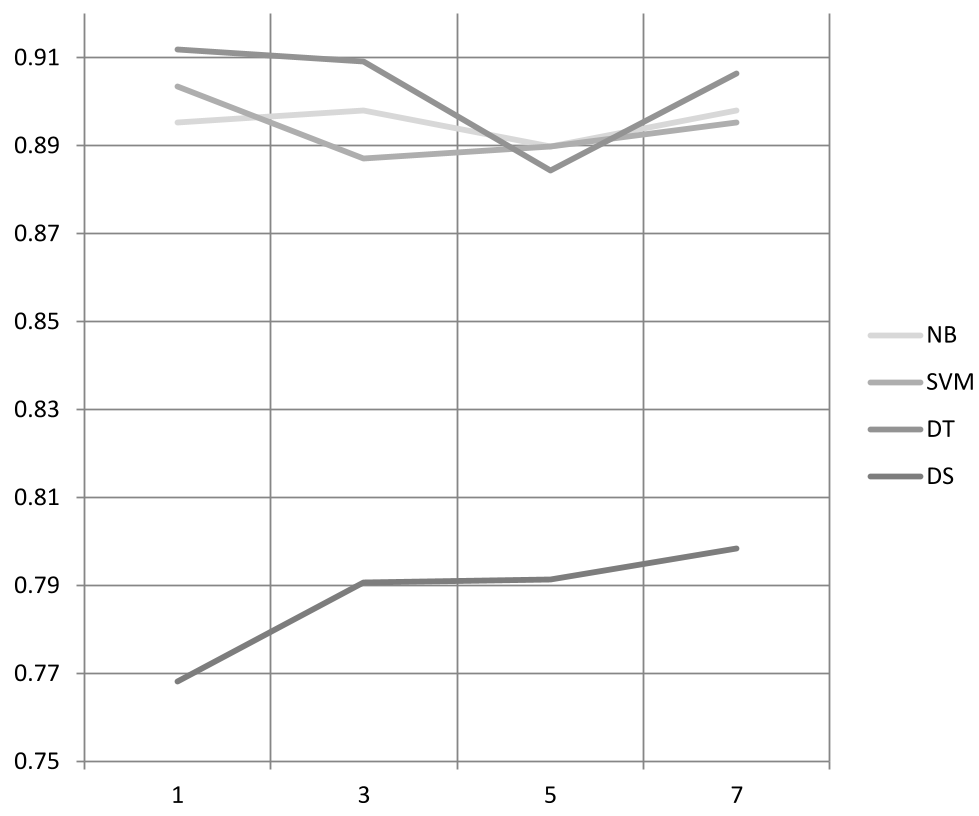 Figure: Accuracy gains versus the number of assignments per task.
Critical Analysis & Conclusion
Takeaway
The framework effectively bridges the gap between expert knowledge and crowd wisdom. By utilizing Worker Quality (WQ) thresholds, the system can autonomously identify and block "BadWorkers," ensuring the training set remains clean despite the inherent noise of micro-tasks.
Limitations
A major challenge identified is that crowd workers often lack domain knowledge. Unlike experts who recognize conference abbreviations, the crowd tends to over-rely on title similarity, occasionally leading to false positives.
Future Outlook
The authors envision a more collaborative future where machines don't just learn from humans, but also provide feedback to workers, correcting their mistakes in real-time to create a truly symbiotic intelligence system.
Key References
- Dawid & Skene (1979) on EM for error rates.
- Settles (2010) regarding Active Learning surveys.
- Ipeirotis et al. (2010) on MTurk quality management.