
Personalized Timing: Maximizing Social Media Engagement via Probabilistic Scheduling
When-To-Post on Social Networks
This paper introduces the "When-To-Post" problem, proposing a personalized scheduling system to maximize audience reactions (likes, retweets, comments) on social networks. By analyzing over 1.1 billion reactions, the authors developed weighted first- and second-degree probabilistic models that outperform global baselines, achieving state-of-the-art results in social media engagement optimization.
TL;DR
In social media, timing isn't just a factor—it's the catalyst. This KDD research from Klout/Lithium Technologies formalizes the When-To-Post (WTP) problem. By analyzing a massive dataset of 144M posts and 1.1B reactions, the authors demonstrate that personalized posting schedules can increase engagement by up to 17% on Facebook, proving that "when" you speak is as vital as "what" you say.
The "Attention Decay" Dilemma
The lifespan of a social media post is brutally short. Previous research suggests most content fades within 20-40 minutes on Twitter and slightly longer on Facebook. If you post when your audience is asleep or overwhelmed by "noise" from other accounts, your content is essentially invisible.
The authors identified a gap: while we know a lot about network cascades (how a post goes viral), we knew very little about how an individual can optimize their own broadcast window. Most users rely on "best practices" (e.g., "Post at 9 AM on Monday"), but these global baselines fail because every user has a unique audience footprint.
Methodology: The Logic of Delay and Degree
The core innovation lies in treating the audience's reaction as a probabilistic event influenced by two factors: Activity and Delay.
1. The Post-to-Reaction Filter
You can't just post when your audience is most active; you must account for the lag between their activity and their reaction. The authors use a discrete convolution to merge the audience's raw activity profile with a network-specific delay function.
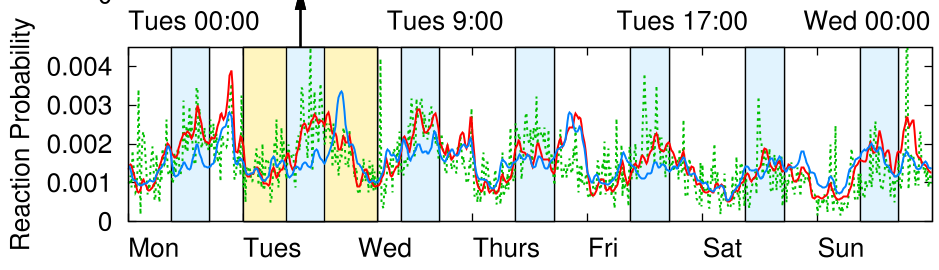 Figure: The "Post-to-Reaction" filter shows that on Twitter, the window for engagement is extremely tight, whereas Facebook allows for a slower decay.
2. Modeling "Degrees" of Interaction
The paper explores two primary modeling strategies:
- First-Degree Schedule (): Looks solely at the reaction patterns of the user's immediate followers.
- Second-Degree Schedule (): Accounts for "competition." It factors in when other people that your followers follow are posting, identifying windows where visibility is higher due to lower noise.
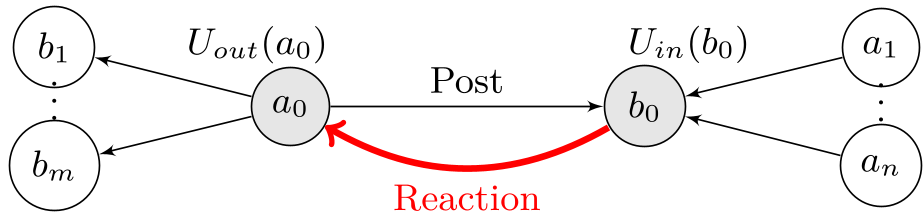 Figure: The simplified social graph showing (the broadcaster) and the interplay between audience and competing broadcasters .
Cross-Network and Cross-City Insights
The study reveals fascinating cultural and technical differences:
- Twitter vs. Facebook: Twitter engagement is 2x more volatile. It peaks sharply during work hours and collapses on weekends. Facebook is more "resilient," with Sunday being its most consistent day.
- City Personalities: Users in Paris and London engage late in the workday, while Tokyo shows a distinct bimodal peak (morning and evening) that strictly avoids standard working hours.
Results: Does it actually work?
In a 56-day deployment at scale, the First-Degree Weighted Schedule—which weights reactions based on the strength of the relationship between the poster and the follower—was the clear winner.
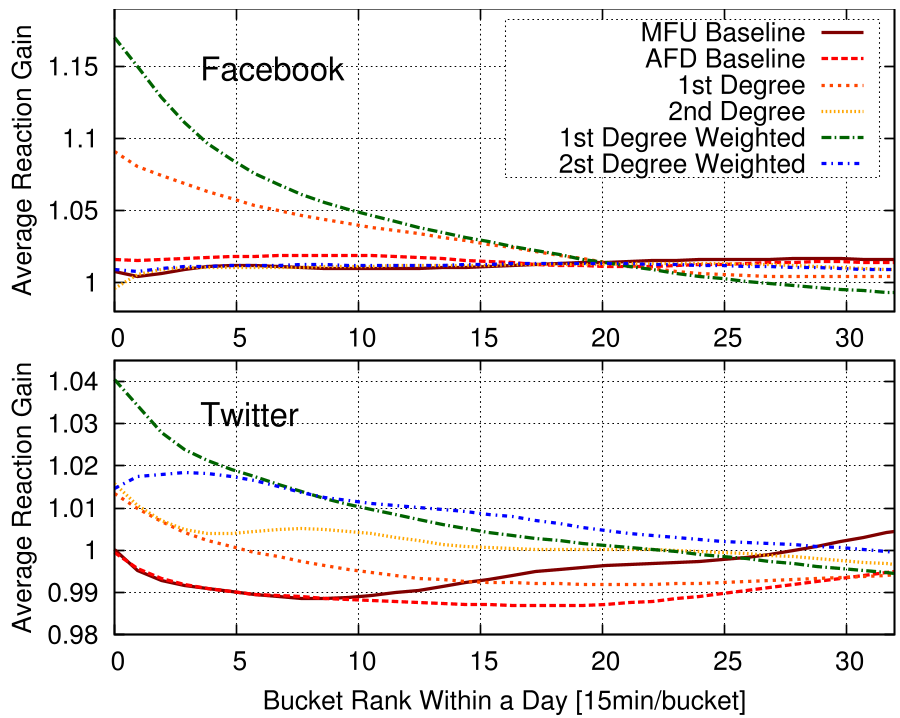 Figure: Average Reaction Gain across top-ranked buckets. Personalized models significantly outperform global baselines.
Key Outcomes:
- Facebook: +17.4% engagement gain in the top-ranked time slot.
- Twitter: +4.2% engagement gain.
- Failure of Baselines: Standard "common knowledge" posting times often resulted in lower than average engagement for specific users, highlighting the danger of non-personalized strategies.
Critical Insight & Conclusion
The paper proves that the "WTP" problem is a crucial component of the modern social media stack. Interestingly, the Second-Degree model (competition-aware) worked better on Twitter than Facebook, suggesting that Twitter's algorithmic feed (at the time of the study) was more sensitive to chronological congestion.
For developers and data scientists, the takeaway is clear: Network topology matters, but temporal behavior dictates reach. By shifting from "global optimums" to "personalized probabilities," platforms can significantly enhance user satisfaction and content discovery.