
Who Shapes the Sound of Youth? Unpacking Interpersonal Influence in Music Discovery
Who Influence the Music Tastes of Adolescents? A Study on Interpersonal Influence in Social Networks
This qualitative study explores how music tastes are influenced within the social networks of late adolescents, identifying the critical role of "music opinion leaders." The research maps the flow of interpersonal influence and provides actionable insights for improving collaborative filtering in Music Recommender Systems (RS).
TL;DR
While algorithms like Last.fm and Spotify dominate our playlists, adolescents still discover their favorite music primarily through people. This research by Audrey Laplante proves that "Music Opinion Leaders" are the true engines of taste-making. By leveraging high "safety credibility" and active information-seeking habits, these individuals bridge the gap between niche artists and the mainstream. For developers, the message is clear: to build a better Recommender System (RS), you must build for the influencers.
The Human Bottleneck: Why Algorithms Struggle
The central paradox of modern music consumption is that despite having the "Long Tail" of global production at our fingertips, we often feel overwhelmed. Current Recommender Systems (RS) usually fail in three areas:
- The Cold-Start Problem: New users or obscure tracks lack the data density to be recommended.
- Static Bias: Systems assume your tastes are fixed, failing to realize that a new friend or a breakup can radically shift your musical "Manifold."
- The Novelty Gap: Collaborative filtering often leads to "echo chambers" rather than true discovery.
Laplante’s study suggests that humans solve these issues through Trustworthy Filtering. We don't just want a "similar" track; we want a track vetted by someone we respect.
Methodology: Mapping the Teenage Social Web
The study utilized Social Network Analysis (SNA) with an egocentric focus. Instead of looking at a platform's total graph, the researchers sat down with 19 adolescents to map their personal "sociograms."
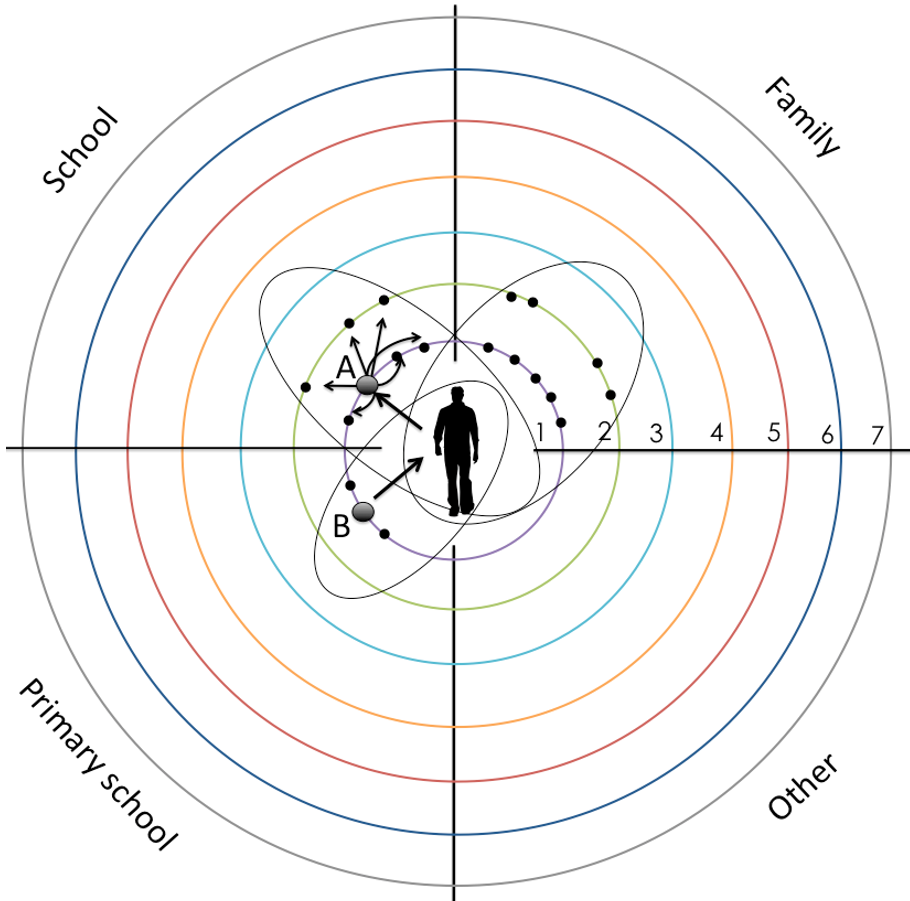 Figure 1: This chart illustrates how a participant acts as a 'bridge,' carrying a discovery from one social clique (Elias) to another (Gaspard), who then disseminates it to the wider group.
The Anatomy of an Opinion Leader
What makes someone a "Music Opinion Leader"? The study identifies four pillars:
- Perceived Expertise: They aren't necessarily professional musicians, but they are perceived to "always have headphones on."
- Active Seekers: Unlike average users who wait for music to find them, leaders use specialized tools (blogs, Last.fm, etc.) to hunt for new sounds.
- Eagerness to Share: They act as "Music Ambassadors," often using aggressive persuasion to "convert" friends to their favorite bands.
- Extroversion: Influence is often a byproduct of a dynamic personality that "takes up space" in the social group.
Key Insight: The Power of Strong Ties
Contrary to the "strength of weak ties" theory often cited in job-hunting, musical influence in adolescence thrives on Strong Ties.
- Competence + Safety: We listen to leaders not just because they know music (competence), but because we trust them (safety).
- Asymmetrical Flow: Influence is a one-way street. Leaders provide recommendations far more often than they receive them.
Impact on System Design: The Future of RS
The paper concludes with a roadmap for more "human-centric" algorithms:
- Detect Social Shifts: If a user's social graph changes (e.g., they join a new "cluster"), the RS should trigger a "Taste Reset" to account for the influence of new peers.
- Transparency is Trust: RS should explain why something is recommended, perhaps by linking it to the profiles of influential users within the network.
- Empower the Hubs: Instead of targeting every user equally, RS should provide specialized tools for "Opinion Leaders" to curate and broadcast, effectively using them as a high-quality filter for the rest of the user base.
Conclusion
This study serves as a reminder that music is a socially instigated act. By understanding the "brokers" of influence, platform designers can move beyond simple matric factorization and towards a system that mirrors the organic, messy, and highly trusted way humans actually fall in love with a new song.
Takeaway for the Industry: Focus on "Social Transparency." The next evolution of Spotify or Apple Music won't just be a better algorithm—it will be a better way for our "tastemaker" friends to influence us.