
Who Influenced You? Decoding the Locality of Social Influence in Retweet Prediction
Who Influenced You? Predicting Retweet via Social Influence Locality
This paper introduces the concept of "Social Influence Locality" to predict retweet behaviors in microblogging networks like Sina Weibo. It employs a Factor Graph Model (FGM) that integrates pairwise influence and structural diversity to achieve state-of-the-art predictive performance (F1-score of 71.65%+).
TL;DR
This research from Tsinghua University shifts the focus of social influence from global trends to Social Influence Locality. By analyzing 23 million retweets on Weibo, the authors discover a counter-intuitive truth: having friends from different social circles retweet a post actually decreases your likelihood of retweeting it. They formalize this into an Influence Locality Function and a Factor Graph Model, outperforming traditional feature-heavy classifiers.
Background: The Mystery of the Ego Network
In the world of microblogging, "influence" is often talked about as a monolithic force. However, social influence is nuanced. If six of your friends retweet a message, does it matter if those six friends all know each other, or if they come from completely different parts of your life (e.g., coworkers vs. high school friends)? This paper argues that the local structure—the "locality"—is the secret sauce to predicting whether you will hit that retweet button.
The Core Insight: Structure Matters (The Circle Effect)
The authors' most intriguing discovery is the negative correlation between "connected circles" and retweet probability. In many social contagion theories, diversity is seen as a positive (reaching more diverse audiences). But for retweets, the data shows that:
- If 6 friends are in 1 or 2 connected circles, the retweet probability is high (Peer Pressure effect).
- If 6 friends are in 6 different circles (they don't know each other), the probability drops by 3x.
This suggests that retweeting is often a behavior driven by group norms and peer pressure within cohesive clusters rather than simple information exposure across disparate groups.
Methodology: Formalizing Locality
The authors define a "-ego network" and use it to build an influence locality function :
1. Pairwise Influence ()
Using Random Walk with Restart (RWR), they calculate the "relatedness" of each active neighbor to the target user. It’s not just about who retweeted, but how "close" they are to you in the social graph.
2. Structural Influence ()
They calculate the number of connected components among influenced friends. They use -brace filters to ensure these "circles" are meaningful and not just linked by coincidental bridges.
3. Factor Graph Model (FGM)
Unlike simple Logistic Regression which treats each user as an independent island, the FGM considers the correlation between neighbors. If your friend is likely to retweet, that probability is "passed" to you through the graph edges.
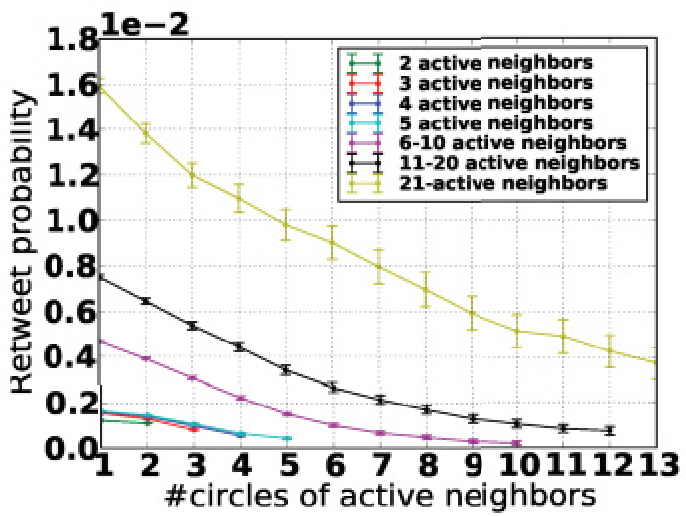 Figure 1: Illustration of how different structures of active neighbors (red nodes) influence the target user (v).
Experimental Battleground
The study utilized a massive crawl of Sina Weibo (1.7M users).
Key Findings:
- F1 Score: Even without complex text-mining features, the influence locality function alone achieves an F1 of 71.65%.
- Time Decay: Influence is strongest 5-10 hours after a post is published; after 48 hours, the marginal effect of adding more active neighbors vanishes.
- Attributes: Users with moderate followee counts (100-150) are the most "influenceable." Elite users or those with massive feeds suffer from information overload and are harder to predict.
 Table: Performance comparison between basic features (LRC-B) and locality-based features (LRC-Q).
Critical Perspective & Takeaways
The "Negative Structural Diversity" finding is a significant departure from previous studies (like Ugander et al. 2012 on Facebook). It highlights that different platforms have different social dynamics: Weibo is an information-sharing hub where "group identity" drives the retweet, whereas Facebook is for social bonding where "novelty from different circles" might drive engagement.
For Developers & Researchers:
- Precision vs. Recall: The Factor Graph Model (FGM-BQ) provides higher precision, making it ideal for notification systems where you don't want to annoy users with "false positive" recommendations.
- Design Insight: Social UI should perhaps highlight which circle is talking about a post (e.g., "3 of your college friends shared this") rather than just showing a raw count.
Conclusion
This work proves that "Who influenced you?" is as much a question of topology as it is of content. By quantifying the locality of influence, we move closer to understanding the underlying mechanics of how information cascades through the digital world.