
Who Reads and Writes the Social Web? Bridging the Usability Gap in Web 2.0 Security
16196_Who Reads and Writes the Social Web A Security Architecture for Web 2.0 Applications.
The paper proposes a decentralized security architecture for Web 2.0 (Social Web) that simplifies complex security policies through a "tag-based access control" paradigm. By integrating Semantic Web technologies (OWL, SWRL) and digital signatures, the system allows lay users to manage content protection and trust across syndicated platforms.
TL;DR
As the Web transitioned from static pages to user-generated "Social Web" (Web 2.0), security remained trapped in complex, expert-only silos. This paper proposes a Semantic Security Architecture that allows everyday users to secure their data using the familiar tagging paradigm. By mapping simple tags to rigorous Semantic Web rules, the authors ensure that data remains protected even when it is "mashed up" or syndicated across the internet.
The "Security Gap" in the Age of Participation
The fundamental shift of Web 2.0 was "participation." However, the authors identify a critical paradox: while users find it easy to publish content, they find it nearly impossible to protect it.
The paper highlights two primary pain points:
- Complexity Exhaustion: Standards like PKI (Public Key Infrastructure) or XACML (eXtensible Access Control Markup Language) are mathematically robust but UX nightmares for the average blogger.
- The Syndication Leak: Once a photo or post moves from a "Social Network" to a "Mash-up Service" via RSS or Atom feeds, the original access controls and identity proofs often vanish, leaving data vulnerable and untraceable.
Methodology: Tags as Security Policies
The core "Aha!" moment of this research is treating tags not just as metadata for categorization, but as triggers for security logic.
The Semantic Bridge
The authors propose a multi-layered architecture where:
- User Layer: A user simply tags a resource as
#friends_onlyor#internal. - Semantic Layer: An OWL (Web Ontology Language) model defines what "friend" or "internal" means in a machine-readable way.
- Rules Layer: SWRL (Semantic Web Rule Language) provides the logic (e.g., "If User X is in the FOAF list of User Y, allow access").
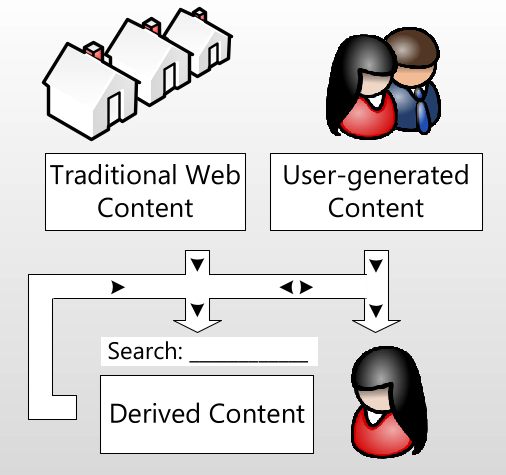 Fig 1: The classification of Web content and how trust flows between traditional and user-generated data.
The Four Milestones to a Web of Trust
The paper outlines a roadmap to fix the broken trust model of the social web:
- Identity Mapping: Bridging decentralized IDs (OpenID) with formal certificates (X.509).
- Anonymity & Reputation: Using Semantic Web technologies to infer if a user is "trustworthy" without forcing them to reveal their real-world identity.
- User-Centric Access Control: Realizing the tag-to-policy translation through dedicated Policy Enforcement Points (PEP).
- Secure Syndication: Carrying security metadata and digital signatures along with the data as it travels across different services.
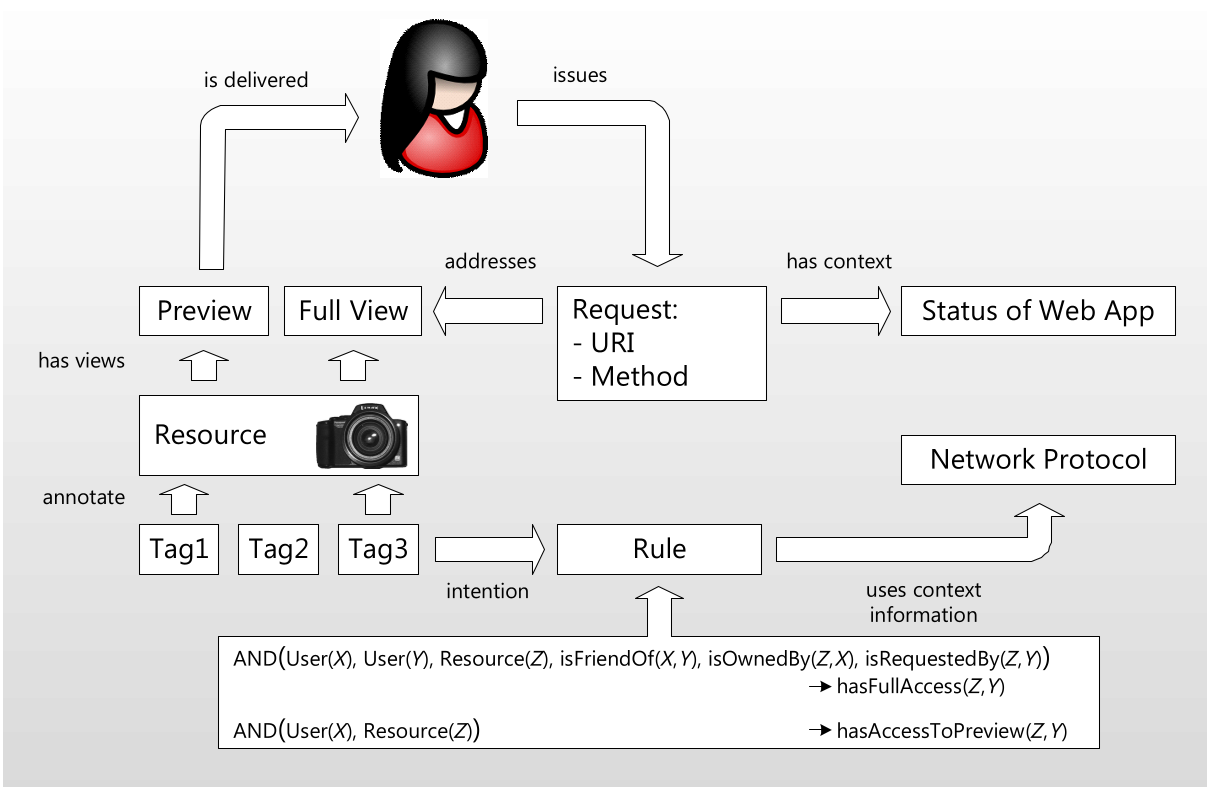 Fig 2: A practical implementation of tag-based access control where social connections (FOAF) dictate resource visibility.
Real-World Applications
The authors demonstrate the versatility of this architecture through three compelling scenarios:
- Stock Photo Purchase: A user tags a photo for sale. The system automatically handles the redirect to a payment service and only grants the full-resolution view once the "payment attribute" is verified.
- Semantic Wikis: In professional settings (like SOA Governance), tagging a wiki page can automatically generate security policies for the underlying technical services.
- Collaborative Quality Assurance: Leveraging user reputation scores to filter "noise" or "spam" in collaborative platforms like Wikipedia.
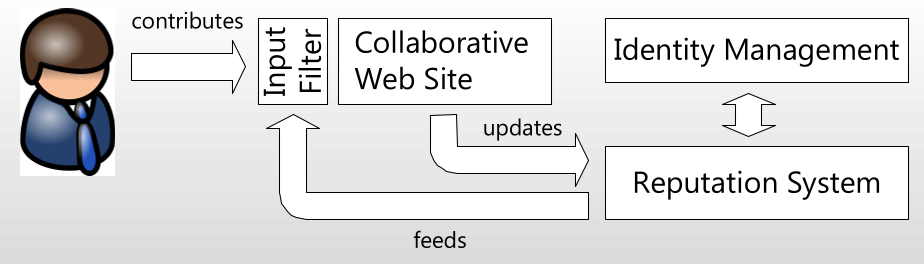 Fig 3: How user reputation acts as a dynamic filter for content quality in social environments.
Critical Insight: Why This Matters
The genius of this work lies in its Inductive Bias toward human behavior. It recognizes that users will never learn cryptography, but they have already mastered tagging. By "piggybacking" on existing behavior, the authors find a way to inject high-level security into the messy, decentralized world of the Social Web.
While the paper was written in the era of XML-signatures and RSS, its core philosophy—decentralized identity (DID), verifiable claims, and metadata-driven policy—is the direct ancestor of today's Web3 and Sovereign Identity movements.
Limitations
One potential hurdle remains the interoperability of trust. For this system to work, the "receiving party" in a syndication chain must respect the semantic rules provided. In a world of centralized "Big Tech" silos, getting dominant platforms to adhere to a universal semantic security standard remains a socio-political challenge, not just a technical one.
Conclusion
This paper serves as a blueprint for "Usable Security." It proves that we don't need to choose between powerful protection and user-friendliness—we just need better abstractions. By turning tags into tools of empowerment, we can finally decide who truly reads and writes our digital lives.