
CORE: Reimagining Social Dynamics via Companion Recommendation in LBSNs
Who Wants to Join Me?: Companion Recommendation in Location Based Social Networks
The paper introduces CORE (Companion Recommender), a novel framework for recommending friends to join a user at a specific venue in Location-Based Social Networks (LBSNs). It utilizes a probabilistic graphical model that integrates latent topics for user interests, friendship types based on shared venue categories, and geographical proximity.
TL;DR
While most LBSN research asks "Where should I go?", this paper asks "Who should come with me?" The authors present CORE, the first dedicated companion recommendation framework that predicts which friends are most likely to join a specific activity by modeling latent "friendship types" and geographical constraints.
Background & Motivation: Beyond Global Friendship
On platforms like Foursquare, recommendations usually help you find a new coffee shop. But social activities are rarely solo. If you’re heading to a Thai restaurant, you don’t just need any friend; you need a friend who likes Thai food and is currently nearby.
The authors identify a critical gap: existing models treat friendship as a binary or a single scalar (strength). They ignore the semantic diversity of social ties. You might have "work friends," "gym buddies," and "concert-goers." Traditional link prediction cannot distinguish between these contexts when a specific venue is proposed.
Methodology: The Core Framework
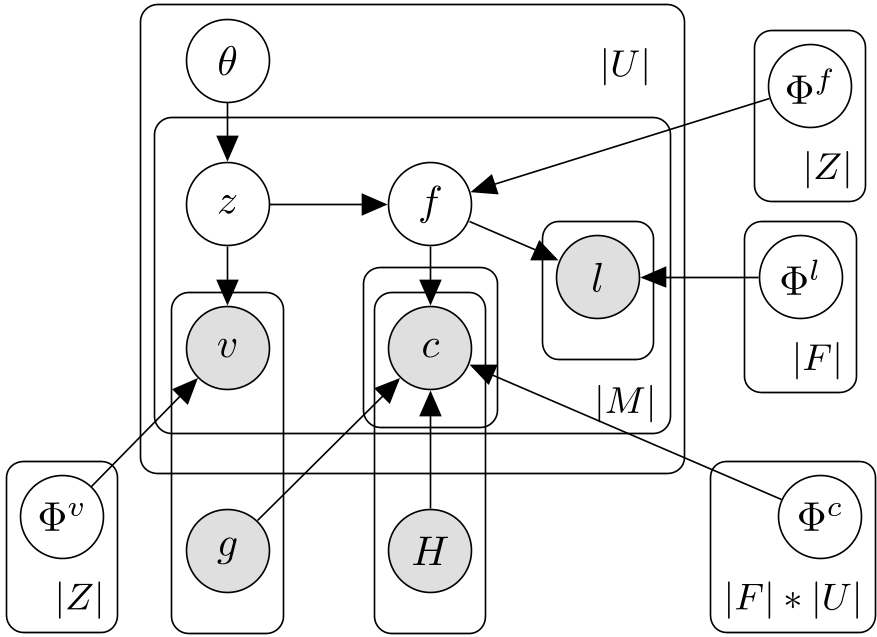
The CORE framework is a probabilistic graphical model that treats the visit intention as a latent topic .
1. Latent Friendship Types
The key innovation is the Friendship Type (). Instead of just modeling a user's interest, the model assumes that every friendship can be clustered based on shared venue categories (e.g., "College Gym", "Art Gallery"). This creates a bridge between the venue's nature and the user's social circle.
2. Geographical Mobility Modeling
The model recognizes that social interest is often bounded by physical distance. They use a compatibility score based on a companion's check-in history : Using the SAGE (Sparse Additive Generative Model) logic, they combine these geographical scores with latent preference scores in log-space to avoid complex switching parameters.
Experiments and Results
The authors tested CORE against three major baselines:
- Relationship-Strength Method (RSM): Ranks friends by overall interaction frequency.
- LDA-Based Method: Ranks friends by general interest similarity.
- Venue-Preference (VP): Focuses on friends who like the venue, regardless of social tie type.
Performance Gains
CORE consistently outperformed all baselines across different scales (City, State, Country).
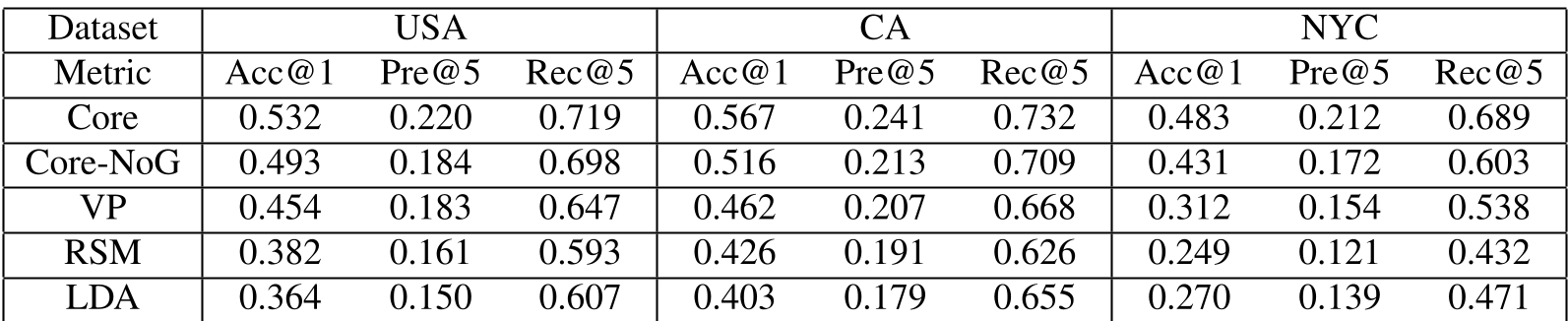
The ablation study (Core-NoG) showed that while geographical information is vital for precision, the core "friendship type" logic provides a stronger baseline for matching social intent than standard interest-based models.
Qualitative Insights: What is a Friendship Type?
The model successfully "discovered" intuitive social clusters. For instance, Type 3 was characterized by category labels like Asian Restaurant, Sushi, and Ramen, while Type 5 centered around Office, Coworking Space, and Tech Startups. This qualitative success proves that our social graphs are indeed multi-faceted.
Deep Insight & Conclusion
CORE represents a shift from Global Social Graphs to Contextual Social Graphs. It acknowledges that our online "friend list" is a collection of diverse sub-networks.
Limitations: The model relies on historical check-in overlap to define companions, which may suffer from sparsity in newer or less active areas. Future work could likely integrate textual content from social posts (NLP) to further refine these friendship semantics.
The Takeaway: For AI-driven social apps, the future isn't just knowing who your friends are, but knowing which tool each friend represents in your social toolkit for a given time and place.