
Beyond the Binary: How Interaction Strength Drives Social Network Growth
Who Will Be Your Next Friend: The Bonding Role of Linkage Influence in Social Networks
The paper introduces a semi-random graph model for social network evolution based on "linkage influence" and path-based analysis. Moving beyond simple Boolean link representations, it replaces the axiomatic "preferential attachment" with a micro-level mechanism of repeated social interactions, achieving SOTA performance in fitting real-world co-authorship networks.
TL;DR
Why do "the rich get richer" in social networks? While classic models simply assume this happens, this paper—Who Will Be Your Next Friend—proves that it is a natural byproduct of interaction strength and path influence. By treating links as weighted coefficients rather than simple 0/1 connections, the authors build a semi-random graph model that predicts real-world network growth with nearly 99% accuracy.
Background: The Limits of Randomness
Since the Erdos-Renyi random graph models of the 1960s, researchers have struggled to replicate the specific "Scale-Free" nature of human societies. Later, the BA (Barabasi-Albert) Model introduced "Preferential Attachment," but it remained a "what" rather than a "why." This paper fills that gap by looking at the micro-level: Social interactions.
Problem & Motivation: The Dangers of Dichotomy
Most existing models suffer from two major flaws:
- Binary Simplification: They treat a link between a close friend and a distant acquaintance as identical (both are just an edge).
- Unexplained Mechanisms: They assume people prefer to link to popular nodes without explaining the sociological drive behind it.
The authors argue that social relationships are built on repeated interactions. Influence isn't just a property of a node's degree; it is a result of the "Linkage Influence" accumulated through shared history and indirect paths.
Methodology: The Bonding Role of Linkage
The core of the paper lies in three mathematical definitions that shift the focus from the macro-structure to the micro-influence:
- Linkage Coefficient (): Instead of a Boolean, this represents the count of interactions.
- Linkage Influence (): A linear function of the coefficient, representing how much node can influence node .
- Path Influence (): This is the most crucial insight. It sums all possible paths from node to . It captures the intuition that "friends of friends" exert cumulative pressure on network formation.

The paper mathematically derives that the probability of a link forming is: The first part represents random uniform growth, while the second part—proportional to (degree)—effectively proves why preferential attachment occurs without needing to assume it from the start.
Experiments: Fitting the Real World
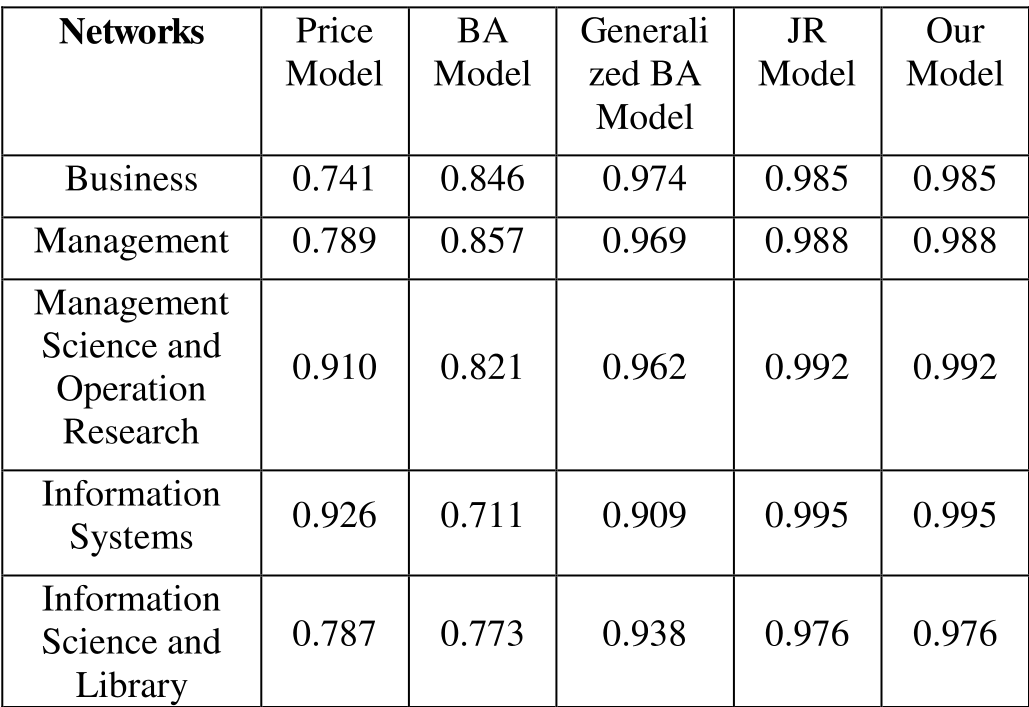
The researchers tested their model against five large-scale co-authorship datasets from the Web of Science (spanning 1999–2008).
SOTA Comparison
As shown in the table below, the proposed model matches or exceeds the performance of the Jackson & Rogers (JR) model and significantly outperforms the classic Price and BA models across all academic disciplines.
The Bonding Index ()
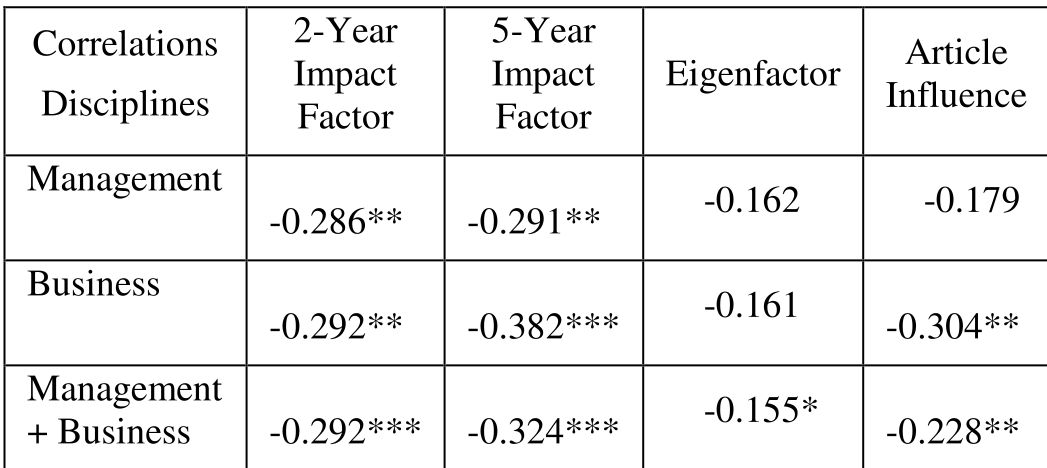
The authors introduced a parameter , the Bonding Index, representing the "cohesiveness" of a network. A fascinating and counter-intuitive result emerged: Higher "bonding" within a journal's author network actually correlated negatively with the journal's Impact Factor. This suggests that "insular ties" lead to a cohesive community but also to social and scientific isolation (the "Echo Chamber" effect).
Critical Analysis & Conclusion
Takeaway
This work provides a rigorous bridge between sociological intuition and graph theory. It successfully deconstructs the "black box" of preferential attachment into a quantifiable process of path-based influence.
Limitations
- Node Homogeneity: The model assumes all nodes have equal "power" or "status" initially, which is rarely true in real life (e.g., a junior researcher vs. a Nobel laureate).
- Dataset Specificity: The empirical evidence is limited to academic co-authorship; future work should apply this to more "volatile" networks like Twitter or Facebook where bonding changes more rapidly.
Future Outlook
The "Bonding Index" is a powerful tool for social platform designers. It could be used to detect when a community is becoming too "inward-looking," allowing for algorithmic interventions that promote "bridging" links to maintain the diversity of information.