
The Whole Story: Leveraging Narrative Retrieval for Cross-Cultural Intelligence
The Whole Story: Retrieving Narratives for Cross-Cultural Understanding
The paper presents a narrative-based computational approach to cross-cultural competence using Case-Based Reasoning (CBR). It introduces a system for indexing and retrieving culturally specific "war stories" to provide actionable insights for decision-makers in foreign environments.
TL;DR
Understanding a foreign culture isn't about memorizing a list of "do's and don'ts"; it's about understanding the stories those people live by. This paper introduces a computational framework that index and retrieves "war stories" using Case-Based Reasoning (CBR). Instead of abstract math, it uses "Intentional Chains" to help military and business planners navigate cultural deadlocks by finding historical parallels.
Background: Why Theory Fails in the Field
Culture is often described as "ineffable"—you know it when you see it, but you can't define it. In post-combat Iraq, U.S. forces found that "forceful searches" weren't just seen as tactical acts; they were perceived as a "public dishonor" to tribal systems, requiring mandatory retribution.
The author argues that standard behavioral models (top-down) can't predict these reactions. We need a bottom-up approach: treating culture as a collection of narratives that prescribe roles (victim, hero, host) and moral consequences to specific actions.
Methodology: Locating Culture in Space and Story
The core of the methodology is "Location in Cultural Space." The system doesn't just look for keywords; it maps an interaction across four dimensions:
- Interaction Context: Geographic and situational features.
- Actors: Group memberships (ethnic, religious, political) and inherited traits like "Power Distance."
- Relationships: Link diagrams and association matrices (e.g., tribal leaders vs. members).
- Events: Formalized narrative patterns of behavior.
The Narrative Indexing Framework
To make these stories searchable, the author uses two primary indexing schemes:
- Universal Indexing Frame (UIF): Focuses on the gap between expectations and perceptions.
- Abby Scheme: Focuses on Intentional Chains—the logic of goals, plans, and actions.
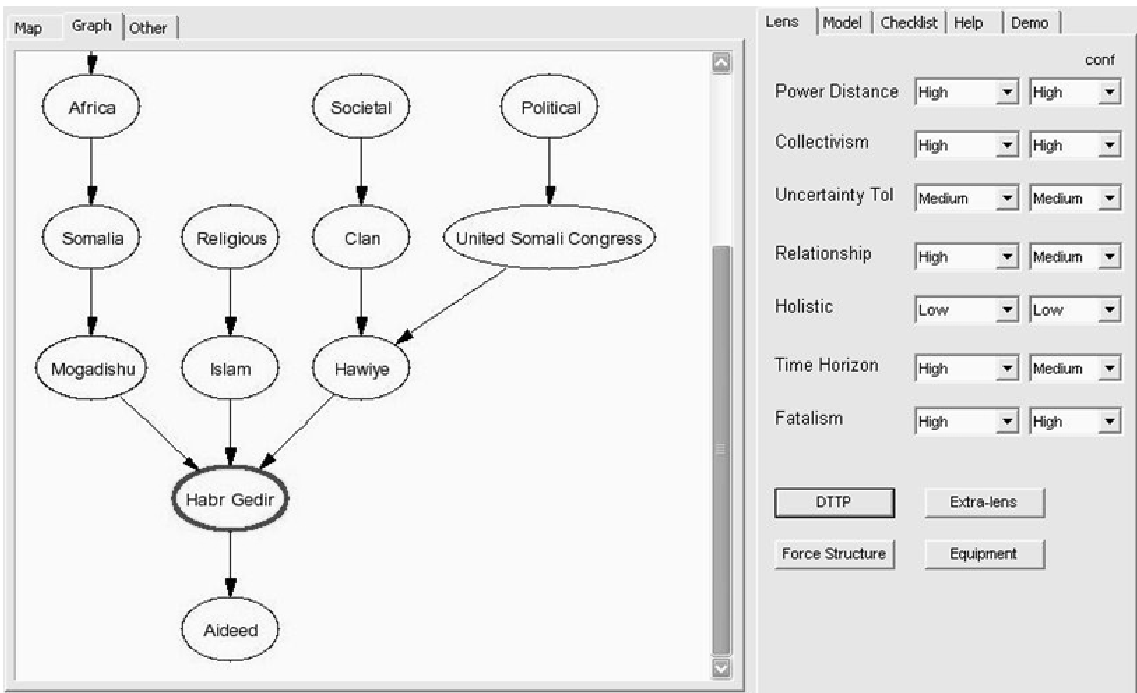 Figure 1: Representation of group memberships and inherited traits for the Somali warlord Aideed, illustrating how narrative roles are identified (Friend vs. Foe).
Case Study: The "Broken" Saudi Shredder
The paper illustrates the method through a fascinating real-world case. A Saudi-owned shredding machine wasn't working to U.S. standards. The Saudis insisted it was "fine" to avoid "losing face." The Americans saw it as "broken."
The deadlock was broken when an American "accidentally" dropped a coin into the blades. Now that it was undeniably broken, the Saudis were "delighted" to replace it, fulfilling the Narrative of Honorable Hospitality.
Intentional Chain Analysis
The system models this interaction by tracking the internal state of the agents:
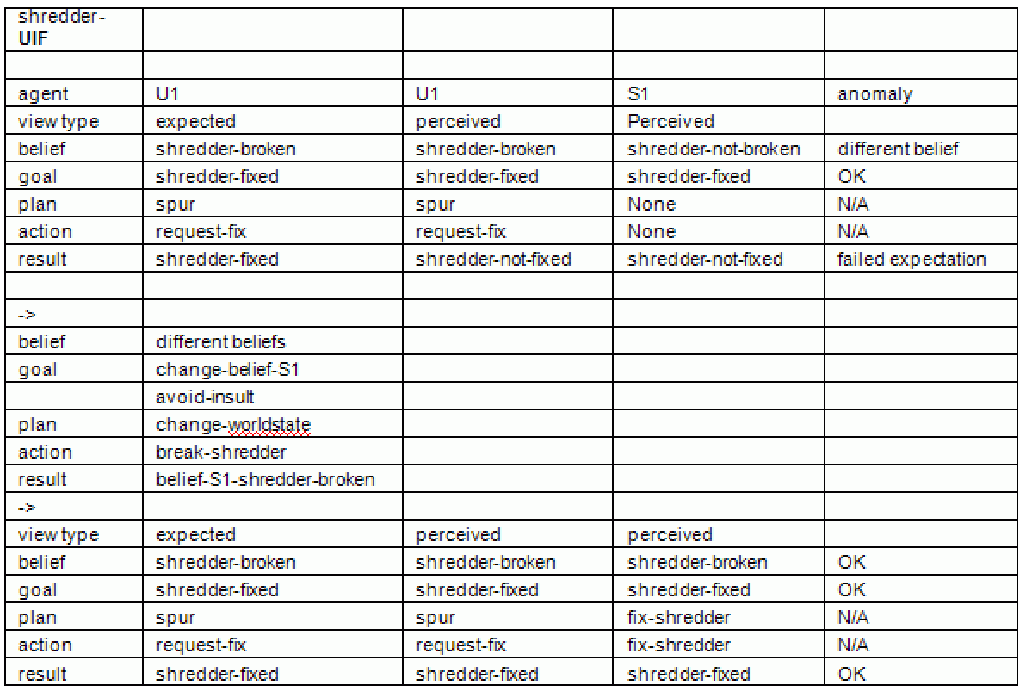 Table 1: The mapping of the Shredder Case using the Abby/UIF hybrid scheme, showing how the goal of "saving face" was computationally modeled as a transition from "different beliefs" to "OK."
Critical Insight: The Cultural Mosaic
In the concluding sections, the author points toward the Cultural Mosaic theory. Instead of seeing a person as just "Saudi" or "Military," we should see them as a collage of geographic, demographic, and associative "tiles."
Key Takeaways for R&D:
- Grounding: Narrative data is grounded in history, unlike theoretical models which are often decoupled from reality.
- Intuition: Narratives are easier for human experts (soldiers, diplomats) to provide than complex rule-bases.
- Retrieval vs. Generation: The goal isn't necessarily to simulate a person, but to retrieve a historical story that acts as a "Social Advice."
Future Outlook
While the current process of indexing is largely manual, the author envisions a "Mixed-Initiative" system where conversational CBR helps users structure their dilemmas in real-time. As we move toward more globalized social media and virtual worlds, these narrative databases will become essential for preventing "accidents of international misunderstanding."