
Why Checkins: Decoding the Human Motivation Behind the Digital Footprint
Why Checkins: Exploring User Motivation on Location Based Social Networks
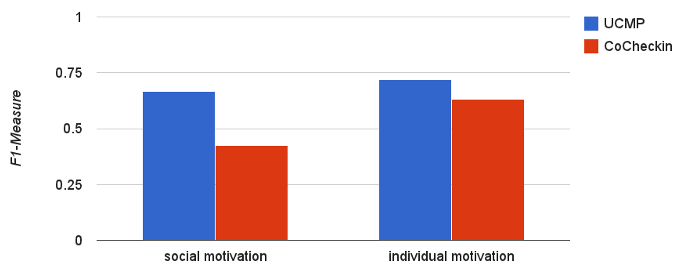
This paper presents the User Checkin Motivation Prediction (UCMP) model, a novel computational framework that utilizes the Model of Goal-directed Behavior (MGB) from social psychology to categorize check-in behaviors into social and individual motivations. Applied to the large-scale Gowalla dataset, it achieves superior accuracy in identifying user intent compared to simple co-checkin baselines.
TL;DR
Why do we check in? Is it to tell a friend we've arrived, or simply to log a beautiful new cafe? This paper bridges Social Psychology and Data Mining by introducing the User Checkin Motivation Prediction (UCMP) model. By transforming the classical Model of Goal-directed Behavior (MGB) into a computational optimization problem, the authors successfully categorize check-ins into Social vs. Individual motivations at scale.
Background: Beyond Where and When
Most LBSN research treats check-ins as mere data points for trajectory prediction. However, a check-in is a purposive human action. Understanding the motivation behind it could revolutionize how we handle ad targeting (e.g., inviting a "social" user to a group hangout) and location recommendation. The authors identify two primary drivers:
- Social Motivation: Incentives to interact with or influence friends.
- Individual Motivation: The desire to explore or record attractive personal milestones.
The Psychological Blueprint: MGB Model
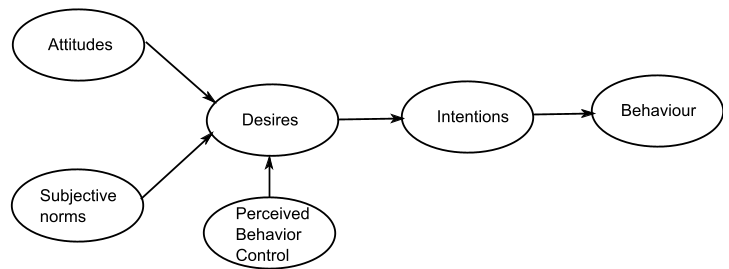
The foundation of this research lies in the Model of Goal-directed Behavior (MGB). In psychology, behaviors aren't random; they are fueled by Desires (Motivations), which are shaped by three pillars:
- Behavioral Attitudes (BA): Does the user like checking in for social or personal reasons?
- Subjective Norms (SN): The "peer pressure" or influence felt from friends' activities.
- Perceived Behavioral Control (PBC): How easy or restrictive is the location for a specific type of check-in?
Methodology: From Theory to Algorithm
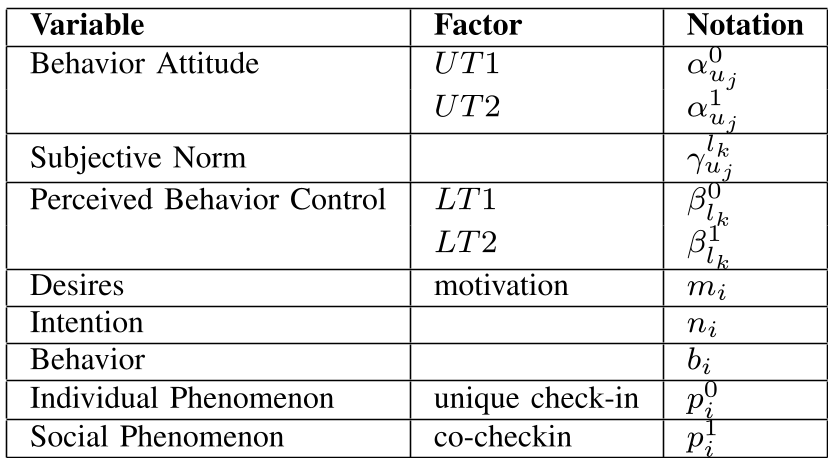
The UCMP model maps these abstract concepts to measurable LBSN features:
- Attitude (): Calculated based on a user's historical ratio of co-checkins vs. unique check-ins.
- Subjective Norm (): Based on the number of friends who have visited a specific location.
- Control (): Derived from location-specific statistics (e.g., is this venue typically a group hangout spot?).
The authors frame this as an optimization problem. They define an objective function that minimizes the difference between the model's "predicted behavior" and the "actual truth" found in the Gowalla dataset.
Experimental Insights: Social Users vs. Social Locations
The study reveals fascinating patterns about our social world:
- Social Locations: Starbucks is a "social location" (high co-checkin rate), while a Target store is "individual" (utility-driven).
- Micro-Geographic Differences: Apple Stores in Manhattan (Soho/NY City) show significantly higher social motivation compared to suburban locations (Paramus), reflecting the different demographics of "young professionals" vs. "families with kids."
- Predictive Power: By knowing a user’s social motivation score, they could predict future check-ins with 65% accuracy.
Conclusion & Critical Analysis
This paper is a pioneer in Computational Social Science. It proves that we don't need to choose between the "deep" why of psychology and the "wide" how of big data.
Limitations: The model relies on co-checkins as a primary proxy for social motivation, which might miss subtle social influences that don't result in immediate proximity. Future Outlook: Integrating text analysis (tips/comments) or sentiment analysis into the BA (Behavioral Attitude) factor could further refine these motivation scores, paving the way for hyper-personalized digital assistants that understand why we go where we go.