
Why Not Scale-Free? Decoding the Unique Logic of Corporate Twitter Networks
Why not scale free? Simulating company ego networks on Twitter
This paper investigates company ego networks on Twitter, demonstrating that the distribution of "followers of followers" (FoF) is neither purely scale-free nor random. The authors propose a novel rate equations model that combines preferential attachment for new followers with strategic exponential decay for departing followers to accurately simulate corporate social capital.
TL;DR
Most social network theories assume the world is "scale-free"—a few superstars and a lot of nobodies. This paper proves that for companies on Twitter, this assumption is wrong. By analyzing S&P 500 tech firms, the authors show that while joining a network follows a "rich-get-richer" logic, leaving it is a strategic choice. They introduce a new mathematical model using rate equations that finally matches actual corporate data, providing a more accurate way to simulate a company's social capital.
The "One-Size-Fits-All" Fallacy in Network Science
For decades, researchers have relied on the Barabasi-Albert model to explain everything from the internet to friendship circles. The logic is simple: Preferential Attachment. The more followers you have, the more you get (Power Law).
However, Twitter isn't Facebook. It's directional and low on reciprocity. For a company, a follower isn't just a "node"; they are a source of Social Capital. The authors argue that existing models fail because they don't account for the "Quality" of followers (those with many followers themselves, or FoF) and the specific ways users "break up" with brands.
The Hidden Asymmetry: Follow vs. Unfollow
The most striking insight of this research is the behavioral asymmetry:
- Following is Random-ish/Popularity-based: People find companies through retweets. Since big companies are retweeted more, they attract more new followers in a power-law distribution.
- Unfollowing is Strategic: People don't unfollow a brand because it's popular or unpopular; they unfollow because the content no longer meets their expectations. This results in an exponential distribution for departing followers.
When you mix a Power Law "In" and an Exponential "Out," the resulting network is a hybrid that traditional models simply cannot replicate.
Methodology: The Rate Equation Model
The authors propose a simulation framework based on four distinct transition events at time :
- New Follower Birth (): Modeled with a "rich-get-richer" factor.
- Follower Departure (): Modeled as a strategic decay.
- New FoF Event: When an existing follower gains their own new followers.
- Departing FoF Event: When an existing follower loses their own followers.
By combining these into a single master rate equation, the simulation can evolve a network from a few followers to thousands while maintaining the realistic "quality" of the follower base.
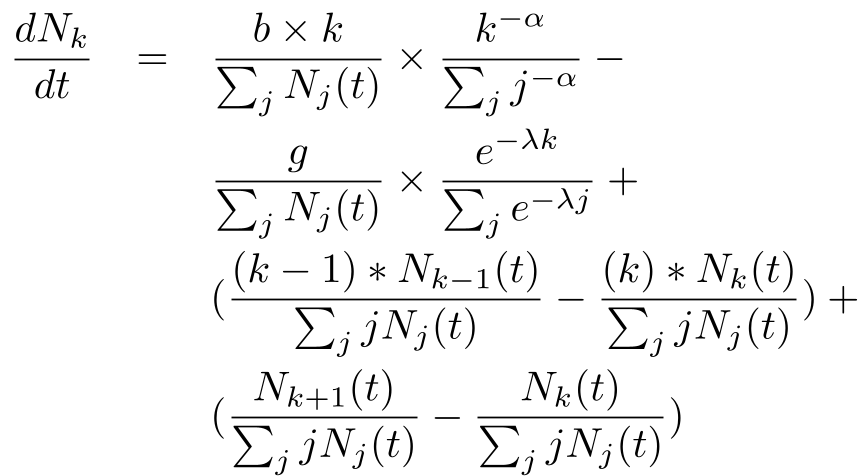 The multi-component rate equation capturing birth, decay, and FoF dynamics.
Experimental Results
Testing the model against data from companies like Amdocs, Teradata, and Williams Co., the researchers used QQ-plots to compare observed data against simulated data.
- Power Law & Exponential Baselines: Failed to capture the specific curvature of the distribution.
- The Proposed Model: Successfully captured the long-tail of the distribution. This is vital because those "long-tail" followers—the ones with massive reach themselves—are the most valuable assets a company has on social media.
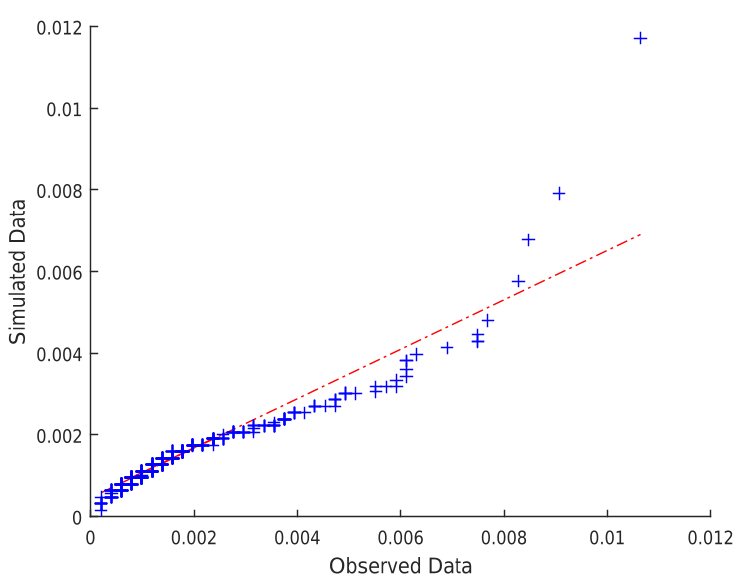 Fig 4: The proposed simulation (right) tracks the 45-degree line of observed data much more closely than standard models.
Critical Insight: Why This Matters for Business
If you are a CMO or a Data Scientist, this paper suggests that your "social reach" is more complex than a single growth metric.
- Retention is Strategic: Since unfollowing isn't just a random churn, companies must focus on the "quality" of the followers they are losing. Losing one "high-FoF" follower is mathematically more damaging than losing a hundred "low-FoF" ones.
- Simulation over Guesswork: By using these rate equations, companies can simulate the long-term impact of their social media strategies before spending a dollar on ad spend.
Limitations: While the model is excellent at capturing the influential long-tail followers, it still struggles slightly with the "small -regime" (users with very few followers). However, for a business focused on influence and diffusion, the long-tail is where the money is.
Conclusion
The corporate wing of Twitter is not a standard social network; it is a marketplace of influence. By abandoning the "Scale-Free" dogma and embracing a more nuanced hybrid model, the authors have provided a powerful new tool for understanding how companies grow, breathe, and occasionally shrink in the digital age.