
Deciphering the SNG Craze: Why We Choose Play Over Privacy
Why do people play social network games?
This study develops a specialized SNG Acceptance Model to investigate the cognitive and affective drivers behind Social Network Games (SNGs). By integrating the Technology Acceptance Model (TAM) with constructs like Perceived Playfulness (PP), Perceived Security (PS), and Flow, the research provides a robust framework for understanding user behavior in Web 2.0/3.0 gaming environments.
TL;DR
Why did millions of people spend hours on FarmVille or Mafia Wars despite rampant security warnings? This seminal study by Shin & Shin (2011) unpacks the psychology of Social Network Games (SNGs). It reveals that while we worry about data theft, our craving for Perceived Playfulness and the state of Flow (immersion) often outweighs our security fears, creating a unique "hedonic-utilitarian" tension in social technologies.
Background: The Rise of the Social Game
By 2010, the gaming industry witnessed a seismic shift. Unlike traditional high-budget titles, SNGs like FarmVille were cheap to build but virally explosive. However, this growth came with a "dark side": security vulnerabilities. Hackers and developers alike used social engineering and "buggy gifts" to harvest data or charge unwanted fees. This paper asks the billion-dollar question: What drives users to continue playing in an environment plagued by security risks?
Problem & Motivation: Beyond "Ease of Use"
Standard models like the Technology Acceptance Model (TAM) usually focus on Perceived Usefulness (getting work done better). But we don't play games to be "productive." The authors realized that for SNGs, the "Usefulness" is social and emotional. They identified a critical gap: existing research didn't explain how Security Concerns (negative factor) interact with Playfulness (positive factor) to form our intention to stick with a game.
Methodology: The SNG Acceptance Model
The researchers designed a survey targeting SNG players (primarily aged 18-30) and used Structural Equation Modeling (SEM) to test the relationships between 7 key constructs.
The Innovation in the Model:
- Perceived Playfulness (PP) & Perceived Security (PS): Replaced generic factors as the "prime movers" of attitude.
- Flow Theory: Integrated the concept of "being there" (telepresence) as a bridge between the interface and the user's desire to play.
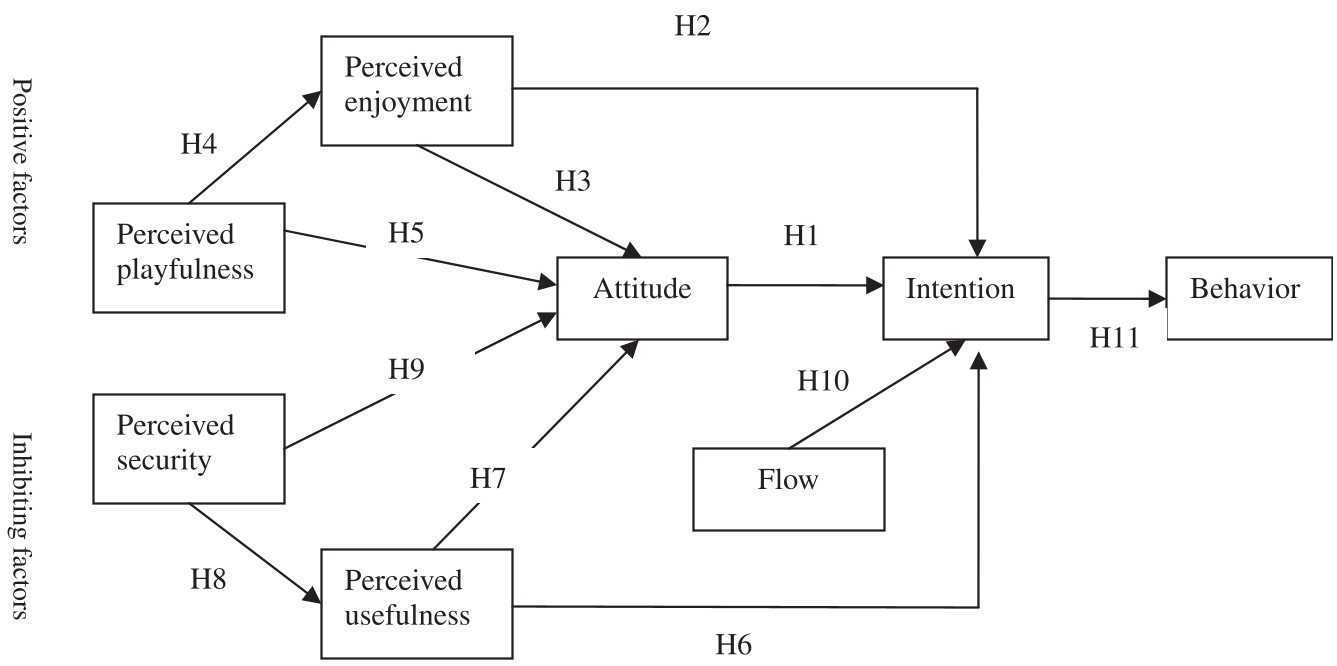 Figure 1: The hypothesized relationships between playfulness, security, and intention.
Experiments & Results: Playfulness Trumps Security
The data analysis yielded three groundbreaking insights:
- The Power of Fun: PP (Playfulness) had the highest impact on Perceived Enjoyment. When a game is fun, users are far more likely to ignore the "boring" aspects of utility.
- The Security Link: Interestingly, Perceived Security significantly impacts Perceived Usefulness (). This suggests that if a user doesn't feel safe, they stop seeing the game as a "useful" social tool for connecting with friends.
- The Attitude Paradox: While security is important, the link from Playfulness to Attitude was stronger than the link from Security to Attitude. We are "pleasure-seeking" animals; we prioritize the dopamine hit of the game over the abstract risk of a data breach.
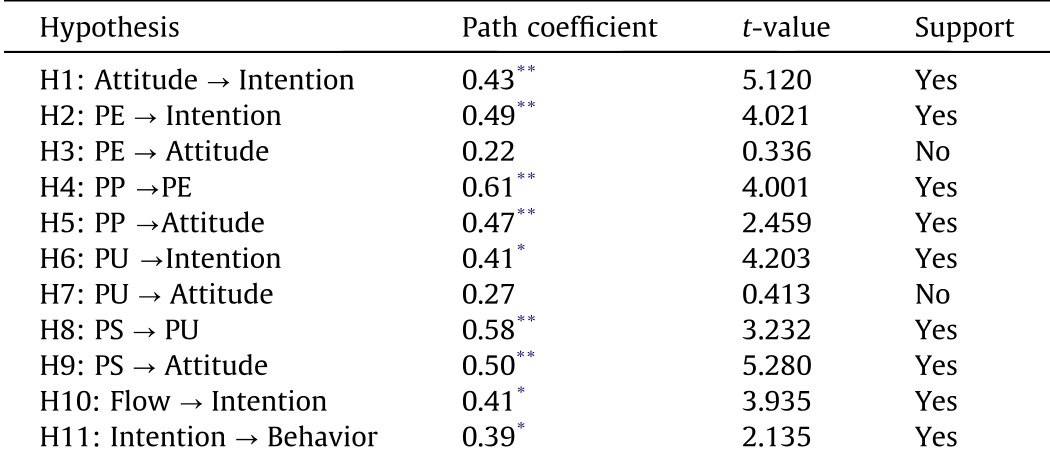 Table 2: Hypothesis test results highlighting the significance of PP and PS paths.
Deep Insights: The "Flow" Factor
The authors extended their model to show that Flow is the "antecedent of the antecedents." If a game can get you into "the zone" (high immersion), it actually improves your perception of both playfulness and security. In a state of Flow, the world (and the hackers) disappear.
Critical Analysis & Conclusion
Takeaway for Developers: To monetize SNGs, you can't just build a "safe" game; you must build a "playful" one that induces Flow. However, ignoring security is a long-term death sentence for a brand.
Limitations: The study primarily focuses on younger Korean students, which may not reflect the diverse demographics of today's "Candy Crush" grandmothers. Furthermore, as we move from Web 2.0 to Web 3.0/Metaverse, the "sociality" of games is becoming even more complex than what was captured here.
Future Outlook: Does the "Playfulness > Security" trade-off hold true in the age of high-stakes NFTs and Play-to-Earn (P2E)? This paper provides the foundational logic that suggests as long as the "Flow" is there, users will continue to take the risk.