
Why They Say No: Deconstructing the Psychology and Culture of Facebook Non-Use
Why some people do not use Facebook?
This qualitative study investigates why individuals choose not to join or opt-out of Facebook. Using semi-structured interviews, it identifies 12 recurring reasons for non-use, validating traditional factors like privacy and trust while surfacing novel socio-cultural drivers like religious beliefs and "infophobia."
TL;DR
While Facebook boasts billions of users, a vocal and conscientious minority is choosing to "opt-out." This study moves beyond the simple "privacy concern" narrative to reveal that the rejection of social media is often tied to deep-seated religious beliefs, cultural norms, and a phenomenon called Infophobia. It isn't just about what Facebook is; it's about what it costs a person's identity and peace of mind.
Academic Context: This is a critical qualitative audit that shifts the focus from "User Retention" to "Resistance Logic," providing a rare look at the demographic that platforms struggle to capture.
The "Groupthink" Resistance: Why People Quit
Most social media research focuses on how to keep us scrolling. However, authors Aloudat, Al-Shamaileh, and Michael look at the "divergent thinkers"—those who refuse to fall prey to the hype. The motivation isn't merely a lack of technical skill. Instead, it is a deliberate "Identity Suicide" where the costs of digital presence—privacy loss, social comparison, and lack of authenticity—outweigh the benefits of connectedness.
Methodology: Listening to the Silent Minority
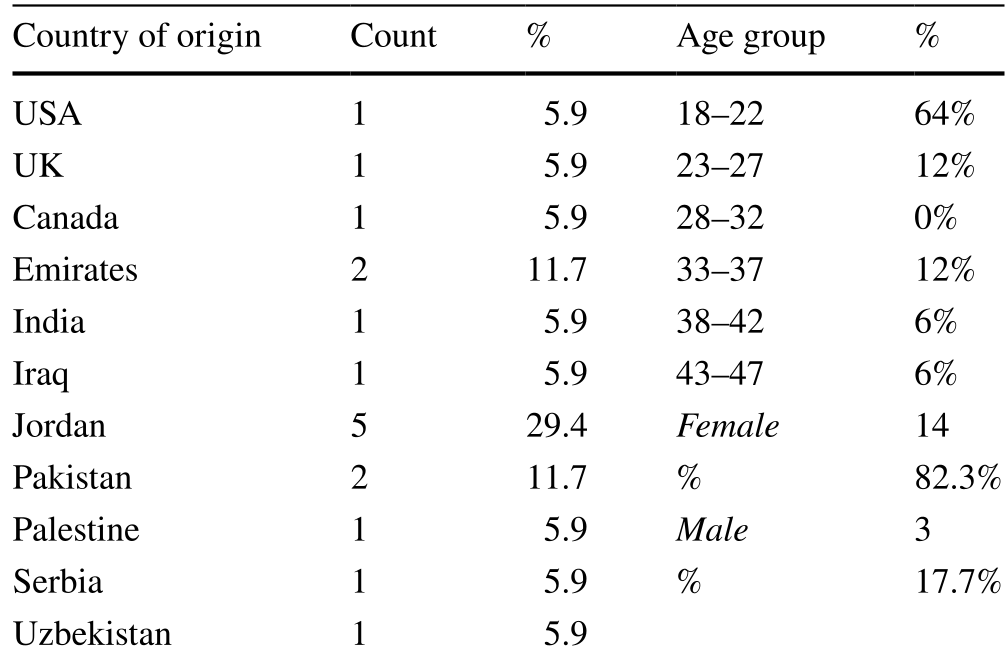
The researchers conducted 17 intensive interviews (14 females, 3 males) across diverse backgrounds. Using a "Data Saturation" strategy, they stopped only when new interviews ceased to provide new insights.
Core Findings: The 12 Pillars of Rejection
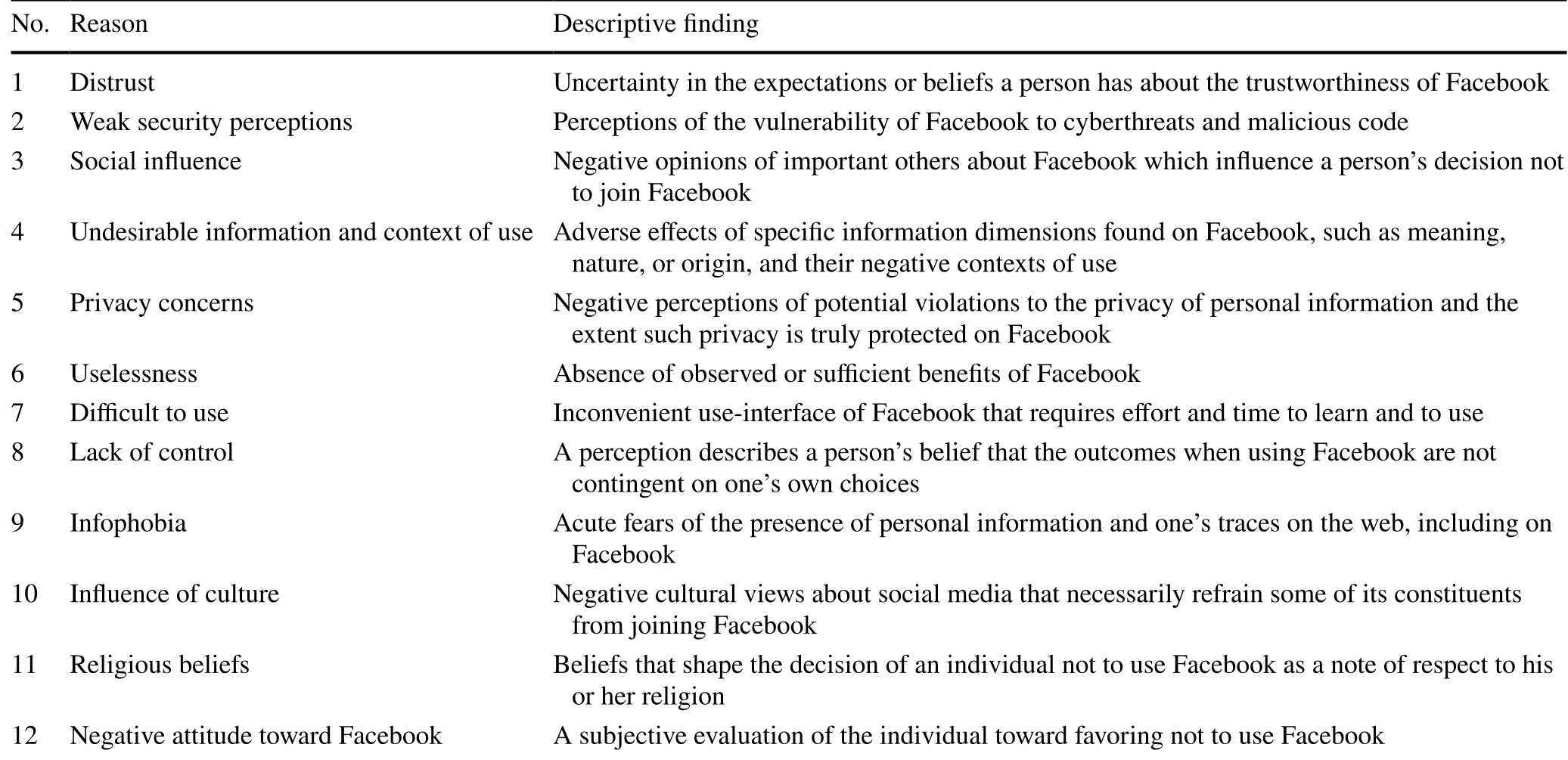
The study categorized reasons for non-use into 12 distinct themes. While traditional issues like Weak Security and Distrust remain high, the paper uncovers more nuanced psychological and cultural barriers:
1. The Physics of Privacy
The authors propose a "Law of Inertia" for privacy: A privacy at rest stays at rest unless acted upon by an unbalanced concern. Users are increasingly weary of "Unauthorized Secondary Use," where data collected for one purpose is sold for another.
- The Snowden Effect: A significant number of respondents cited surveillance and government monitoring as a primary reason for staying offline, viewing Facebook as a "spying machine."
2. Cultural & Religious Friction
This is where the paper truly shines. In conservative contexts (like the Middle East), Facebook is often seen as a threat to cultural modesty.
- Gender Inequality: Cultural views often make it "socially acceptable" for men to be online, but stigmatize women who post photos.
- Religious Beliefs: Some non-users cited the "Evil Eye" (the fear of jealousy causing harm) as a reason not to share personal life milestones online.
3. Infophobia and Radical Authenticity
One of the most striking findings is the existence of Infophobia—an acute fear of even having a digital footprint. Participants expressed a visceral discomfort with the idea that their information is "immortal" on a server, even after an account is deleted.
SOTA Comparison: Diverging from the Norm
Unlike previous studies that suggest social media is a substitute for face-to-face social connectedness (specifically for the shy), this research finds that non-users view Facebook interactions as "Human-less." They perceive the platform as a stage for "self-emotional deception" and "bragging," favoring "old-fashioned" traditional communication over the "fabricated" nature of digital posts.
Critical Insight: The "Uselessness" of the Giant
There's a growing sentiment that Facebook is becoming "outdated." Respondents noted that interactive platforms like Instagram and Snapchat feel "quicker" and represent "real-life moments," whereas Facebook feels like an "over-analyzed" archive of lies.
Conclusion & Future Outlook
This study serves as a wake-up call for Big Tech. The assumption that everyone wants to be connected is a fallacy. As the novelty effect of social media wears off, the "resistance" factors—privacy, religious alignment, and the desire for "digital silence"—are becoming the new SOTA for user behavior research.
Takeaway: Future social platforms should not just focus on features, but on "de-datafication"—giving users back the control they feel they've lost to the "monetization of the self."
Study Limitations
The sample size (17) is small and skewed toward females (82.3%). While qualitative saturation was reached, the findings are indicative rather than globally generalizable, necessitating further quantitative "big data" validation of these cultural resistance factors.