
Wi-Fi 2.0: Orchestrating the Economics of Spectrum "Whitespaces"
11055_Understanding Wi-Fi 2.0 from the economical perspective of wireless service providers.
The paper introduces "Wi-Fi 2.0," a framework for dynamic spectrum access (DSA) in licensed whitespaces (WS). It proposes a profit-maximization strategy for Wireless Service Providers (WSPs) through a "private commons" model, utilizing joint customer admission and eviction control to navigate time-varying spectrum availability.
TL;DR
The paper shifts the focus of Cognitive Radio (CR) from purely technical sensing to economic sustainability. It defines "Wi-Fi 2.0" as Internet access provided over licensed whitespaces (like TV bands). The core contribution is a profit-maximization framework for Wireless Service Providers (WSPs) that uses joint admission and eviction control to handle the unpredictable return of licensed primary users.
Background: Beyond the Crowded ISM Bands
Current Wi-Fi operates in unlicensed ISM bands (2.4GHz/5GHz), which are increasingly congested. Deeply rooted in Dynamic Spectrum Access (DSA), the authors propose moving into the "Whitespaces" (WS)—licensed bands temporarily unused by their owners. Wi-Fi 2.0 offers better propagation and larger coverage, but it introduces a fatal flaw: Preemption. If a Primary User (PU) returns, the secondary user must leave immediately.
The Core Problem: The Eviction Dilemma
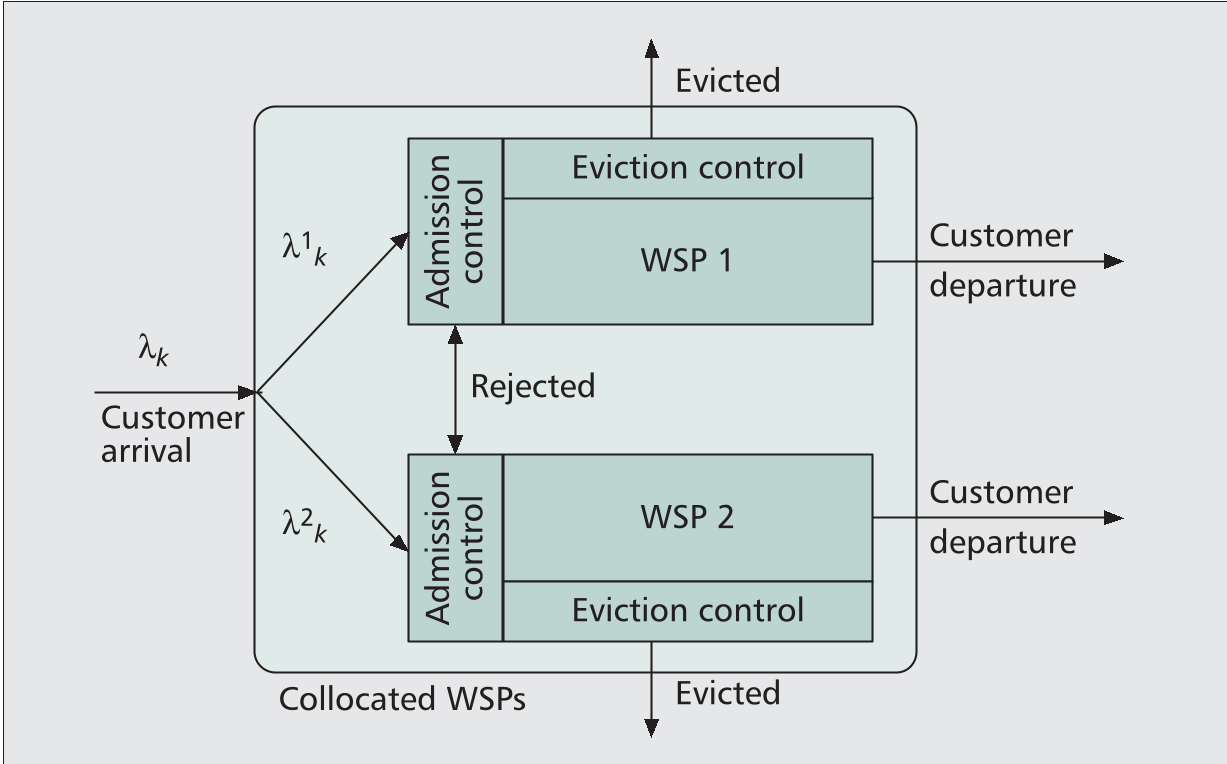
In traditional networks, you either admit a user or reject them (Admission Control). In Wi-Fi 2.0, you might have to kick them out mid-session (Eviction Control).
- The Conflict: How do you decide who to kick out?
- The Cost: Eviction requires paying the user a reimbursement to mitigate dissatisfaction.
- The Goal: Maximize the WSP's profit, which is:
(Service Charges) - (Spectrum Leasing Costs) - (User Reimbursements).
Methodology: The Three-Tier Market & SMDP
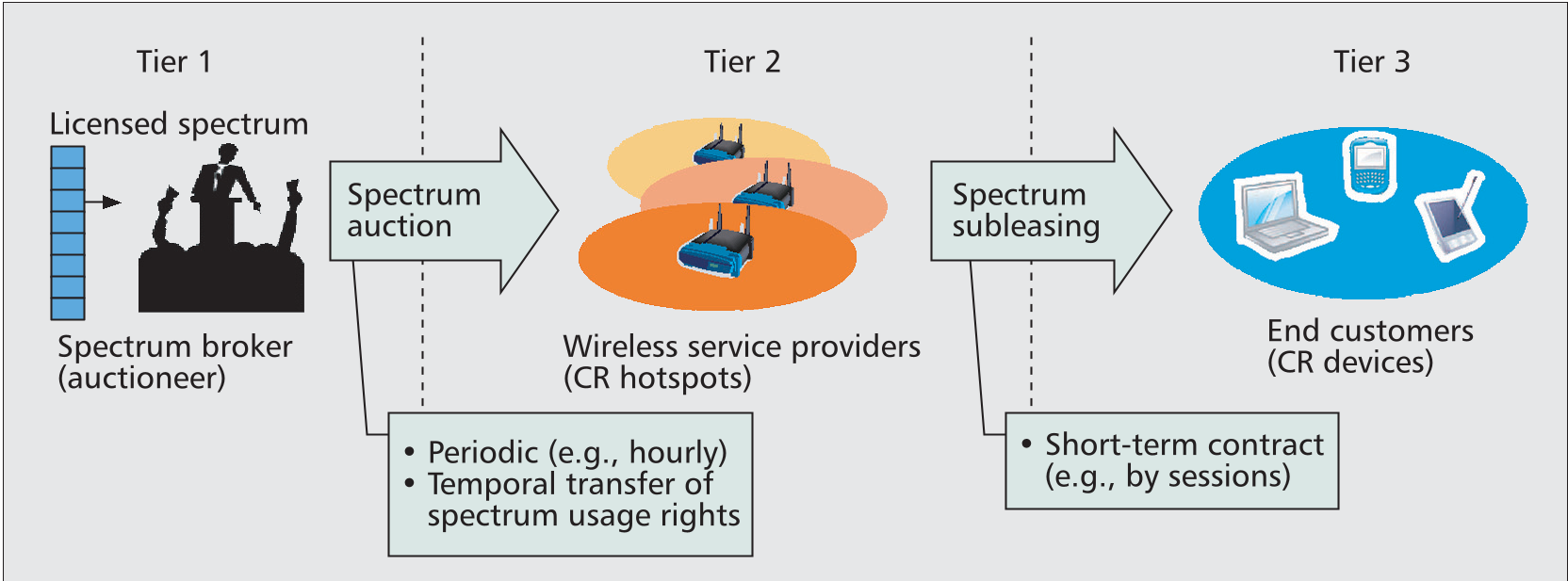
The authors propose a Dynamic Spectrum Market (DSM) consisting of a Spectrum Broker, WSPs, and CR Customers.
The SMDP Framework
To solve the optimization problem, the authors use a Semi-Markov Decision Process (SMDP). The state of the system is defined by the number of users in each QoS class and the current availability of channels.
- Decision Epochs: Triggered by user arrivals, departures, or PU state changes (ON/OFF).
- Actions: Admit/reject arrivals, and choose which class to evict when a channel "disappears" because a PU returned.
Prioritized Control
Not all users are equal. By categorizing users into priority classes (e.g., Gold, Silver, Bronze), a WSP can evict lower-priority users (web surfers) first to preserve the connection of high-priority users (video streamers), thereby maximizing the "value" of the remaining spectrum.
Experimental Insights: Finding the Sweet Spot
The paper provides a rigorous analysis of the trade-offs between Blocking Probability (Pb) and Dropping Probability (Pd).
As shown in the charts, there is a "concave" relationship between price and profit:
- Low Price: High user volume, but low revenue per head and high spectrum leasing costs lead to low profit.
- High Price: High revenue per head, but the arrival rate drops exponentially, leaving channels underutilized.
- The Optimum: A balanced tariff that maximizes throughput while keeping the "reimbursement risk" manageable.
Critical Analysis & Future Value
While written in 2010, the insights regarding market competition and QoS-aware eviction remain highly relevant for modern Open-RAN and Private 5G/6G deployments.
Limitations noted:
- The model assumes a Poisson arrival rate, which may not capture bursty modern data traffic.
- The "sensing" is assumed to be perfect, whereas in reality, hidden terminal problems could lead to harmful interference.
Conclusion
Wi-Fi 2.0 isn't just about better radios; it's about a better market. By treating spectrum as a preemptible asset and using SMDP to manage the risks of user eviction, WSPs can turn volatile whitespaces into a profitable venture.