
WicLoc: Revolutionizing Indoor Positioning via Passive Crowdsourcing and MDS-C
WicLoc: An indoor localization system based on WiFi fingerprints and crowdsourcing
WicLoc is a crowdsourced indoor localization system that utilizes WiFi fingerprints and user motion data (accelerometer/gyroscope) to eliminate the need for labor-intensive site surveys. It utilizes a weighted KNN algorithm for room-level classification and a novel Multi-Dimensional Scaling with Calibrations (MDS-C) algorithm for precision absolute coordinate estimation.
TL;DR
Building a WiFi fingerprint database usually involves a grueling process of walking through every inch of a building. WicLoc changes this by leveraging the data already being generated by users' smartphones during their daily routines. By combining a weighted version of the K-Nearest Neighbor (KNN) algorithm with a calibrated Multi-Dimensional Scaling (MDS-C) approach, WicLoc achieves an impressive 4.65m average accuracy without a single manual site survey.
The Pain Point: The Death of the "Site Survey"
Fingerprint-based localization relies on the Map-Matching principle: if you know what the WiFi signal "looks like" at Point A, you can find Point A again later. However, the manual collection of these fingerprints is:
- Labor-Intensive: Imagine walking 1,600 sqm and stopping every 2 meters.
- Stale: WiFi signals change when furniture moves or doors open/close, rendering static databases useless.
WicLoc addresses this by using Crowdsourcing. It silently collects WiFi RSSI (Received Signal Strength Indication) and inertial sensor data (Accelerometer/Gyroscope) from users' phones to build the database dynamically.
Methodology: Turning Motion into Math
WicLoc's architecture is a two-phase pipeline that bridges the gap between raw signal collection and absolute spatial coordinates.
1. The Fingerprint Model and Anchor Points
The system doesn't just collect data; it looks for "Events." When a user turns at a corner or enters a room, the WiFi signal strength often shows a characteristic spike or drop. WicLoc uses these as Anchor Points.
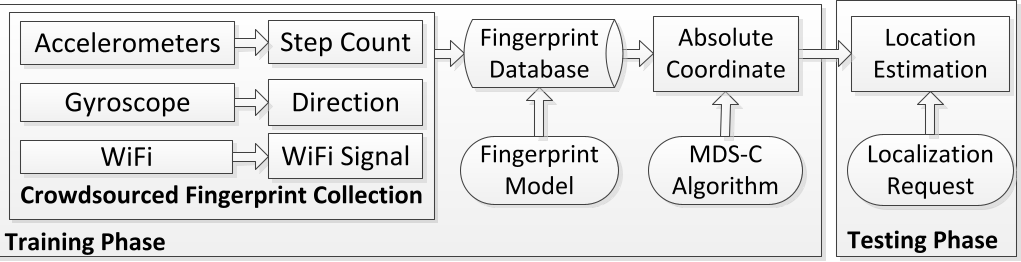 Fig 1: The dual-phase architecture of WicLoc, from crowdsourced collection to absolute coordinate mapping.
2. Manhattan-W-KNN for Room Leveling
Standard KNN treats all Access Points (APs) equally. WicLoc identifies that some APs provide redundant information. It assigns weights () to APs—the more an AP correlates with others, the lower its weight. Using Manhattan Distance with these weights, the system hits an average 87% accuracy in room-level classification.
3. MDS-C: Beyond Relative Coordinates
Standard MDS converts distance matrices into spatial coordinates, but they are often "floating" or rotated incorrectly. WicLoc’s MDS with Calibrations (MDS-C) uses the detected anchor points (corners/doors) to perform a Least Squares (LS) transformation, pinning the relative "cloud" of points onto the actual floor plan.
Performance Benchmarks
WicLoc was tested in a 10th-floor environment at Beihang University against two major competitors: LiFS and EZ.
- Accuracy: WicLoc (4.65m) > LiFS (5.88m) > EZ (7.0m).
- Stability: The system becomes highly stable once the training set reaches 80% of the total collected fingerprints, showing its resilience to the "noise" typical of crowdsourced data.
 Fig 2: CDF of localization errors. WicLoc shows a significant lead, with 70% of errors falling under 6 meters.
Critical Insight & Conclusion
The genius of WicLoc lies not just in the math of MDS, but in the physical intuition that human movement patterns (turns and door entries) serve as perfect "natural landmarks." While the 4.65m error is higher than some specialized hardware solutions (like UWB), it represents a State-of-the-Art (SOTA) achievement for zero-effort, software-only deployment.
Future Outlook: The next step for such systems is moving toward Heterogeneous Crowdsourcing, where different types of smartphones (with varying sensor qualities) can contribute to a single, unified signal map.