
WikiBrain: Democratizing Computation on the World's Knowledge
WikiBrain: Democratizing computation on Wikipedia
WikiBrain is an open-source Java-based software framework designed to provide high-performance access to Wikipedia's massive datasets and state-of-the-art algorithms. It democratizes research by offering integrated "primitives" for multilingual concept alignment, semantic relatedness (SR), and geospatial data analysis, outperforming existing niche tools in scope and usability.
TL;DR
Wikipedia has evolved from a human reference to a fundamental backbone for AI and Data Science. However, the engineering overhead to mine its terabytes of data is a massive barrier. WikiBrain is a Java-based powerhouse that provides "one-stop-shop" access to Wikipedia-based algorithms, including semantic relatedness, geospatial analysis, and multilingual alignment. Essentially, it turns complex data engineering into a few lines of code.
The Engineering Bottleneck: Why Wikipedia Research is Hard
For a decade, researchers in Natural Language Processing (NLP) and Geographic Information Science (GIS) have struggled with the same "plumbing" issues:
- Parsing Hell: Handling messy Wikitext, templates, and redirect graphs.
- Resolution Bias: Managing the "Geoweb Scale Problem," where a city like Berlin (900 km²) is reduced to a single latitude/longitude point.
- Fragmentation: Tools like DBpedia provide facts but no algorithms; tools like Wikipedia Miner provide one specific algorithm but no flexibility.
WikiBrain's insight is to treat these challenges not as unique problems, but as computational primitives that should be baked into the library.
Methodology: The Core Primitives
1. Multilingual Alignment (The Concept Layer)
Instead of treating Chaque language edition as a silo, WikiBrain aligns them into Universal Concepts. Using Wikidata and the Conceptualign algorithm, it maps "Germany" (EN), "Deutschland" (DE), and "Alemania" (ES) to a single concept ID. This allows for "language-neutral" world models.
2. Semantic Relatedness (SR)
WikiBrain implements six SOTA algorithms (e.g., Milne-Witten, ESA) to calculate the "closeness" between two terms.
- Speed Optimization: It uses a sparse matrix representation in memory-mapped flat files to retrieve ~1 million links per second.
- Ensemble Power: It supports linear combinations of multiple SR metrics to mimic human intuition more accurately.
3. Spatial Intelligence
To fix the Geoweb Scale Problem, WikiBrain integrates Natural Earth shapefiles. Instead of seeing Alaska as a dot, the system understands its polygonal boundary, enabling correct distance and "localness" calculations.
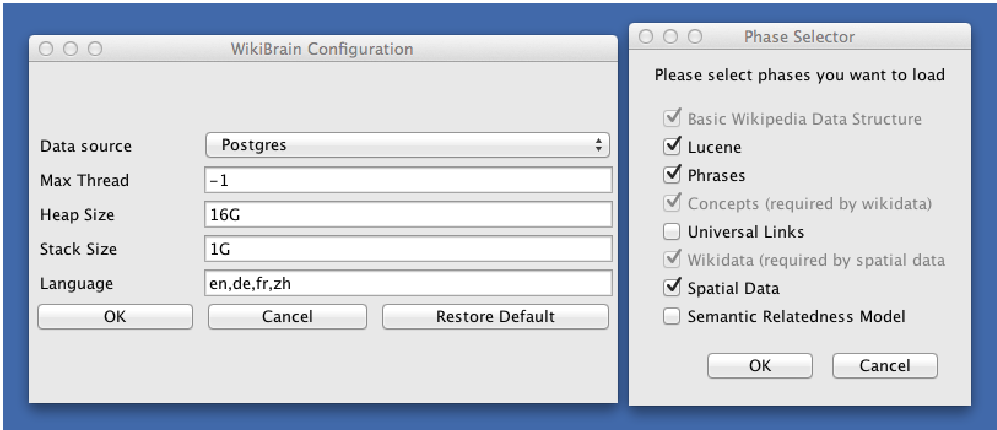 Figure 1: The WikiBrain GUI simplifies the import of massive Wikipedia dumps into localized SQL databases.
Experiments & Case Study: Tobler's First Law
The authors demonstrated WikiBrain's power by replicating a famous study on Tobler’s First Law: "Everything is related to everything else, but near things are more related than distant things."
Earlier researchers spent months and thousands of lines of code to prove this. Using WikiBrain, the replication requires a simple loop:
- Sample 100k pairs of concepts.
- Calculate geodetic distance using the built-in
GeodeticCalculator. - Calculate semantic similarity using the
SRMetric.
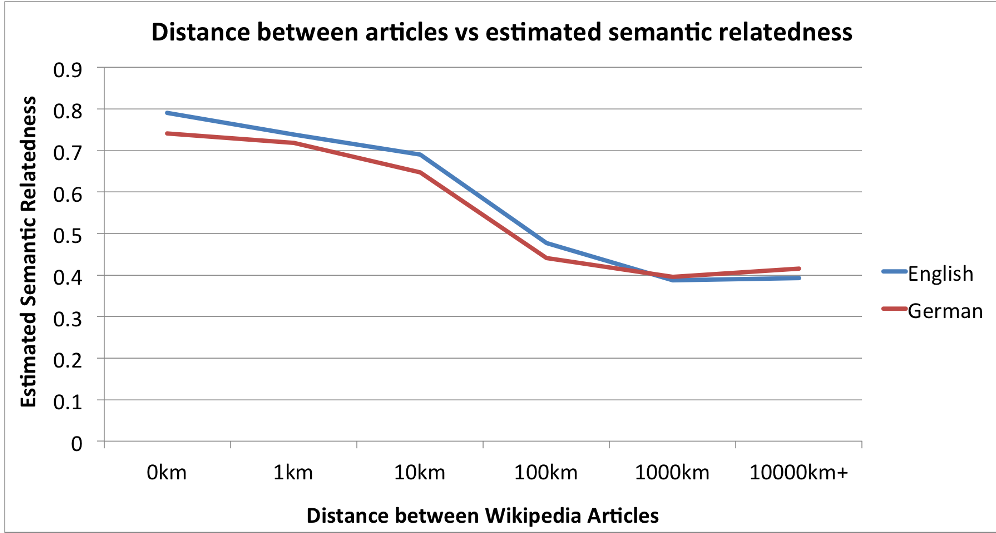 Figure 2: Results from 100,000 concept pairs showing a clear decay in semantic relatedness as geographic distance increases—consistent across multiple languages.
Performance Benchmarks
| Language Segment | Article Count | Link Count | Import Time |
|---|---|---|---|
| Simple English | 102K | 6M | 8 min |
| Full English | 4.6M | 470M | 10.6 hours |
| 25 Largest Languages | 25M | 1.6 Billion | ~52 hours |
Critical Insight & Conclusion
WikiBrain represents a "democratization" effort. By lowering the barrier to entry, it allows a lone developer on a laptop to perform the same scale of analysis previously reserved for teams at Google or Microsoft.
Limitations: Being Java-based, it may feel heavyweight for the modern Python-dominated AI ecosystem. Furthermore, while it addresses spatial and semantic data, it is just beginning to integrate edit histories and user reputation—key components for studying misinformation and collaborative behavior.
Future Outlook: As we move toward LLMs and Retrieval-Augmented Generation (RAG), frameworks like WikiBrain serve as the essential bridge between unstructured text dumps and structured, queryable knowledge.