
WikiDetect: Mastering Wikipedia Vandalism Detection via Pure Linguistic Intelligence
WikiDetect: Automatic Vandalism Detection for Wikipedia Using Linguistic Features
WikiDetect is an automatic vandalism detection system for Wikipedia that utilizes 28 linguistic and semantic features processed through machine learning classifiers. It achieves a state-of-the-art ROC-AUC of 0.893 and 0.889 on the PAN 2010 and 2011 datasets, respectively, without relying on external user reputation metadata.
TL;DR
With millions of edits daily, Wikipedia is a prime target for malicious "vandalism." WikiDetect is a software system that ditches external user reputation scores to focus purely on the text. By combining traditional NLP features with semantic analysis (WordNet) and a robust ensemble of classifiers, it achieves a high ROC-AUC of ~0.89, competing with top-tier systems from the PAN international competitions.
Background: The Open-Gate Dilemma
Wikipedia’s strength—its openness—is also its greatest vulnerability. Malicious edits range from "blanking" pages to subtle, ironic misinformation. While bots exist to revert obvious spam, many "sneaky" vandals bypass simple filters. Previous SOTA methods (like WikiTrust) relied on the history of the person editing. WikiDetect asks a harder question: Can we detect a lie just by looking at the words?
Methodology: The 28-Feature Arsenal
The authors identified 28 independent features that define the "fingerprint" of a vandal.
1. Syntactic & Statistical Features
- Length Ratios: Significant drops in article length often signal content deletion.
- Character Patterns: Longest sequences of identical characters (e.g., "aaaaa") or excessive uppercase letters (shouting).
- Vulgarity & Suspicion: Counts of vulgar words and suspicious pronouns.
2. Semantic Analysis (The Secret Sauce)
WikiDetect utilizes Apache Lucene to calculate cosine similarity between the old and new text. More importantly, it uses WordNet and the Jiang-Conrath similarity measure to determine if added text actually belongs to the topic. If an edit introduces words that have zero semantic relation to the existing paragraph, the vandalism probability spikes.
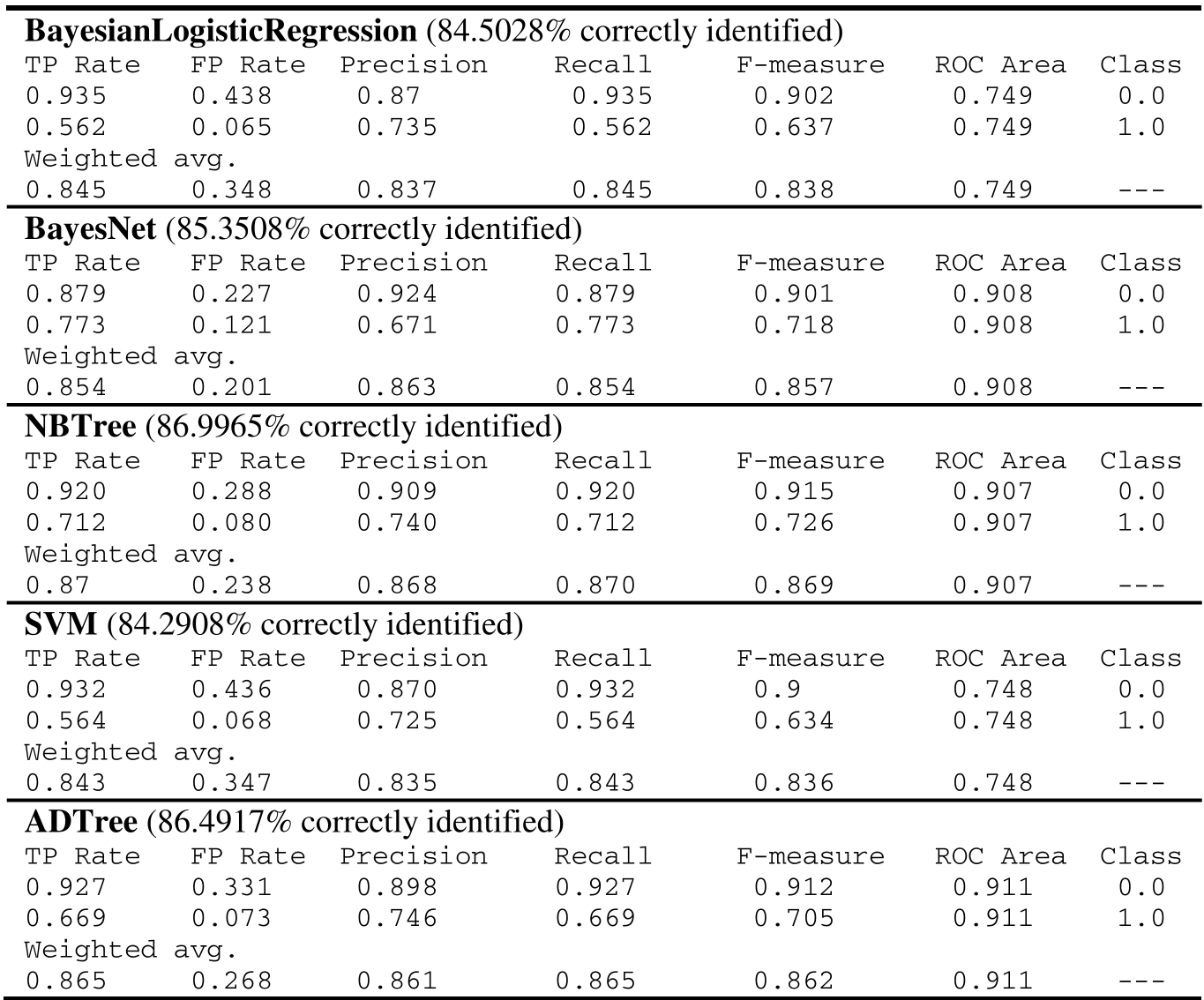 Table 1: Performance of various classifiers after adding semantic and similarity features.
Experiments & Results
The researchers faced a common ML hurdle: Class Imbalance. Vandalism only represents about 10% of the data. They handled this by filtering regular edits and normalizing features to ensure algorithms like SVM wouldn't be biased by large numerical ranges.
Classifier Performance
- ADTree (Alternating Decision Tree): Proved to be the most consistent individual performer (~86% accuracy).
- The Voting Model: By combining multiple models (SVM, BayesNet, NBTree), WikiDetect produced a more grounded "verdict" that inherited the strengths of each.
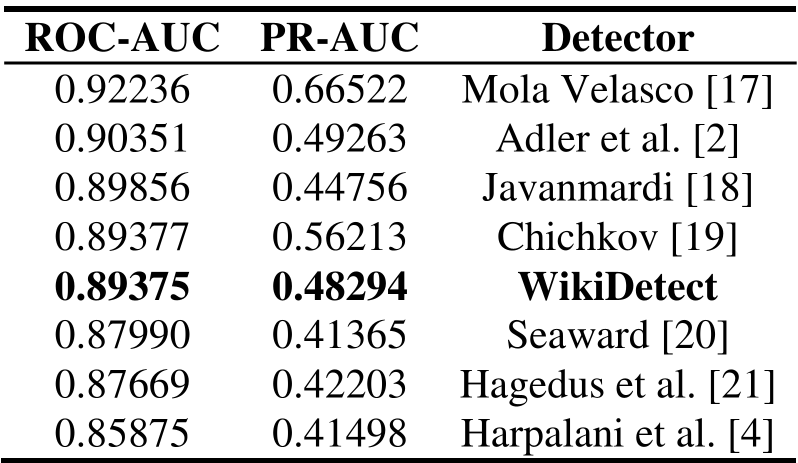 Table 2: WikiDetect rankings (ROC-AUC 0.893) against top participants in the PAN-10 competition.
In the PAN-2011 evaluation, WikiDetect outperformed others with a ROC-AUC of 0.889, confirming the system's robustness across different years and datasets.
Critical Insight: Why This Matters
The most defining features determined by the system’s feature selection were:
- Anonymous Flag: Anonymous users are statistically more likely to vandalize.
- Lucene Similarity Score: Malicious edits often disrupt the "thematic flow" of text.
- Uppercase Ratio: Emotional/destructive edits often involve "screaming" in text.
Conclusion & Future Outlook
WikiDetect proves that we don't always need to know who an editor is to know what they are doing. Future iterations could leverage Pragmatic Analysis (understanding the intent behind a sentence) to catch even more sophisticated vandals.
Limitations
Despite high ROC-AUC scores, some vandalism patterns (like subtle factual errors: changing a date from 1980s to 1970s) remain difficult to catch because they are linguistically "clean" but factually "dirty."
Takeaway: Effective vandalism detection requires a blend of statistical anomaly detection and deep semantic understanding.