
WikiNetViz: Mapping the Battlefield of Collaborative Knowledge
WikiNetViz: Visualizing friends and adversaries in implicit social networks
This paper introduces WikiNetViz, a visual analytics tool designed to quantify and visualize disputes between Wikipedia contributors. Leveraging the ControversyRank model, it maps implicit social networks based on recursive "edit-warring" behaviors (text deletions) to identify controversial articles and opposing user factions.
TL;DR
Wikipedia is often praised for consensus, but its foundation is built on conflict. This paper presents WikiNetViz, a tool that transforms the "invisible wars" of Wikipedia edit histories into navigable social maps. By measuring how much content contributors delete from one another, the system identifies controversial topics and unmasks the hidden "lobbies" or factions fighting for narrative control.
The Hidden Complexity of Antagonistic Networks
In traditional social networks, we look for "links" as signs of affinity. In Wikipedia, however, the most informative links are often negative. Existing research (like History Flow) has looked at how articles evolve, but it often misses the human element: Who is fighting whom?
The authors argue that a "dispute" is best defined by deletion. If User A deletes 500 words written by User B, there is a measurable antagonistic relationship. These interactions form an implicit social network that reflects the actual power dynamics of online activism.
Methodology: ControversyRank and Dispute Networks
The core of the system relies on two pillars:
1. The Dispute Metric
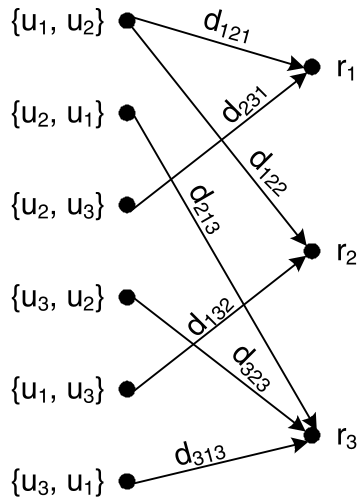
The researchers model disputes as a bipartite graph between contributors and articles. The "weight" of a dispute is the number of words deleted. Crucially, they distinguish between active disputes (deleting others' work) and passive disputes (having one's own work deleted).
2. ControversyRank (CR)
Borrowing logic from PageRank but applying it to conflict, CR uses a mutual reinforcement principle:
- An article is highly controversial if it attracts disputes from users who are otherwise "peaceful."
- A contributor is highly controversial if they engage in conflicts across articles that are generally stable.
3. Clustering the Lobbies
Once the network is built, the tool uses the CLUTO toolkit to cluster users. Since the edges represent conflict, the tool calculates "similarity" as the absence of conflict. Users who don't delete each other's work but do delete the same "enemies'" work are clustered together, revealing ideological factions.
Experimental Results: The "Ars Technica" Case Study
The authors tested WikiNetViz on the "Ars Technica" article, a known magnet for edit wars regarding the inclusion of site criticisms.
- Quantitative Success: Out of a dataset of 11,545 articles, the CR model correctly flagged Ars Technica as the 5th most controversial.
- Visual Proof: The tool identified the 10th most active "warriors" and visualized their interactions, with node height representing their controversy score and edge thickness representing the scale of deletions.
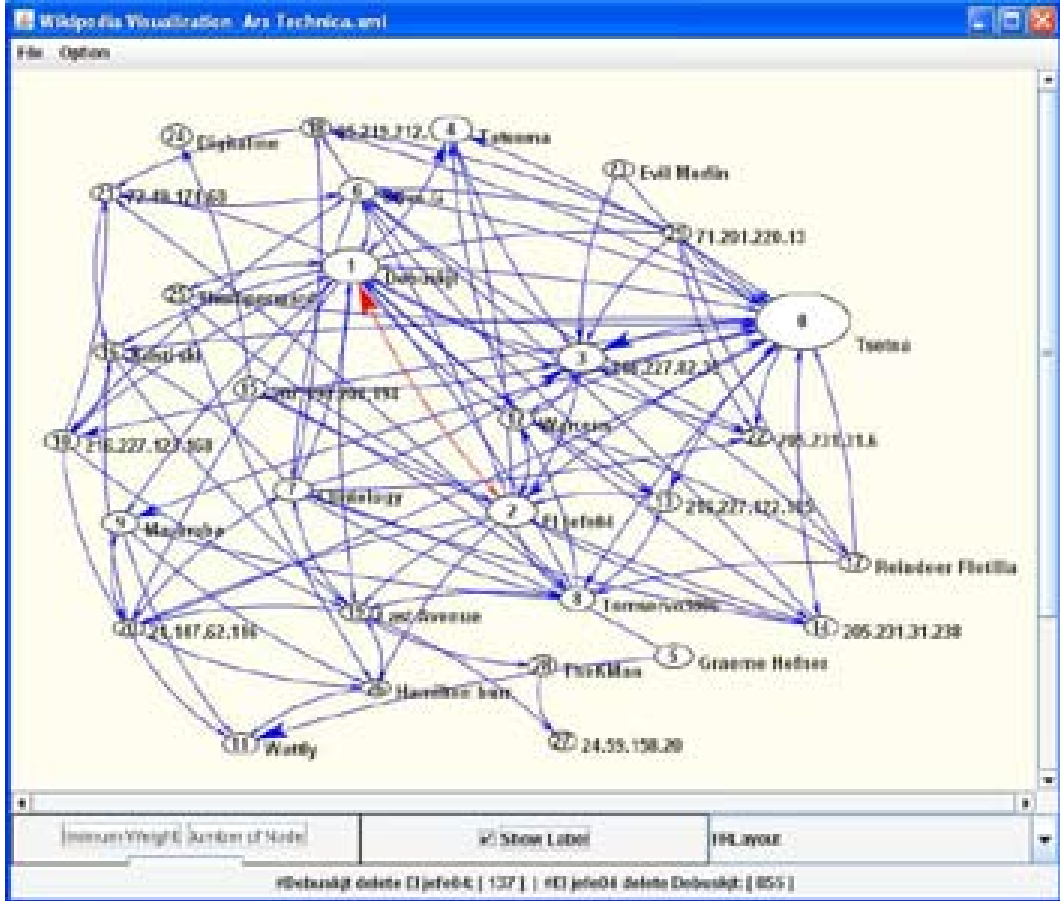
The clustering algorithm effectively separated the "Supportive" group (those wanting to include criticisms) from the "Opposing" group (those trying to remove them), providing a clear map of the editorial stalemates that define controversial topics.
Critical Analysis & Future Outlook
Takeaway
WikiNetViz proves that "Shared Antagonism" is as strong a clustering signal as "Shared Interest." By quantifying deletions, we can gain an objective view of subjective biases.
Limitations
- Semantic Blindness: The current model treats all deletions equally. It cannot distinguish between a "vandalism revert" and a "genuine ideological dispute" without manual intervention.
- Temporal Latency: The model relies on historical dumps; real-time tracking of edit wars would require higher-frequency data processing.
Future Work
The integration of Natural Language Processing (NLP) to analyze the sentiment of the deleted text—and the comments left in talk pages—could refine the "controversy score" and differentiate between constructive editing and toxic gatekeeping.