
On the Windfall of Friendship: How Altruism Reshapes Social Network Security
On the Windfall of Friendship: Inoculation Strategies on Social Networks
This paper introduces a game-theoretic framework to analyze a "Virus Inoculation Game" on social networks, specifically defining the "Windfall of Friendship" (WoF). It measures how social welfare improves when players care about their neighbors' utility, proving that while players generally benefit from altruism, the social welfare does not increase monotonically with the degree of friendship.
TL;DR
Is being a "good friend" actually good for the system? This paper explores a Virus Inoculation Game through a socio-economic lens. It introduces the Windfall of Friendship (WoF)—a metric quantifying the social gain when individuals care about their neighbors' security costs. The findings are a mixed bag for altruism: while friendship generally improves social welfare, more "caring" can sometimes lead to worse global outcomes due to the complex stability of Nash Equilibria.
Problem & Motivation: The Cost of Selfishness
In a digital ecosystem (like Facebook or mobile networks), viruses spread through connection components. Each user faces a dilemma: spend on inoculation (antivirus) or risk an infection cost with a probability proportional to the size of their vulnerable "attack component."
Previous research identified the Price of Anarchy (PoA): in purely selfish environments, the social cost can be times higher than the social optimum. However, these models assume we are heartless agents. In reality, we often care if our neighbor’s computer crashes. The authors ask: Can we quantify this "friendship" and does it actually fix the inefficiency of decentralized networks?
Methodology: The Friendship Factor
The core innovation is the distinction between Actual Cost (intrinsic loss) and Perceived Cost (what drives decision-making).
Perceived Individual Cost
A player doesn't just look at their own risk; they incorporate the costs of their friends scaled by a Friendship Factor (F):
This leads to the Friendship Nash Equilibrium (FNE). When , we return to the classic selfish model. When , you value your friend's wallet as much as your own.
 Figure 1: Title and Authors from the original EC '08 presentation.
Mathematical Insight: The Non-Monotonicity of Caring
One might assume that increasing (stronger friendship) always improves the system. This is false.
The authors prove that the Windfall of Friendship does not grow monotonically. In certain "Star" network configurations, a medium level of friendship might stabilize a highly efficient equilibrium (where the center node inoculates), but increasing friendship further could make that state unstable, causing the system to collapse back into a more expensive equilibrium.
Experimental Analysis: From Stars to Complete Graphs
The paper provides a rigorous analysis of specific topologies to bound the "Windfall":
- Complete Graphs (): In a perfectly connected world, the Windfall of Friendship is at most 4/3. Friendship helps, but the "anarchy" is relatively contained.
- Star Graphs (): Here, friendship is a game-changer. A selfish center node might refuse to inoculate, forcing all leaves to pay for protection. However, a "friendly" center node will take the hit to protect its neighbors. In these cases, the WoF can reach , nearly reaching the social optimum.
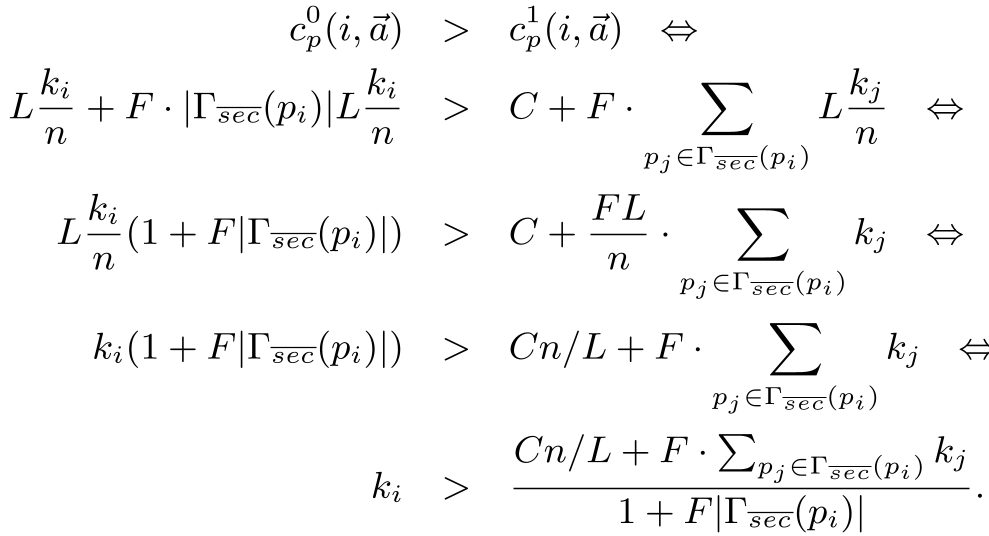 Figure 2: The critical threshold for inoculation in an FNE, showing how neighbor component sizes () influence individual decisions.
Hardness Results
The authors also deliver a dose of reality for algorithm designers: finding the "best" or "worst" friendship equilibrium is NP-hard. They prove this via reduction from Vertex Cover and Independent Dominating Set, suggesting that even with altruistic agents, predicting the final stable state of a network is computationally intensive.
Critical Analysis & Conclusion
This work provides a formal bridge between sociology and network security.
- The Good: It proves that local altruism (caring for neighbors) is a viable decentralized path to lowering social costs.
- The Bad: It warns policy makers that "encouraging responsibility" is not linear; structural incentives matter more than raw altruistic sentiment.
- Future Work: The model reaches its limits with its "1-hop" friendship definition. Future research should examine "transitive friendship" or Euclidean distance-based caring, reflecting more nuanced social ties.
Final Takeaway: Friendship is a windfall for social welfare, but in the game of network security, the structure of the "friendship graph" determines whether that windfall is a slight breeze or a revolutionary gale.