
Social-Aware Edge Caching: Optimizing F-RANs Through the Lens of Human Interaction
SPECIAL SECTION ON WIRELESS CACHIING TECHNIQUE FOR 5G
This paper introduces a social-aware edge caching framework for Fog Radio Access Networks (F-RANs), utilizing a Markov-chain-based model to analyze content diffusion. It optimizes caching strategies across both User Equipment (UE) and Remote Radio Heads (RRHs) by leveraging mobile social relationships and user clustering behaviors.
TL;DR
To address the explosive growth of mobile data traffic, this paper proposes a Social-Aware Edge Caching scheme within Fog Radio Access Networks (F-RANs). By modeling mobile users as nodes in a social network and using a Markov-chain-based diffusion model, the researchers optimized where and when to cache content across User Equipment (UE) and Remote Radio Heads (RRHs). The result? A significant reduction in backhaul pressure and faster content delivery.
Context: Why Social Context Matters for 5G
The transition to 5G and beyond isn't just about faster radios; it's about smarter distribution. F-RANs leverage the "fog"—the edge of the network—to process and store data. However, most caching algorithms treat users as isolated data sinks. In reality, humans are social; we cluster in shopping malls and share viral videos with friends via D2D (Device-to-Device) links like Bluetooth or Wi-Fi. Ignoring these social ties leads to redundant transmissions and wasted bandwidth.
Methodology: The Markovian View of Viral Content
The authors treat content diffusion as a state-transition problem. If you have users, there are possible states representing who has the content and who doesn't.
1. The Three Paths of Access
The model assumes a hierarchy of retrieval to minimize cost:
- UE-UE (D2D): Highest priority. If a friend has it, get it from them.
- RRH-UE: Get it from a local edge node if no peer has it.
- Cloud (RCC): Last resort. Fetch from the remote center via the heavy fronthaul link.
2. Architecture & Optimized Caching
The paper introduces two layers of optimization:
- UE Caching: Identifying "Influentual" users based on their social contact frequency (inter-contact time) to act as initial seeds.
- RRH Caching: A dynamic utility function that drops content when the cost of storing it exceeds the "income" generated by saved fronthaul bandwidth.
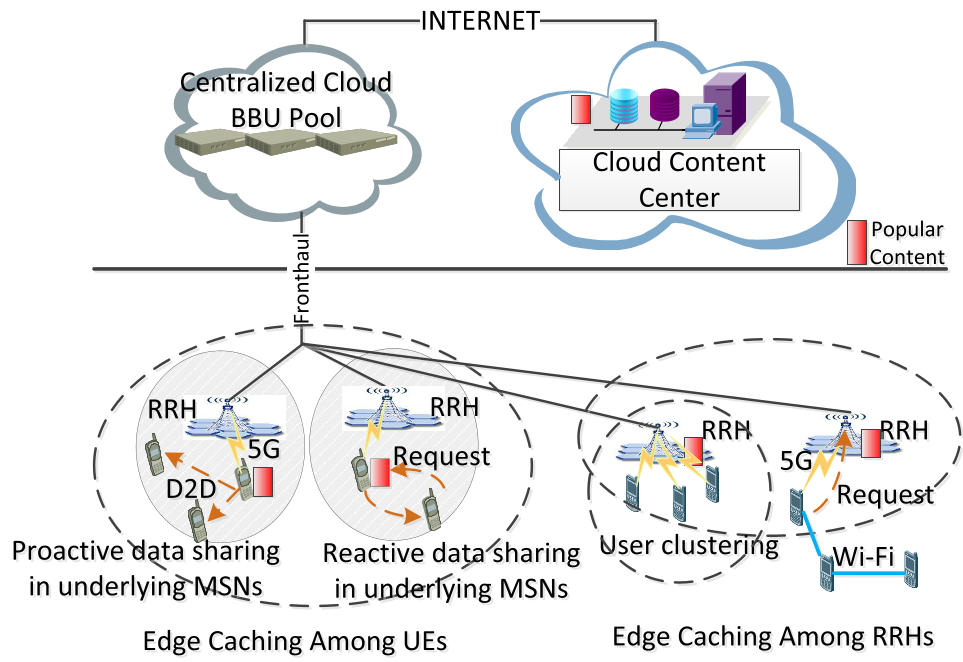 Figure 1: The F-RAN architecture showing the interaction between UEs, RRHs, and the Cloud.
Experiments: Performance Gains
The researchers validated their model using MATLAB simulations with 14 users and 4 RRHs. Key findings include:
- Reduced Latency: As the network operator invests in caching at more UEs (higher initial traffic cost), the overall diffusion delay drops sharply because peers help each other.
- The Efficiency "Sweet Spot": The paper identifies a point of diminishing returns. There is an optimal number of "seed" UEs where the delivery ratio is maximized relative to the bandwidth spent.
- Utility of RRHs: The "Income" of an RRH (saved bandwidth minus storage cost) peaks and then declines as more users successfully receive the content through social sharing, signaling the RRH to purge its cache.
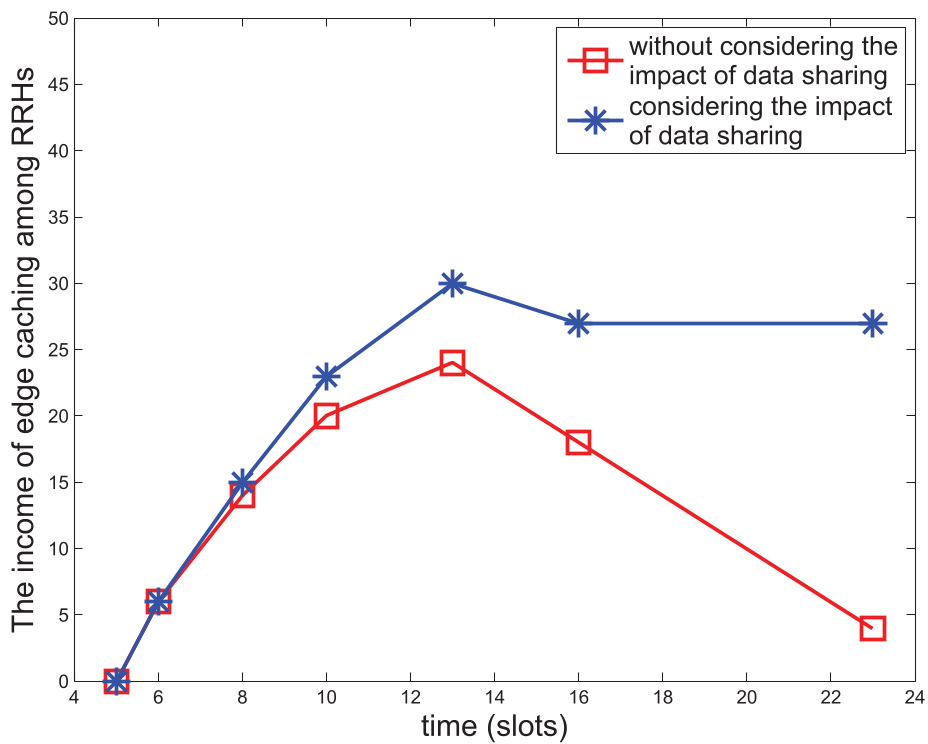 Figure 2: The utility (income) of RRH caching over time, highlighting the peak efficiency point.
Critical Insight: The Value of "Social" Inductive Bias
The brilliance of this work lies in its utility-driven cache eviction policy. Most caching schemes use LFU (Least Frequently Used) or LRU (Least Recently Used). This paper, however, uses the expected reduction in future fronthaul traffic as the metric. By predicting that social sharing will eventually satisfy user demand, the RRH can proactively free up storage space before the content even becomes "unpopular."
Conclusion & Future Outlook
This paper provides a robust mathematical framework for social-aware networking. While the state-space complexity () is a challenge for massive networks, the proposed suboptimal algorithms offer a practical path forward. Future research could integrate Federated Learning to protect user privacy while still allowing the network to learn social patterns for even more precise caching.
Takeaway: The future of 5G efficiency isn't just in the hardware—it's in understanding the social fabric of the people using it.