
[IEEE 2026] CLOVER: Bridging the Gap Between Wireless Stochasticity and MARL Coordination
Wireless Communication Enhanced Value Decomposition for Multi-Agent Reinforcement Learning
The paper introduces CLOVER, a cooperative Multi-Agent Reinforcement Learning (MARL) framework that integrates value decomposition with realistic, stochastic wireless communication. It utilizes a GNN-based centralized mixer conditioned on the realized inter-agent communication graph to achieve topology-aware credit assignment, outperforming standard QMIX and TarMAC baselines in Predator-Prey and Lumberjacks environments.
Executive Summary
TL;DR: CLOVER (Communication-enhanced vaLue decOmposition oVer rEalistic wiReless channels) is a novel MARL framework that treats the realized communication graph—the "who heard whom" map of a physical system—as a structural prior for credit assignment. By replacing flat mixing networks with a GNN-based mixer conditioned on wireless topology, CLOVER achieves SOTA performance in environments where communication is noisy and unreliable.
Background Positioning: This work sits at the intersection of Networked Control Systems and Cooperative RL. It moves beyond the "idealized channel" assumption of classic MARL (like CommNet or TarMAC) and provides a rigorous theoretical bridge between physical wireless dynamics and the Individual-Global-Max (IGM) consistency in value decomposition.
1. The "Ideal Communication" Fallacy
In traditional MARL research, communication is often treated as a "black box" where messages are delivered perfectly. However, in real-world search-and-rescue or swarm robotics:
- Medium Contention: Agents "collide" on frequencies.
- Signal Fading: Obstacles and distance drop packets.
- Dynamics: The network topology changes every millisecond.
The paper points out a critical flaw in existing mixers: QMIX and VDN are "blind" to the communication success. If Agent A fails to hear Agent B, the centralized mixer should know that their coordination was limited by that failure. Instead, standard mixers treat agent utilities as an unstructured collection, losing the valuable relational inductive bias provided by the actual communication outcomes.
2. Methodology: Topology as an Inductive Bias
Causal State Alignment
To train end-to-end, the authors solve a major technical hurdle: wireless arbitration (calculating SINR, packet drops) is non-differentiable. CLOVER uses Causal State Alignment, buffering messages at step for consumption at . This isolates the stochastic channel from the gradient path, allowing standard backpropagation.
The GNN Mixer & PEHypernet
The core innovation is the Communication-Graph-Conditioned GNN Mixer.
- The Graph: Nodes are agents; edges exist if a message was successfully received.
- The Propagation: Individual local Q-values () are propagated along these edges. Multi-hop GNN layers allow the value of one agent to be "reshaped" by its neighbors' inputs.
- The Weights: Unlike standard GNNs, the weights aren't fixed. A Permutation-Equivariant Hypernetwork (PEHypernet) generates node-specific weights based on the global state , ensuring the mixer remains sensitive to the environment context.
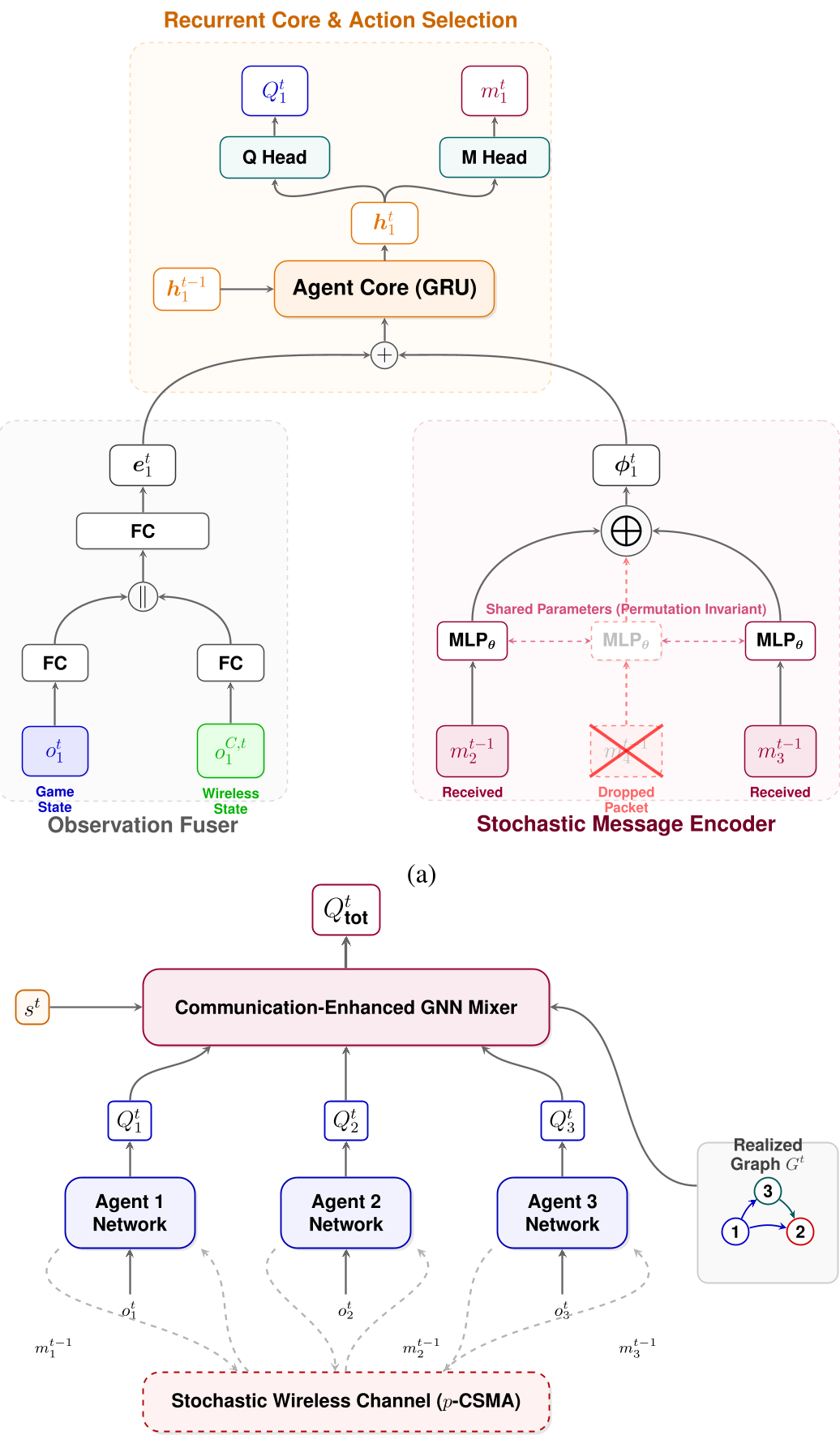 Figure: The CLOVER Architecture showing how the realized communication graph directly modulates the Value Mixer.
Mathematical Rigor
The authors prove that this GNN mixer is:
- Permutation Invariant: Reordering agent IDs doesn't change the outcome.
- Monotonic: It preserves , satisfying the IGM condition for decentralized execution.
- Strictly More Expressive: They prove the GNN mixer can represent coordination patterns that standard QMIX-style mixers simply cannot.
3. Experiments: Surpassing the Baselines
CLOVER was tested on Predator-Prey (PP) and Lumberjacks (LJ) under realistic p-CSMA wireless protocols.
- Performance Gain: In challenging settings (10x10 grids with obstacles), CLOVER consistently outperformed graph-agnostic models. In Lumberjacks, where coordination is harder (trees require 2 agents to chop), CLOVER continued to improve long after baselines plateaued.
- Bandwidth Adaptation: Behavioral analysis showed that CLOVER agents learned to communicate less when bandwidth was restricted, without losing significant performance—acting more like human coordinators who only speak when necessary.
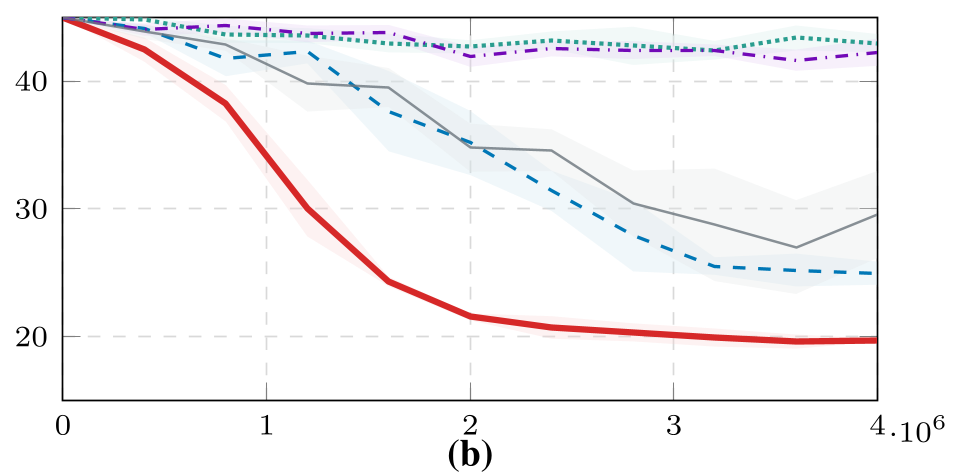 Figure: Learning curves in Lumberjacks. CLOVER (blue) shows superior sample efficiency and terminal reward.
4. Deep Insights: "Positive Listening"
A fascinating part of the ablation study is the visualization of speaker consistency. By analyzing the latent space of messages, the authors found that agents developed a "vocabulary." Messages sent when a prey was spotted were clusters together in the latent space, proving that the agents weren't just exchanging noise—they were performing grounded communication.
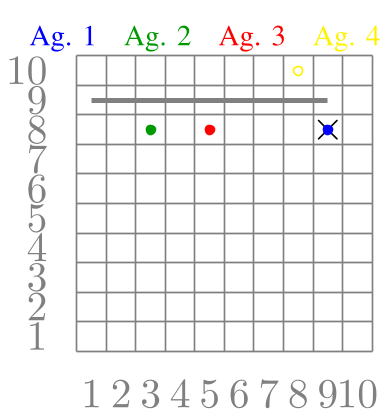 Figure: A sample trajectory showing Agent 2 "listening" to Agent 1 and immediately reversing direction to assist in the hunt.
5. Summary & Future Outlook
The value of CLOVER lies in its recognition that communication is part of the agent's environment, not a separate utility. By conditioning the value mixer on the realized communication graph, we allow the model to learn localized, topology-aware credit assignment.
Limitations: Currently, the framework uses a binary "talk/silent" decision. Future iterations could explore power control or frequency hopping within the same differentiable framework.
Conclusion: For researchers working on real-world multi-robot deployments, CLOVER provides the blueprint for making MARL robust to the "messiness" of physical wireless networks.