
Wireless Holon Networks: Revolutionizing Job Shop Control with Embedded Intelligence
Wireless Holon Network for job shop isoarchic control
This paper introduces a Wireless Holon Network (WHN), a novel Cyber-Physical Production System (CPPS) for job shop control. It implements the PROSIS isoarchic architecture using Wireless Sensor Network (WSN) technology to embed decisional intelligence directly into physical entities (Products, Resources, and Orders), achieving collective intelligence without central hierarchy.
TL;DR
Researchers have moved beyond theoretical "holons" to create the Wireless Holon Network (WHN)—a system where products and machines "talk" to each other via wireless motes to decide the best production path in real-time. By removing central controllers and using isoarchic (equal-power) logic, they achieved a nearly 400% improvement in reducing production delays compared to traditional scheduling rules.
The "Centralized" Bottleneck
In modern manufacturing, the "Brain" (Centralized Controller) often becomes the bottleneck. When a machine breaks or a rush order arrives, centralized systems struggle to recalculate the entire factory schedule fast enough. This leads to idle machines and missed deadlines. Furthermore, the physical constraint of "wired" sensors makes reconfiguring a factory floor a nightmare of cabling and software reprogramming.
The Core Insight: Isoarchy & Wireless Autonomy
The authors propose a radical shift: Isoarchy. In this model, there is no boss. All entities—the Product, the Resource (machine), and the Order—have equal power.
How does it work?
- Embedded Decisional Intelligence: Each physical item is equipped with a wireless "mote" (a tiny computer).
- Collective Intelligence: Instead of waiting for a central command, holons engage in an Auction Mechanism. If a machine is free, it broadcasts a "Call for Proposal." Products in the queue bid based on their priority and deadlines.
- Cyber-Physical Integration: Using G-DEVS formal modeling, the physical movement of a shuttle or the processing of a part is mirrored in a digital state machine, allowing the system to detect delays or anomalies instantly.
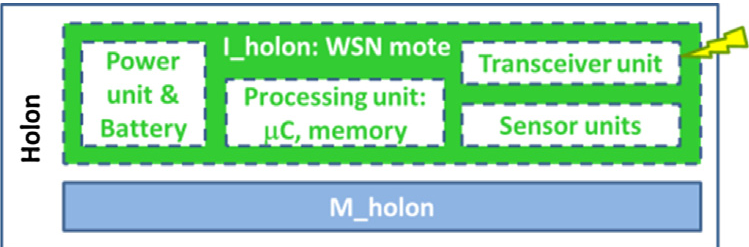 Figure 1: The architecture of a Holon, integrating a WSN mote as the 'Intellectual' part (I_Holon) of a 'Material' entity (M_Holon).
Methodology: The Math Behind the Decision
The secret sauce is the Analytic Hierarchy Process (AHP). When multiple products are waiting at a workstation, the workstation (acting as the "Requester") runs an AHP algorithm to rank them.
- Criterion 1 (Flow Progression): Prioritizes remaining slack and proximity to deadlines.
- Criterion 2 (Special Cases): Manages bottleneck workstations and queue times.
This ensures that the decision is not just "first come, first served," but a multicriteria optimization that maximizes the overall factory efficiency.
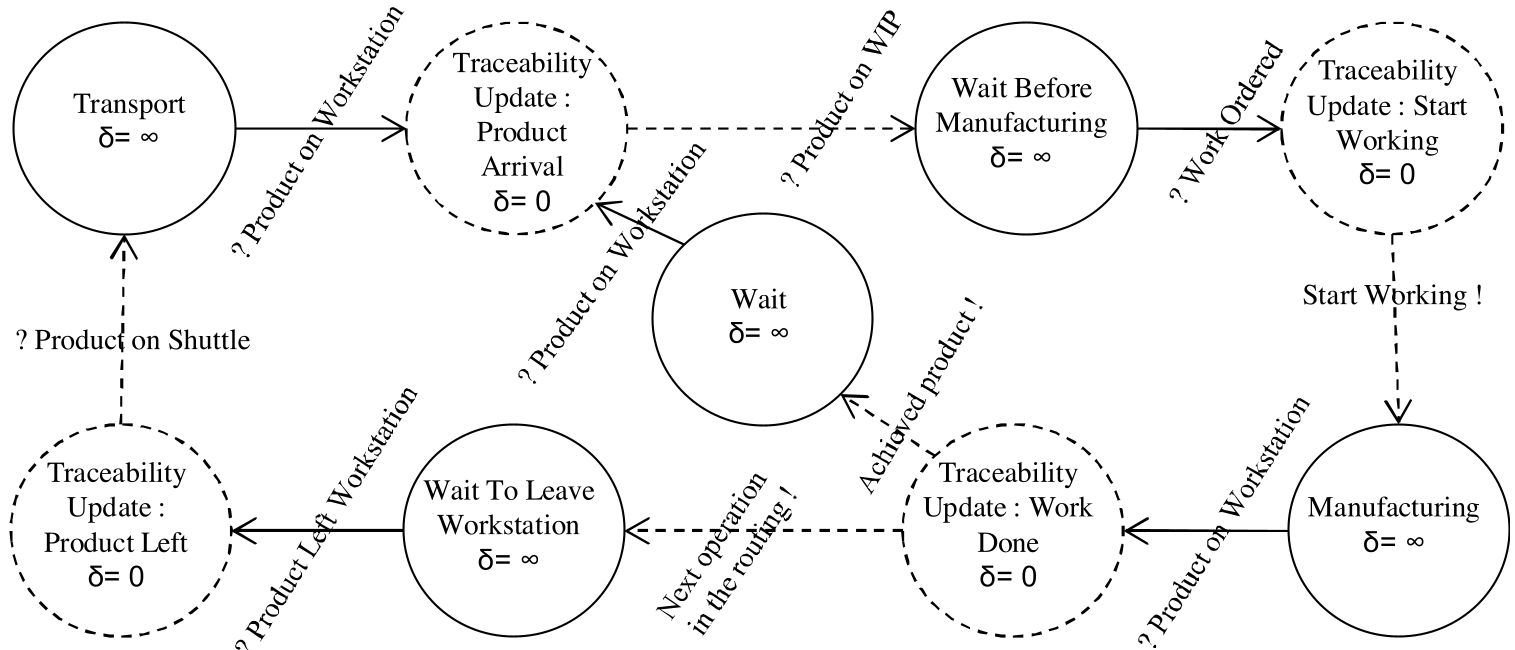 Figure 2: Formal G-DEVS model of a Product Holon's state machine, tracking states from 'Wait' to 'Manufacturing' to 'Transport'.
Experimental Results: Death to Traditional Heuristics
The team tested the WHN against four industry-standard heuristics (like "Shortest Operation Time"). The results were staggering. Using a dataset of 20 complex job shop instances:
- Traditional Rules: Resulted in an average of ~2 delays per instance.
- WHN + AHP: Slashed the average delay to 0.6.
- Improvement: The WHN approach was 3.1x to 3.9x more effective at maintaining schedule integrity.
| Heuristic | Average Number of Delays | Performance vs. WHN |
|---|---|---|
| Remaining Margin / Working Time | 2.35 | 392% of WHN delays |
| Longest Operation | 1.95 | 325% of WHN delays |
| WHN & AHP | 0.60 | Baseline |
Critical Insight: Organizational Hurdles
While the technology is a clear winner, the authors warn of "Prior Technology Drag." Many firms are hesitant to abandon the certainty of traditional ERP/MES systems for an "emergent" intelligence where they can't see a master schedule. Transitioning to a WHN requires a socio-technical shift:
- Trialability: The system is modular, meaning it can be implemented one machine at a time.
- Observability: The real-time dashboard makes the "invisible" decisions of the holons visible to human managers.
Conclusion
This work transitions Holonic Manufacturing from a nice academic concept to a robust, operational reality. By leveraging Wireless Sensor Networks, the WHN provides a framework for Reconfigurable Manufacturing Systems (RMS) that can adapt to the chaotic reality of the modern factory floor. The future of the "Physical Internet" likely looks a lot like this wireless, autonomous, and egalitarian network.