
WSNs for the Wild: Navigating the Technical Bottlenecks of Environmental Sensing
Wireless sensor networks for environmental research: A survey on limitations and challenges
This survey provides a comprehensive analysis of Wireless Sensor Networks (WSNs) applied to environmental research, including water monitoring, agriculture, and wildlife observation. It categorizes existing SOTA implementations and identifies critical hardware and operational limitations that hinder long-term autonomous deployment.
TL;DR
Wireless Sensor Networks (WSNs) are the backbone of modern "Ecoinformatics," enabling high-frequency, in-situ monitoring of natural phenomena. However, this survey reveals a sobering reality: despite the potential for 24/7 data streaming, existing networks struggle with hostile environments, high costs (up to $1k/node), and significant data loss (17-50%). The paper advocates for a move toward reconfigurable hardware (FPGAs) to solve the integration and robustness challenges of traditional nodes.
The "Eco-Logistics" Gap: Why Environmental WSNs are Hard
Most WSN research originated in controlled military settings or industrial floors. When moved to "the wild," the Inductive Bias of these systems fails. The authors identify three primary constraints:
- Fabrication Cost: Scaling a network to cover a forest requires hundreds of nodes; at current price points, this is economically unfeasible for most research.
- Energy vs. Intelligence: Processing capabilities are directly tethered to battery life, forcing a trade-off between simple "dumb" sensing and energy-intensive "smart" filtering.
- Physical Integrity: "Bio-fouling" (organism growth on sensors) and extreme humidity/temperature variations decimate sensor accuracy over time.
Methodology: A Taxonomy of Deployments
The survey scrutinizes various hardware stacks—from the MSP430-based TelosB to the ATMega-powered MICA series.
Hardware Comparison Table
The following table illustrates the power profiles of the most common "motes" used in the surveyed literature:
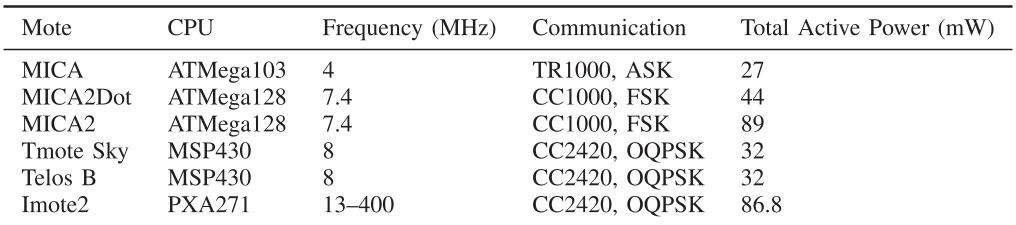
The authors specifically highlight the IEEE 802.15.4 protocol as the standard for low-power communication, though they note its fragility in dense vegetation (e.g., signal attenuation in rainforest pathways).
The Multi-Disciplinary Frontier
The paper categorizes current applications into five primary domains:
- Marine & Freshwater: Using pressure transducers and pH probes for real-time water quality analysis, though hampered by acoustic communication limits underwater.
- Precision Agriculture: Optimizing fertilizer and water via moisture sensors, often utilizing "Fuzzy Decision Systems" for automated irrigation.
- Wildlife Observation: Tracking behavior using GPS collars on cattle or acoustic arrays for woodpecker localization.
- Disaster Prevention: Flood detection and fire monitoring via multi-layer cluster hierarchies.
- Urban Pollution: Leveraging "Participatory Sensing" where smartphones act as mobile noise-moitroing nodes.
Critical Insight: The Shift to FPGA-MCU Hybrids
The most forward-looking contribution of this survey is the critique of Proprietary Interfaces. Many environmental sensors use undocumented standards, making integration a nightmare for scientists.
The authors propose a Hybrid Architecture:
- MCU (Low Power): Handles the protocol stack and basic scheduling.
- FPGA (Efficiency/Parallelism): Handles sensor auto-calibration, proprietary interface translation (SPI/I2C/Parallel), and heavy edge-processing (e.g., sound/image recognition for bird species identification).
Experimental Reality Check: Signal Attenuation
A key experimental result mentioned is the performance of RSSI (Received Signal Strength Indicator) in different terrains. In a parking lot, a 20% packet delivery ratio was achieved at 70 meters. In a dense forest, that range plummeted to 15 meters. This "15-meter barrier" currently forces researchers to deploy significantly more nodes than traditional models predict.
Conclusion: Toward Autonomous Ecoinformatics
Wireless Sensor Networks are the only viable path to achieving "Variable-scale high-frequency monitoring." However, the field is currently held back by:
- Sensor Aging: Data quality drops over time due to bio-fouling.
- Limited Portability: Nodes are still too bulky and difficult to deploy by non-technical staff.
- Lack of Standardization: Each vendor uses different data-loggers and interfaces.
The path forward lies in Self-Testing and Remote Configuration. Scientists shouldn't have to visit a site to change a duty cycle; the network should intelligently adapt to its environment.
Senior Editor’s Note: This paper provides a crucial baseline for anyone moving from lab-based IoT to rugged, outdoor deployments. The "physics" of the forest—water in leaves absorbing 2.4GHz signals—is a hurdle that no amount of pure software can solve without a change in hardware strategy.