
Wisdom of the Crowd: How Social Influence Redefines Recommendations
Wisdom of the Crowd: Incorporating Social Influence in Recommendation Models
The paper introduces two novel recommendation models—the Social Contagion Model for individuals and the Social Influence Model for groups—integrating interpersonal dynamics into traditional Collaborative Filtering (CF). It moves beyond the assumption of user independence to leverage the "Wisdom of the Crowd" for more accurate, socially-aware predictions.
TL;DR
Researchers from Princeton and Deutsche Telekom Laboratories have challenged the status quo of Collaborative Filtering (CF) by introducing Social Contagion and Social Influence models. These models treat recommendations not just as a pattern-matching exercise in a matrix, but as a dynamic process where users are influenced by their peers' "word-of-mouth" and engage in "compromised disagreement" to make group decisions.
Problem & Motivation: The Myth of the Isolated User
Most recommendation systems (think early Netflix or Amazon) operate on a fundamental assumption: users are independent agents. While CF techniques like Matrix Factorization are powerful, they suffer from data sparsity and the "cold start" problem.
The authors argue that in the real world, we are rarely independent. If a friend raves about a book, you’re more likely to buy it even if it’s not your usual genre. Conversely, making a group decision (like picking a movie for a night out) isn't just about averaging everyone's favorite genres—it's a social negotiation where some people are more influential, and others are more willing to compromise.
Methodology: From Contagion to Compromise
1. For Individuals: The Social Contagion Model
To capture the "Word-of-Mouth" effect, the paper uses a Modified Linear Threshold Model.
- The Intuition: A user becomes "activated" (decides to like or dislike an item) when enough of their neighbors in a social graph adopt that opinion.
- The Threshold: Unlike standard models where thresholds are random, here the threshold is tied to the user's CF prediction. If you already have a high CF score for a movie, you need less "social proof" to be convinced to watch it.
 Equation 4: Defining the influential threshold based on CF predictions.
2. For Groups: Social Influence Network Theory
Group recommendation is more than just taking the average of everyone’s taste. The authors propose a recursive model to reflect Opinion Evolution:
- A (Susceptibility): How much a member is willing to change their mind.
- W (Interpersonal Influence): How much power one member has over another.
This allows the system to model scenarios where, for example, a group of friends defers to a guest’s preference, or a "stubborn" member anchors the group's decision.
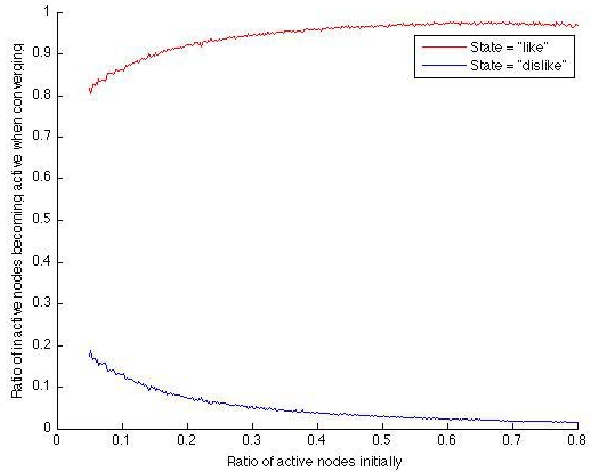 Figure 1: Simulation of how opinions spread across a network of 1000 nodes under different thresholds.
Experiments & Results
Through simulations on Watts and Strogatz small-world networks, the authors found:
- Susceptibility Matters: In highly susceptible networks, a tiny fraction of "early adopters" can trigger a cascade that clarifies the majority opinion for the whole group.
- Convergence: Social contagion typically converges quickly (often in under 10 iterations), making it computationally feasible for real-time recommendations.
- Group Dynamics: Unlike traditional tools like POLYLENS, this model correctly predicts that final group preferences lean towards members who are "essential" or highly influential, rather than just settling on the lowest common denominator.
Critical Analysis & Conclusion
Takeaway
The paper’s greatest strength is its departure from "independent" user modeling. By introducing Susceptibility (), it provides a mathematical framework for "social intelligence" in AI.
Limitations
- Weight Acquisition: The model assumes we know the interpersonal influence weights () and susceptibility (). In practice, these are incredibly hard to mine from clickstream data alone.
- Scale: While the simulation addresses 1000 nodes, modern social networks like Facebook or TikTok involve billions of edges, requiring significantly more optimized graph processing.
Future Outlook
The next frontier is using Machine Learning to automatically cluster users into types (e.g., "The Influencer," "The Conformist") to automatically set these social parameters. As social commerce grows, models that understand who we listen to will eventually outperform models that only look at what we bought.