
[2026 Tech Insight] WisPaper: Bridging the Gap Between Search Engines and AI Scholars
WisPaper: Your AI Scholar Search Engine
WisPaper is an integrated AI-driven academic platform that unifies literature discovery, management, and tracking. It introduces WisModel, a specialized agent that outperforms GPT-4o and DeepSeek-V3 in complex scholarly reasoning, offering a "closed-loop" research workflow.
TL;DR
Researchers are currently drowning in a flood of over 200 million papers. WisPaper is a new AI-native platform that solves this by replacing fragmented tools (like Zotero + Google Scholar) with a unified "Knowledge Loop." Its core engine, WisModel, uses advanced agentic reasoning to actually "understand" if a paper fits your specific research criteria, achieving a staggering 93.7% accuracy in literature matching.
The "Fragmented Workflow" Problem
Academic research is currently a broken cycle. You find papers on Google Scholar (Discovery), save them to Zotero (Management), and manually check ArXiv daily (Tracking). These tools don't talk to each other. More importantly, keyword-based search cannot handle complex nuance—it can't tell you why a paper is relevant, only that it contains the word "Transformer."
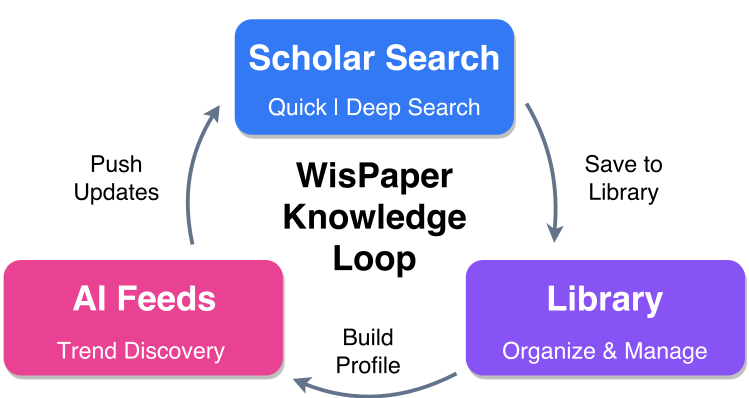
WisPaper addresses this by treating literature research as a closed-loop system:
- Discovery: Deep agentic reasoning instead of keywords.
- Management: AI-assisted summaries and cross-library search.
- Tracking: Personalized AI Feeds that learn from your library.
Methodology: The Secret Sauce of Deep Search
The most impressive part of WisPaper is Deep Search. Unlike typical RAG (Retrieval-Augmented Generation) systems that just summarize top results, WisPaper deploys an autonomous agent called WisModel.
1. Two-Stage Reasoning
WisModel breaks down a user query into two distinct phases:
- Query Understanding: It decomposes a complex prompt (e.g., "How do transformers handle long sequences?") into specific Boolean queries and Validation Criteria (e.g., specific weights for Task, Method, and Dataset).
- Paper Validation: It analyzes paper metadata against these criteria, classifying results as Support, Somewhat Support, Reject, or Insufficient Info.
2. Training with GRPO
The authors didn't just use a generic LLM. They used Group Relative Policy Optimization (GRPO) to fine-tune WisModel. This reinforcement learning technique optimizes the model’s ability to justify its scientific judgments, specifically training it to provide evidence-based explanations for why a paper matches or fails a criterion.
Experiments: Surpassing the Giants
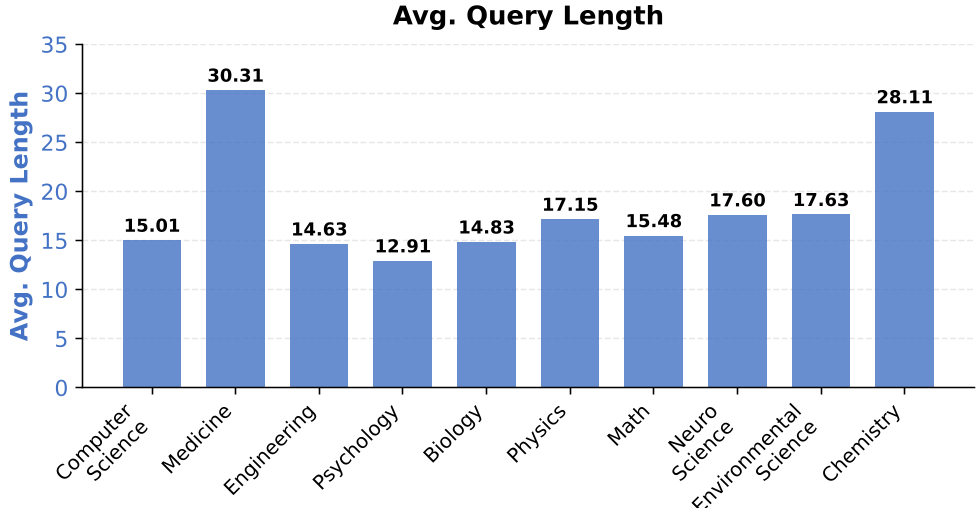
In a comprehensive evaluation across 10 academic disciplines (including Biology, Physics, and Law), WisModel was tested against heavyweights like GPT-4o, Gemini-3-Pro, and DeepSeek-V3.
The "Partial Support" Breakthrough
Most LLMs are binary—they think a paper either matches or it doesn't. However, scientific research is full of "gray areas." WisModel’s ability to identify "Somewhat Support" (where a paper partially addresses a complex query) reached 91.8%, while competitive models like Gemini-3-Pro crashed to 15.9% in the same category.
| Model | Overall Accuracy | Support Accuracy | Somewhat Support |
|---|---|---|---|
| WisModel | 93.70% | 94.38% | 91.82% |
| Gemini-3-Pro | 73.23% | 91.10% | 15.90% |
| GPT-5.1 | 70.81% | 85.40% | 31.40% |
Critical Insights & Future Outlook
The core value of WisPaper isn't just "better search"—it's reduced cognitive load. By automating the screening process (which usually takes researchers 1-2 hours daily), it allows scholars to focus on synthesis rather than filtering.
Limitations: Currently, Deep Search relies heavily on abstracts and metadata. While highly efficient, true "Deep Reasoning" will eventually require full-text analysis across millions of PDFs, which presents massive computational and licensing challenges.
Conclusion: WisPaper represents the shift from "Search Engines" to "Research Assistants." It proves that SOTA performance in specialized domains requires more than just scaling; it requires specialized training pipelines (like GRPO) and a deep understanding of the professional workflow.
For those interested in trying the platform, it is accessible at wispaper.ai.