
Witchcraft as Alternative Modernity: Decolonizing Well-being in rural Bangladesh
Witchcra and HCI: Morality, Modernity, and Postcolonial Computing in Rural Bangladesh
This paper presents an eight-month ethnographic study of witchcraft practices in rural Bangladesh, exploring their role in health, well-being, and social justice. It introduces the concept of "occult practices" as a form of "alternative modernity" within Human-Computer Interaction (HCI) and postcolonial computing.
TL;DR
This research challenges the long-standing "secular bias" in Human-Computer Interaction (HCI) by examining witchcraft in rural Bangladesh not as an archaic superstition, but as a sophisticated, moral, and modern infrastructure. By documenting how local witches integrate mobile phones and digital tools into their "Tantra," the authors argue for a postcolonial approach to computing that respects indigenous knowledge systems.
Contextualizing the "Magical" in Computing
In the hallowed halls of HCI research, well-being is usually measured by heart rate monitors, sleep trackers, and cognitive behavioral apps. However, for millions in the Global South, well-being is an entanglement of the physical, the social, and the supernatural. In rural Jessore, Bangladesh, if a child drowns or a crop fails, the community doesn't just look for a biological or economic reason—they look for the "why" behind the misfortune through the lens of witchcraft.
The authors argue that ignoring these practices isn't just a missed opportunity; it’s a form of colonial residue. When we try to "fix" rural health through purely Western scientific apps, we often bypass the very moral and spiritual authorities that the community trusts most.
Methodology: An Ethnography of the Occult
The researchers spent eight months in the trenches of rural Jessore. They moved beyond being mere observers, actively helping with household chores and participating in village life to gain the trust of both the villagers and the practitioners (witches).
The Stages of Witchcraft Therapy
The paper beautifully deconstructs the "technology" of the occult into four distinct stages that mirror professional consultancy:
- Investigation: Using informal conversations and deep local history to diagnose problems.
- Explanations and Predictions: Narrating the role of supernatural entities (Jinn, Voot) to help clients make sense of their trauma.
- Performance (Keramoti): Demonstrations of power that build trust and social proof.
- Treatments: The application of "Allahr Kalam" (Islamic scripts) or "Kali Mantra" (Hindu scripts) through amulets (Tabiz) and rituals (Tantra).
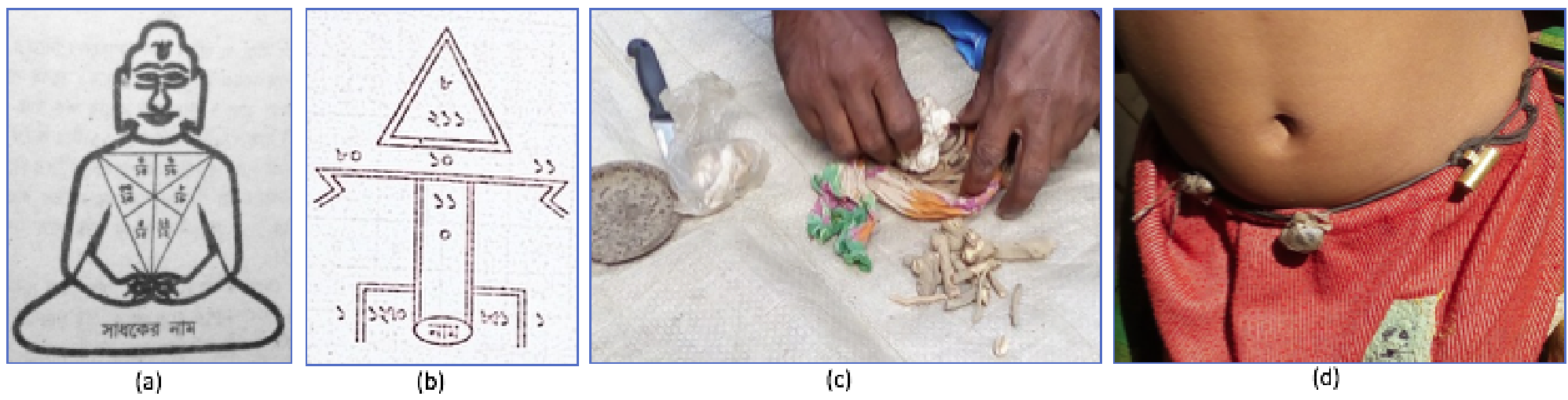 Figure 1: Traditional 'Jantra' and Amulets used in rural therapy, showcasing the material culture of local well-being.
The "Multiple Modernities" Framework
The core technical insight of this paper is the application of S.N. Eisenstadt’s theory of Multiple Modernities. Instead of seeing modernity as a single path led by the West, the authors show that witchcraft is inherently modern because it:
- Provides Universal Theories: Witches explain everything from local illness to international airplane crashes through a unified spiritual logic.
- Flows from Center to Periphery: Witches act as a localized "center" of knowledge, challenging both corrupt legal courts and distant medical hospitals.
- Constantly Updates: This is the most shocking find for a traditional technologist. Witches are using BKash for transactions, performing spells over mobile phones, and even diagnosing issues via digital photos shown on smartphones.
Witchcraft as Social Regulation
Beyond health, witchcraft serves as a Moral Infrastructure. Witches often act as informal judges, scolding husbands for polygamy or protecting women from abusive in-laws. In a region where formal law is often inaccessible or corrupt, the "witch" provides a form of social justice that is culturally grounded.
Furthermore, it acts as a Political Counter-Power. Witches maintain networks with the police, local council members, and even religious leaders (Imams and Pujaris), accumulating a form of "spiritual capital" that allows them to protect their clients against social stigmas.
Critical Insight: Why This Matters for the Future of HCI
The paper concludes with a powerful call for Postcolonial Computing. The takeaway for developers and researchers is clear:
- Participatory Design with Witches: Instead of building apps against traditional beliefs, we should explore building them with these influential figures.
- Decoupling Rationality and Modernity: Just because a practice is "irrational" by Western standards doesn't mean it isn't "modern" or effective in its situated context.
- Sustainable HCI: By integrating with local history and culture, technology becomes more resilient and relevant.
Limitations and Future Work
The authors are careful not to romanticize witchcraft. They acknowledge the existence of "fake" witches and the potential for these practices to reinforce certain social harms. However, the goal is not to prove witchcraft is "scientifically true," but to demonstrate that it is "socially real" and functionally modern.
Future research in HCI must continue to decolonize its assumptions. If we want to design for the global majority, we must be prepared to look into the smoke, the amulets, and the digital screens of the rural village witch.
Takeaway: Witchcraft isn't the opposite of technology; in rural Bangladesh, it is the social operating system upon which technology must be installed.