
WiTrace: Achieving Centimeter-Level Precision in Passive WiFi Gesture Tracking
WiTrace: Centimeter-Level Passive Gesture Tracking Using OFDM Signals
WiTrace is a high-precision, device-free gesture tracking system that utilizes Channel State Information (CSI) from standard OFDM WiFi signals. It achieves centimeter-level accuracy (1.46 cm for 1D and 2.09 cm for 2D tracking) by measuring phase changes in reflected signals, marking a significant leap from traditional decimeter-level gesture recognition systems.
TL;DR
WiTrace is a breakthrough in device-free Human-Computer Interaction (HCI) that enables high-precision hand tracking using standard WiFi signals. By moving beyond simple gesture recognition to actual centimeter-level tracking (2.09 cm average error), it bridges the gap between commodity hardware and specialized sensing equipment like FMCW radar or Leap Motion.
Background & Positioning
Passive sensing—detecting movement without requiring the user to wear any devices—is the "holy grail" of smart home and VR/AR control. While computer vision (Kinect) and acoustics (LLAP) have dominated this space, WiFi-based sensing offers unique advantages: it works through walls and is unaffected by lighting conditions. WiTrace positions itself as a SOTA improvement over previous WiFi systems like Widar and QGesture, focusing on sub-decimeter granularity over a long range (up to 3.5m).
The Core Challenge: Signal Contamination and Initial State
Why is WiFi tracking hard?
- Static Interference: The signals reflecting off your hand are orders of magnitude weaker than reflections from walls or floors.
- Phase Noise: Hardware imperfections like Sampling Frequency Offset (SFO) and Carrier Frequency Offset (CFO) scramble the phase information needed for distance measurement.
- The "Initial Position" Paradox: You can measure how much a hand moved by tracking phase cycles, but if you don't know where it started, you cannot map those relative changes to an absolute 2D coordinate.
Methodology: The WiTrace Solution
WiTrace solves these issues through a sophisticated signal-processing pipeline.
1. Extracting the Dynamic Vector (ESC Algorithm)
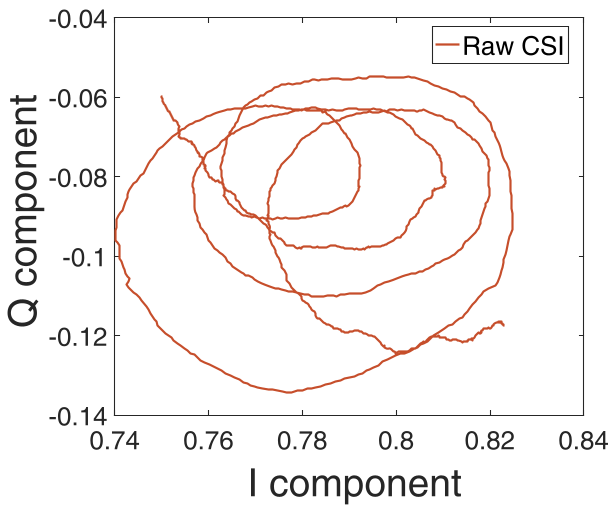
To isolate the hand's movement, the authors developed the Extracting Static Component (ESC) algorithm. Unlike previous methods that failed under low Signal-to-Noise Ratio (SNR), ESC uses a temporal threshold linked to the maximum Doppler frequency. This ensures that only high-probability "local extrema" in the CSI signal are used to cancel out static environmental reflections.
2. The Two-Step Initial Position Localization
This is the technical heart of the paper.
- Coarse Step: Uses the phase difference between multiple subcarriers within a single WiFi link. Since different frequencies respond differently to path length, the ratio of these changes provides a "rough" distance estimate (0.31m error).
- Fine Step: The user performs a "preamble gesture" (a quick X and Y axis push). The system compares the observed trajectory against a mathematical model for all candidate points in a 0.5m square. The point where the physics of the trajectory matches the observations best is set as the starting point.
Experiments and Performance
The system was tested using USRP-N210 software radios.
- Accuracy: WiTrace achieved a mean 1D tracking error of 1.46 cm and a 2D tracking error of 2.09 cm.
- Robustness: Even when other people were walking in the same room (2m away), the tracking error only increased slightly by approximately 1 cm, demonstrating excellent spatial filtering.
- Trajectory Correction: By applying a Kalman Filter (CWPA model), the system smooths out the "jitter" caused by hardware noise, allowing for smooth drawing of letters and shapes in the air.
 Table 1: WiTrace vs. Prior SOTA. Note the superior granularity (2.09 cm) and range (3.5m+).
Critical Analysis & Future Outlook
The primary limitation of WiTrace is its reliance on USRP hardware with synchronized clocks. Implementing this on standard commercial WiFi chips (like those in smartphones) remains the next major hurdle due to their high intrinsic phase noise. Furthermore, while 2D tracking is excellent, the jump to 3D tracking remains difficult because human body reflections become significantly more complex to decouple from the hand.
However, the "preamble gesture" insight for initial position estimation is a powerful contribution that could be applied to other RF sensing domains, such as RFID or UWB-based tracking.
Conclusion (Takeaway)
WiTrace defines the upper bounds of what is possible with 20 MHz WiFi bandwidth. By treating the phase as a high-resolution ruler and solving the initial position problem, it transforms a communication signal into a centimeter-accurate spatial sensor.